- Emirates introduces new tarmac delay protocols following major winter disruptions at Toronto Pearson International Airport.
- The policy ensures earlier water service and proactive rebooking for passengers stuck on grounded aircraft.
- Heavy snow and A380 gate scarcity combined to cause multi-hour delays for flight EK241 arrivals.
(TORONTO, CANADA) — If you landed on Emirates in Toronto this week, “on time” didn’t mean you’d be inside the terminal anytime soon. After heavy snow snarled ramp operations at Toronto Pearson International Airport, Emirates added clarity to how it handles extended post-landing tarmac delays, including earlier water service, more frequent updates, and clearer rebooking guidance when a long delay threatens connections.
This change matters because a post-landing tarmac delay is the most frustrating kind of disruption. You’ve already arrived, but you can’t park at a gate. That means no deplaning, limited lavatory servicing, and no easy way to grab food. It also increases the odds you’ll miss rides, meetings, and onward flights.
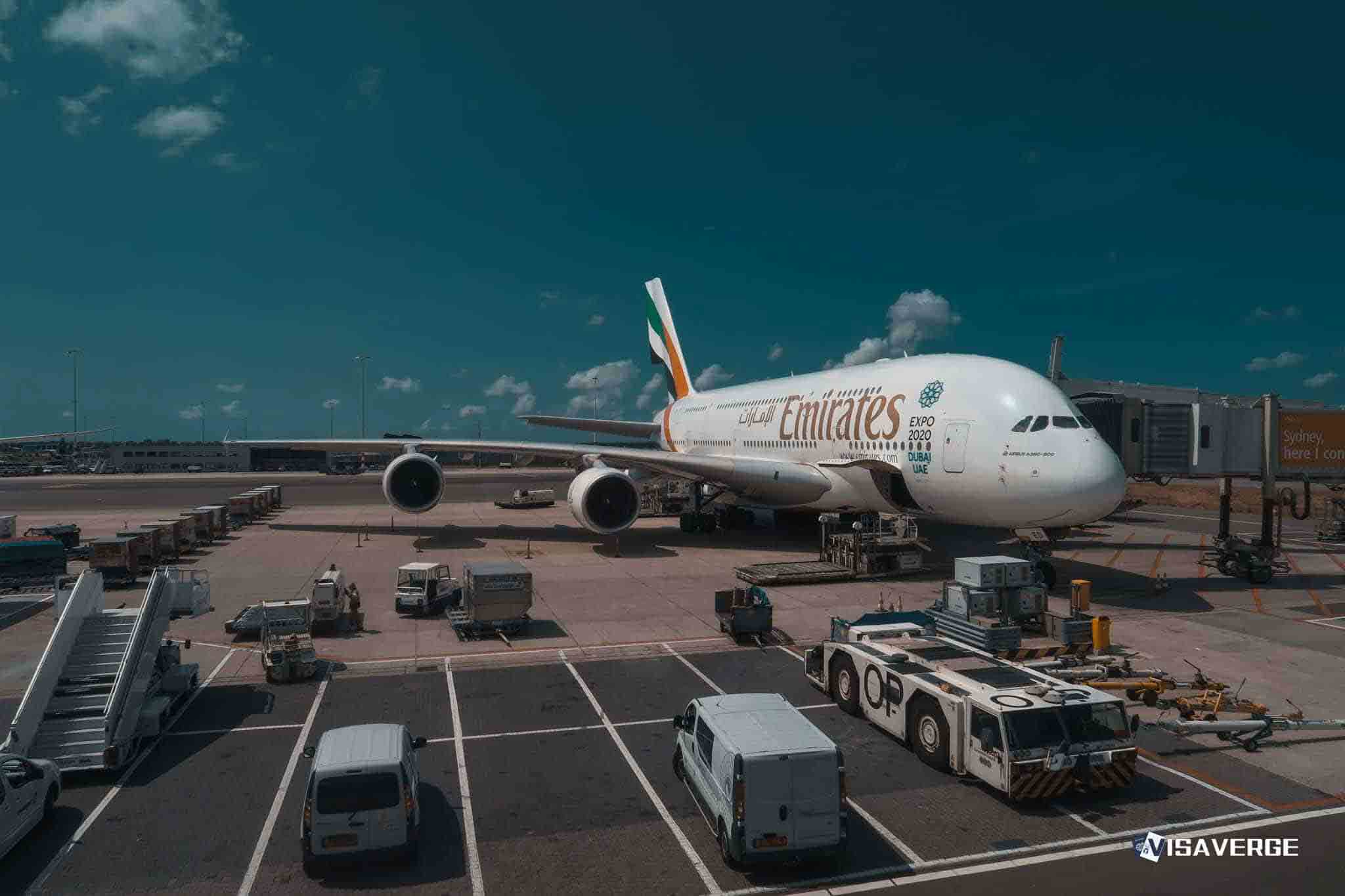
The policy refresh comes after Emirates EK241, the daily Dubai-to-Toronto flight operated by an Emirates Airbus A380, sat for hours after touchdown on January 15. The aircraft landed only slightly late, but passengers did not get off until much later. The exact landing time, deplaning time, and total on-ground delay are captured in the flight status details referenced in the on-page badge.
Before/After: What Emirates is changing for tarmac delays
Emirates’ update is centered on communication and onboard care while the aircraft is stuck waiting for a gate, plus more proactive reaccommodation when a delay threatens misconnects.
| Policy area | Before | After (effective Jan. 16, 2026) |
|---|---|---|
| Passenger updates while waiting for a gate | Updates varied by station and crew workload | Updates at set intervals, with a clear reason for the hold and best estimate for gate access |
| Water and basic refreshments | Provided when available, timing inconsistent | Earlier water service once a delay stretches, with more predictable refreshment checks |
| Rebooking guidance for misconnects | Often handled after deplaning at service desks | Earlier instructions via app/agents, with priority reaccommodation for tight connections |
| Customer care documentation | Disruption notes could be hard to find later | Clearer flight record notes that support claims, refunds, and employer travel letters |
These changes won’t make snow disappear. They can make the wait less chaotic, and they can speed up recovery once you’re off the aircraft.
Emirates’ updated tarmac-delay playbook applies starting Friday, Jan. 16, 2026, following the EK241 disruption on Thursday, Jan. 15.
Incident overview: Why EK241 mattered
EK241 operates from Dubai (DXB) to Toronto (YYZ), and it’s one of the flagship A380 routes into Canada. On January 15, the flight arrived after nearly 14 hours in the air. It then faced an extended post-landing delay because it could not access an A380-capable gate.
For passengers, that kind of delay creates a unique stack of problems. You can’t freely move around or exit the aircraft. Lavatories may become strained if servicing is delayed.
- You can’t freely move around or exit the aircraft.
- Lavatories may become strained if servicing is delayed.
- Catering is limited because the flight is “done,” but you’re still onboard.
- Ground transportation, hotel check-ins, and same-day plans start collapsing.
Pearson has dealt with other operational headaches lately, including airport operations disruptions that show how quickly a normal day can spiral when systems or staffing get strained.
EK241’s exact touchdown, door-open time, and total on-ground delay are summarized in the flight status module on the page.
Airport gate and ground handling constraints: Why the A380 gets “stuck”
Toronto Pearson can handle the A380, but it’s not swimming in compatible gates. In practice, the airport has a small number of stands that can reliably park an A380 at a passenger gate, plus a reserve option for contingencies. When even one gate is occupied longer than planned, the whole A380 arrival sequence can jam up.
Here’s what that looks like operationally:
- Gate turns slow down in snow. De-icing, marshalling, and equipment positioning all take longer.
- Towing and pushbacks get constrained. Reduced ramp speed and safety spacing limit movement.
- Equipment and crews are finite. One delayed widebody can tie up stairs, tractors, or specialized teams.
- Gate conflicts compound fast. If the prior aircraft can’t push, the arriving aircraft has nowhere to go.
This is the same bottleneck dynamic airports are trying to solve with better stand planning and passenger handling, including ideas discussed around overcrowding fixes at major hubs.
The flight status badge captures the exact time gap between landing and deplaning. It’s a stark illustration of how “arrived” can still mean “waiting.”
Weather and snow impact: How 12 cm can break the schedule
Toronto saw more than 12 centimeters of snow overnight, and accumulation continued during the day. That’s enough to trigger a full winter ops posture. Snow doesn’t just slow landings. It reduces capacity across the airport.
- Runway throughput drops. Plowing and treatment cycles interrupt arrival and departure flows.
- Taxi speeds reduce. Braking action concerns mean more spacing and slower movement.
- Aprons and stands become the choke point. Snow removal prioritizes runways first, then taxiways, then gates.
- Staffing and equipment get stretched. Winter ops can require more people for longer shifts.
Even when aircraft can land safely, the “last 500 feet” to the gate can be the hardest part.
For a useful comparison, similar patterns show up during big weather events in the U.S., where NY metro delays often come down to gate availability and ramp limitations, not just runway closures.
Impact on the return flight and schedule: How EK242 got pushed back
An A380 turnaround is a long chain of tasks. When gate arrival is delayed, everything that follows gets compressed: deplaning and cabin sweep, deep cleaning and restocking, catering uplift for a 13+ hour sector, fueling, baggage unload and reload, crew duty and rest rule compliance, boarding, and final checks.
EK242, the return Toronto-to-Dubai service, departed later than scheduled. That’s a predictable knock-on effect when a widebody spends hours waiting for a gate.
One more wrinkle: published arrival times can be confusing because of time zones. Always confirm in the Emirates app and make sure your phone is set to local time at your destination.
This kind of recovery planning is exactly where airlines make or lose the day. It’s also why carriers invest heavily in disruption playbooks, including post-shutdown rebalancing of crews and aircraft.
Operational implications for ultra-large aircraft in winter (A380)
The A380 is a passenger favorite for its quiet cabin and onboard bar (on Emirates). Operationally, it’s a special challenge in winter. Ultra-large aircraft need specialized gate geometry, dual jet bridges, more ramp space and safety clearances, more time to service and cater, and more baggage and cargo equipment on tight timelines.
- Specialized gate geometry and dual jet bridges.
- More ramp space and safety clearances.
- More time to service and cater.
- More baggage and cargo equipment on tight timelines.
Airports and airlines can reduce risk with pre-planned remote stand and tow procedures, priority gate rules for ultra-large arrivals in peak banks, extra staffing buffers on snow days, and stronger passenger communication during holds.
For you as a traveler, the passenger-facing effects are real: higher misconnect risk if you’re continuing onward from Toronto, longer baggage delivery times after a delayed gate arrival, and ground transport disruptions if roads are also impacted by snowfall.
Terminal transfer steps and in-airport routing details are provided in the terminal guide module, since those directions change based on where the A380 finally parks.
Miles and points: What this disruption means for loyalty strategy
On a paid Emirates ticket credited to Emirates Skywards, you generally earn miles based on fare class and route. A long tarmac delay does not reduce mileage credit by itself. If your trip gets rebooked, though, the new flight number, carrier, or fare basis can change earning.
If you’re crediting to a partner program, always check the partner earning table before you accept a reroute. A same-day rebooking on a different airline can mean reduced mileage earning, different elite-qualifying credit, and different upgrade eligibility.
On the redemption side, weather events can quietly create award opportunity. When flights get disrupted, some seats open up on later departures as airlines reshuffle passengers. If you have flexible points, it can be worth checking inventory after the storm passes.
Who’s affected — and who isn’t
Most affected:
- Passengers on Emirates EK241/EK242 during winter disruption periods
- Travelers connecting onward at Toronto Pearson on separate tickets
- Anyone with time-sensitive plans on arrival day
Less affected:
- Passengers traveling nonstop to Toronto with no connections
- Travelers booked with generous layovers or arriving a day early
- Those with lounge access and flexible changeable fares, since rebooking is simpler
How to avoid the worst outcomes
If you’re flying into Toronto during a snow forecast, build a buffer. Treat “on-time arrival” as “maybe on-time gate arrival,” especially on an A380.
- Choose later ground transportation pickup windows on snow days.
- Avoid tight same-day connections on separate tickets through YYZ.
- Keep essentials in your personal item, including meds and a charger.
- Use the airline app for rebooking before you reach the service desk.
Key metrics at a glance
EK241’s disruption came from three forces stacking together: A380 gate scarcity, winter ramp limits, and schedule knock-on effects that pushed the return flight later. Add more than 12 centimeters of snow, and a long wait becomes much easier to understand.
The flight status module shows the exact landing time, deplaning time, and total on-ground delay. Those figures matter because they reflect where the real pinch point was: not the flight, but the last step into the gate.
If you’re flying into Toronto this winter on a large aircraft, plan for a longer “arrival to curb” time. Book refundable ground plans when you can, and give yourself at least a half-day cushion for anything you truly can’t miss.