- Heathrow saw a one point eight percent decline in June traffic due to Middle East regional conflict.
- North American traffic rose one point two percent fueled by the FIFA World Cup tournament demand.
- The airport completed CT security scanner rollouts across all terminals, maintaining wait times under five minutes.
Heathrow Airport reported a 1.8% decline in passenger traffic in June, with the airport handling 7.2 million travelers compared with 7.4 million in the same month of 2025. Middle East routes drove the fall.
Traffic to and from the region dropped 26.2% to 468,000 passengers. Heathrow attributed the continued weakness to the US-Iran war, while stronger demand from North America and Asia-Pacific offset part of the loss.
North American traffic rose 1.2% to 1.97 million passengers. It marked a second consecutive month of growth.
The FIFA World Cup also brought more travelers to the United States, Canada and Mexico, where the tournament was hosted. North America became the airport’s main bright spot in a month shaped by conflict and weaker regional demand.
Thomas Woldbye, Heathrow’s chief executive, said the airport had finished the first half with sustained demand across key long-haul markets.
“It’s been a strong end to the first half of 2026, despite the challenges presented by the situation in the Middle East. Sustained growth in North American and Asia-Pacific coupled with climbing cargo volumes demonstrates the strength of demand for global connectivity.”
The airport’s wider results remained slightly positive. Heathrow handled 40.0 million passengers in the first six months of 2026, up 0.2% from the same period a year earlier.
North America and Asia-Pacific carried the growth
Asia-Pacific was the fastest-growing major market in June, with traffic up 2.5%. The European Union remained Heathrow’s largest listed regional market at 2.6 million passengers, although traffic slipped 0.1%.
Africa and Latin America also declined. Their traffic fell 1.4% and 1.9%, respectively.
| Market | June 2026 result | Year-on-year change |
|---|---|---|
| Middle East | 468,000 passengers | Down 26.2% |
| North America | 1.97 million passengers | Up 1.2% |
| Asia-Pacific | Not stated | Up 2.5% |
| European Union | 2.6 million passengers | Down 0.1% |
| Africa | Not stated | Down 1.4% |
| Latin America | Not stated | Down 1.9% |
Cargo provided another counterweight to the passenger decline. The airport handled 135,000 tonnes in June, up 3.8% from a year earlier.
North American cargo increased 6.3%, while Asia-Pacific cargo climbed 11.7%. Heathrow said it handled nearly £300 billion of British trade during the past year, underlining the airport’s role as an air-freight gateway as passenger demand shifted between regions.
Heathrow cut its 2026 forecast after the June figures
Heathrow lowered its passenger forecast for 2026 on June 26 and warned that profits could decline during the year as global uncertainty weighs on travel.
Investor reports indicated that annual profits could fall by £147 million year-on-year. The Middle East conflict has also affected the availability and price of jet fuel, according to Stefan Schulte, chief executive of Frankfurt Airport operator Fraport.
Frankfurt recorded a 1.7% decline in June traffic, falling to 5.7 million passengers. Schulte said the first half had been shaped by extraordinary factors, including the war’s effect on fuel and passenger demand.
“The first half of 2026 had been affected by many extraordinary factors, including the impact of the Iran war on both the availability and price of jet fuel, which has also led to reduced demand from passengers.”
Heathrow reported 230,485 air transport movements during the first half of 2026, down 1.8%. The movement figure fell even as total first-half passenger numbers edged higher.
Security waits stayed below five minutes during June
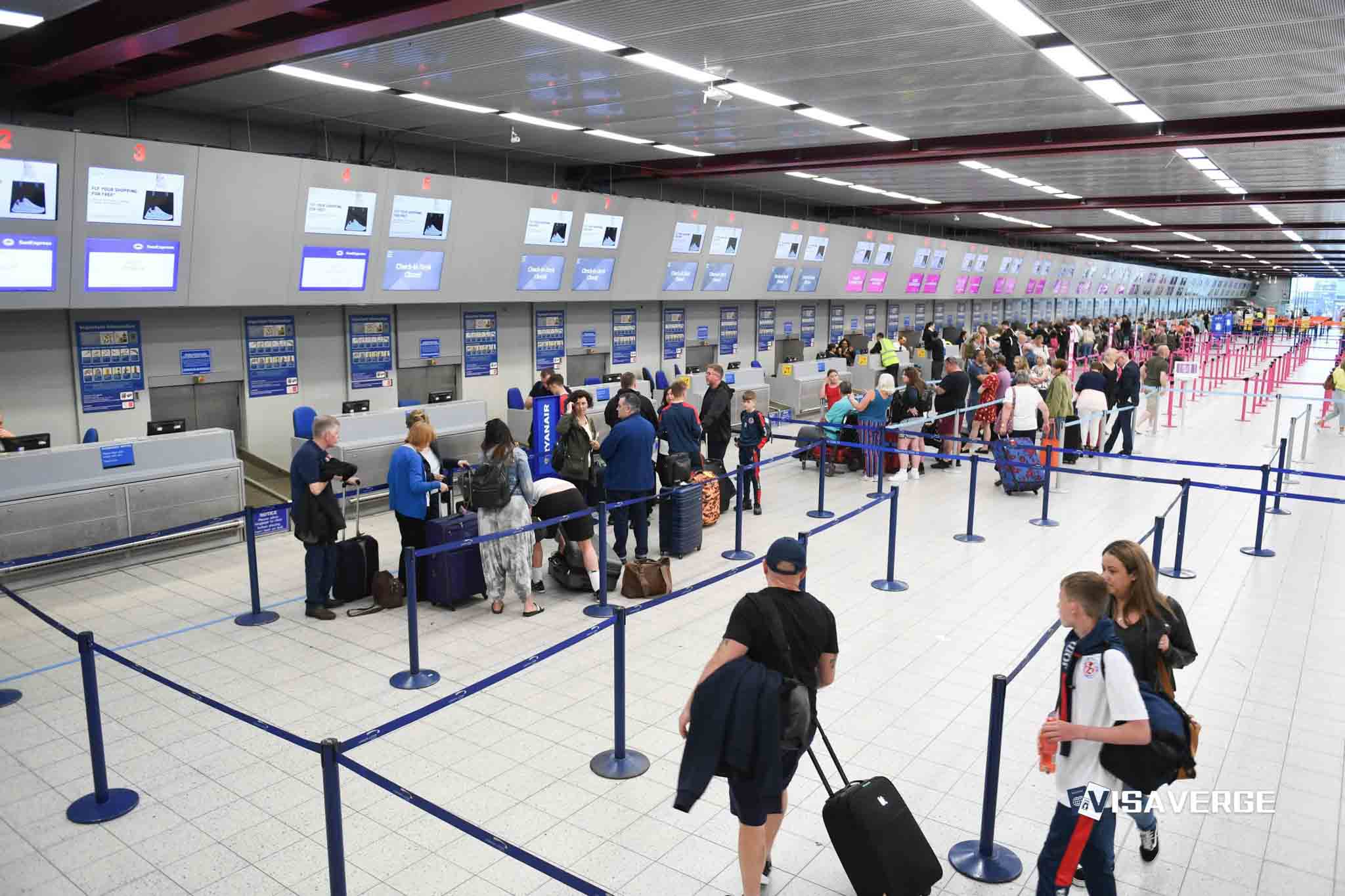
The airport completed the rollout of next-generation CT security scanners across its four active terminals during June. Heathrow said security wait times stayed consistently below five minutes, even with World Cup-related traffic.
Passengers could keep liquids and laptops inside their bags during screening. The equipment change improved the screening process without preventing the airport from recording lower overall passenger traffic.
The month’s figures also renewed pressure for expansion. Woldbye said Heathrow was “effectively full” and argued that capacity limits prevent the airport from adding routes to markets such as Asia-Pacific.
He used the results to revive the case for a third runway as the government considers projects intended to drive economic growth across the country.
“As the Government looks for projects that can drive economic growth across the whole of the country. Heathrow’s privately funded expansion presents an open goal. A third runway will unlock new opportunities. It’s time to get this vital project off the bench and onto the pitch.”
The airport continues discussions with the Civil Aviation Authority over the costs and funding of the proposed runway. Its June performance leaves that debate tied to two opposing trends: long-haul growth in North America and Asia-Pacific, and a sharp contraction on Middle East routes.
The next figures will show whether the World Cup boost and cargo growth can continue to cushion weaker regional traffic through the rest of 2026.