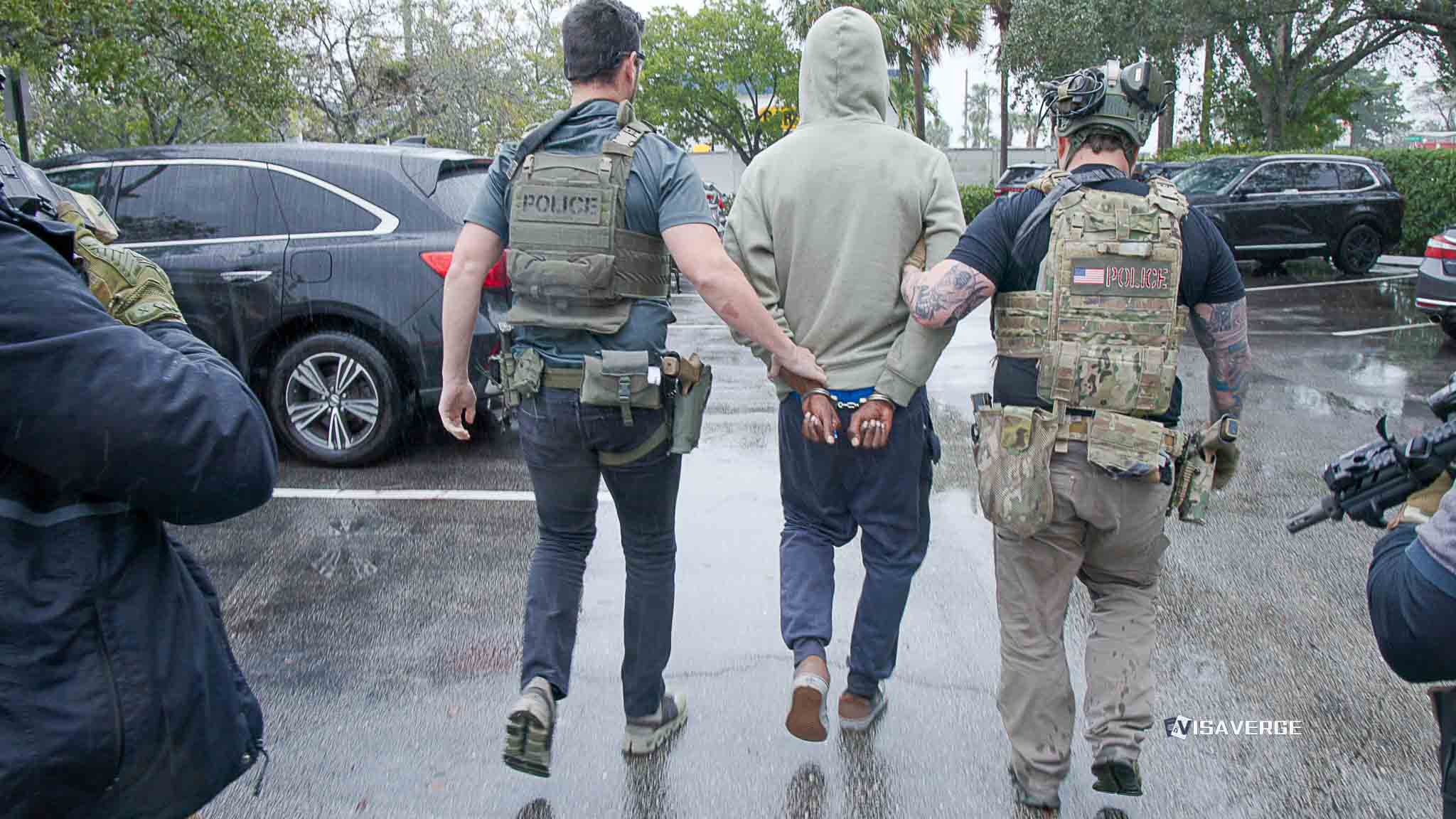
- Five defendants pleaded guilty to U-Visa fraud involving fabricated police reports and certifications in Louisiana.
- The scheme involved three current or former police chiefs who created false records for paying foreign nationals.
- Applicants should independently verify all filings as fraudulent documents can lead to permanent immigration bars and prosecution.
Federal prosecutors announced guilty pleas June 30, 2026, from five defendants in a Louisiana U-Visa fraud case involving fabricated armed-robbery reports and immigration certifications. The group included three current or former police chiefs, a town marshal and Louisiana businessman Chandrakant “Lala” Patel.
The defendants allegedly turned public authority into a document-production system. Foreign nationals seeking U-Visas allegedly paid Patel thousands of dollars to be identified as victims of crimes that never happened.
Free toolH-1B Cost Calculator Online
The case ran from approximately December 2015 through July 2025, according to federal prosecutors. Officials allegedly prepared or authenticated false police reports and supplied them for fraudulent U-Visa petitions.
The five defendants pleaded guilty. Their maximum penalties differ sharply.
| Defendant | Role described in the case | Statutory maximum stated by the Justice Department |
|---|---|---|
| Chandrakant “Lala” Patel | Oakdale business owner | Up to 20 years in federal prison |
| Chad Doyle | Served as Oakdale chief of police | Five years in prison |
| Glynn Dixon | Served as Forest Hill chief of police | Five years in prison |
| Tebo Onishea | Served as Glenmora chief of police | Five years in prison |
| Michael Slaney | Served as marshal for Ward 5 in Oakdale | Five years in prison |
Those figures are statutory maximums, not sentences already imposed. The defendants were originally indicted July 2, 2025, before entering guilty pleas during 2026.
Officials allegedly certified crimes that never occurred
The alleged police certification scheme went beyond inaccurate paperwork prepared by an immigration consultant. Prosecutors said law-enforcement officials used their government positions to create and certify reports describing armed robberies that had not occurred.
The arrangement depended on official-looking records. A police report bearing an authorized signature can appear persuasive, but the certification does not itself decide whether an immigrant qualifies for protection.
Court records show that Patel also tried to pay a Rapides Parish Sheriff’s Office agent $5,000 in February 2025 for another false report. The case therefore involved an intermediary and public officials, not simply applicants submitting unsupported claims.
U nonimmigrant status, commonly called a U-Visa, protects victims of certain crimes who assist law-enforcement agencies investigating or prosecuting criminal activity. Qualifying crimes can include domestic violence, sexual assault, trafficking, kidnapping, extortion, felonious assault and obstruction of justice, along with other listed or substantially similar offenses.
A police complaint alone is not enough. A principal petitioner generally must show five things:
- The person suffered qualifying criminal activity.
- The person experienced substantial physical or mental abuse because of that crime.
- The person has information about the criminal activity.
- The person has been, is being or is likely to be helpful to law enforcement.
- The crime occurred in the United States or violated applicable United States law.
The applicant must prove those requirements to U.S. Citizenship and Immigration Services. Financial or personal hardship, without more, does not create eligibility.
Supplement B supports a petition but cannot approve it
A principal petitioner generally submits Form I-918, Supplement B, U Nonimmigrant Status Certification. An authorized official from a qualifying law-enforcement agency, prosecutor’s office, court or other permitted certifying body completes the form.
The official addresses the alleged qualifying crime, the applicant’s victim status, the applicant’s knowledge and the applicant’s helpfulness to investigators or prosecutors. The official signs under penalty of perjury, confirming that the information is true and correct to the best of that official’s knowledge.
USCIS, not the certifying agency, has jurisdiction over the petition. The agency independently assesses whether the applicant meets the legal and evidentiary requirements.
USCIS may weigh the certification against police reports, court documents, personal declarations, medical records and other evidence. An authorized signature does not bind the agency to approve the petition.
An Administrative Appeals Office decision explains that USCIS has sole jurisdiction over U-Visa petitions and evaluates the credibility and evidentiary value of the submitted material, including the law-enforcement certification.
Genuine applicants face individual review, not automatic cancellation
The Justice Department announcement does not say that every petition connected to the affected Louisiana departments has been cancelled or denied. USCIS may examine applications supported by reports or certifications associated with the defendants, but each case ordinarily turns on its own records, facts and evidence.
Four situations can produce very different legal questions. One involves an applicant who knowingly paid for a false crime report. Another involves a person who knowingly signed a fabricated statement. A third involves a genuine victim who received help from an official later accused of unrelated misconduct. The fourth involves someone who unknowingly used a dishonest or unauthorized representative.
Knowledge, participation and the importance of a false statement can affect whether USCIS finds fraud or willful misrepresentation. USCIS guidance generally describes willful misrepresentation as a knowingly false representation of a material fact made with the intent to obtain an immigration benefit.
A genuine victim does not automatically lose a legitimate claim because an official later faces criminal charges. The underlying crime, the applicant’s conduct and the remaining evidence will matter.
Applicants should preserve records and inspect every filing
Applicants can reduce avoidable problems by checking the documents tied to the reported crime. Dates, locations, the description of the offense and the victim’s identity should match what actually happened.
An applicant should address an error before repeating it in an immigration filing, even when a department or attorney prepared the document. Independent records can help establish the underlying events if an official retires, changes jobs, withdraws a certification or later faces credibility questions.
Useful records can include:
- Police incident reports
- Photographs or videos
- Medical or counseling records
- Court filings
- Restraining orders
- Communications with investigators
- Witness information
- Records showing continued cooperation with law enforcement
Applicants also must read the petition before signing. Form I-918 requires the petitioner to certify under penalty of perjury that the petition and supporting documents are complete, true and correct.
That review should cover names, addresses, dates, immigration history, criminal history and the description of the qualifying crime. An attorney, consultant or intermediary may have prepared the filing, but the applicant should not assume every entry is accurate.
Promises to manufacture a crime, insert a person’s name into a report or obtain an official signature without a factual basis signal fraud. Legitimate legal fees may cover eligibility analysis and application preparation. Applicants should not pay a police officer, intermediary or immigration consultant to invent an incident or secure a certification.
Notarios, immigration consultants and businesses cannot provide immigration legal advice unless they are legally authorized to do so. People who need legal advice should use a licensed attorney or an accredited representative working through an organization recognized by the U.S. Department of Justice.
Withdrawal can trigger a response deadline
A certifying agency may withdraw or disavow Form I-918, Supplement B after the applicant submits it to USCIS. Because a properly completed certification is required evidence for a principal petition, withdrawal can place the application at risk.
A USCIS appeals decision involving a withdrawn certification shows that the agency may issue a notice giving the petitioner an opportunity to respond. If the petitioner cannot resolve the problem or provide an acceptable certification, USCIS may deny the petition.
An applicant who learns that a certification has been withdrawn, questioned or linked to an official under investigation should seek qualified legal advice promptly. The response may need to establish that the crime occurred, explain how the applicant obtained the documentation and address any request for evidence or notice from USCIS.
Applicants should not send speculative or contradictory explanations or destroy records. The right response depends on what was submitted, what the applicant knew and the person’s broader immigration history.
False documents can affect future immigration benefits
Knowingly presenting a fabricated police report can lead to consequences beyond denial of the immediate petition. Depending on the facts, possible outcomes include denial or revocation of an immigration benefit, findings of fraud or willful misrepresentation, referral for investigation or prosecution, removal proceedings, loss of employment authorization or deferred action, and complications in later visa, permanent residence or citizenship applications.
A person who already submitted false information should not try to correct it by filing another inconsistent statement. Individual legal analysis is needed because the consequences depend on the document, the person’s knowledge, whether the falsehood was material and the person’s wider immigration record.
The Louisiana prosecution does not erase the program’s purpose. Victims of domestic violence, trafficking, sexual assault and other serious offenses may hesitate to report crimes because of retaliation fears, deportation concerns or contact with government authorities.
The U-Visa framework encourages victims to assist investigators without making immigration status the controlling barrier. Fraud can instead consume investigative resources, increase scrutiny and weaken confidence in certifications issued by honest agencies.
The guilty pleas show that an official signature cannot cure fabricated facts. Applicants with legitimate claims should retain original records, remain responsive to law enforcement and obtain authorized legal advice if a certification becomes disputed.
This article provides general information and is not legal advice. Consult a qualified immigration attorney about your specific case.