EES Border Queues Exceed Two Hours, with Some Travelers Waiting Up to Five
Travel and airline executives at the ABTA Travel Regulations Conference in London, in the week before November 25, 2026, criticized EES-related border delays affecting non-EU short-stay travelers.
At a glance
- Travel groups said EES queues stayed excessive at a November 2026 London conference.
- The EES has been fully operational at participating countries' borders since April 10, 2026.
- Covers non-EU short stays of up to 90 days in any 180-day period.
Reviewed November 26, 2026 Checked against eur-lex.europa.eu, home-affairs.ec.europa.eu and travel-europe.europa.eu
Follow-up to: EU’s Biometric Border System Sparks Multi-Hour Delays at Airports
At the ABTA Travel Regulations Conference in London in the week before November 25, 2026, travel and airline executives criticized disruption linked to the European Union’s Entry/Exit System (EES), the system that records eligible non-EU short-stay travelers’ border crossings and biometric data. The EES is fully operational at participating countries’ external borders and has replaced passport stamps for covered travelers.
What travelers are experiencing
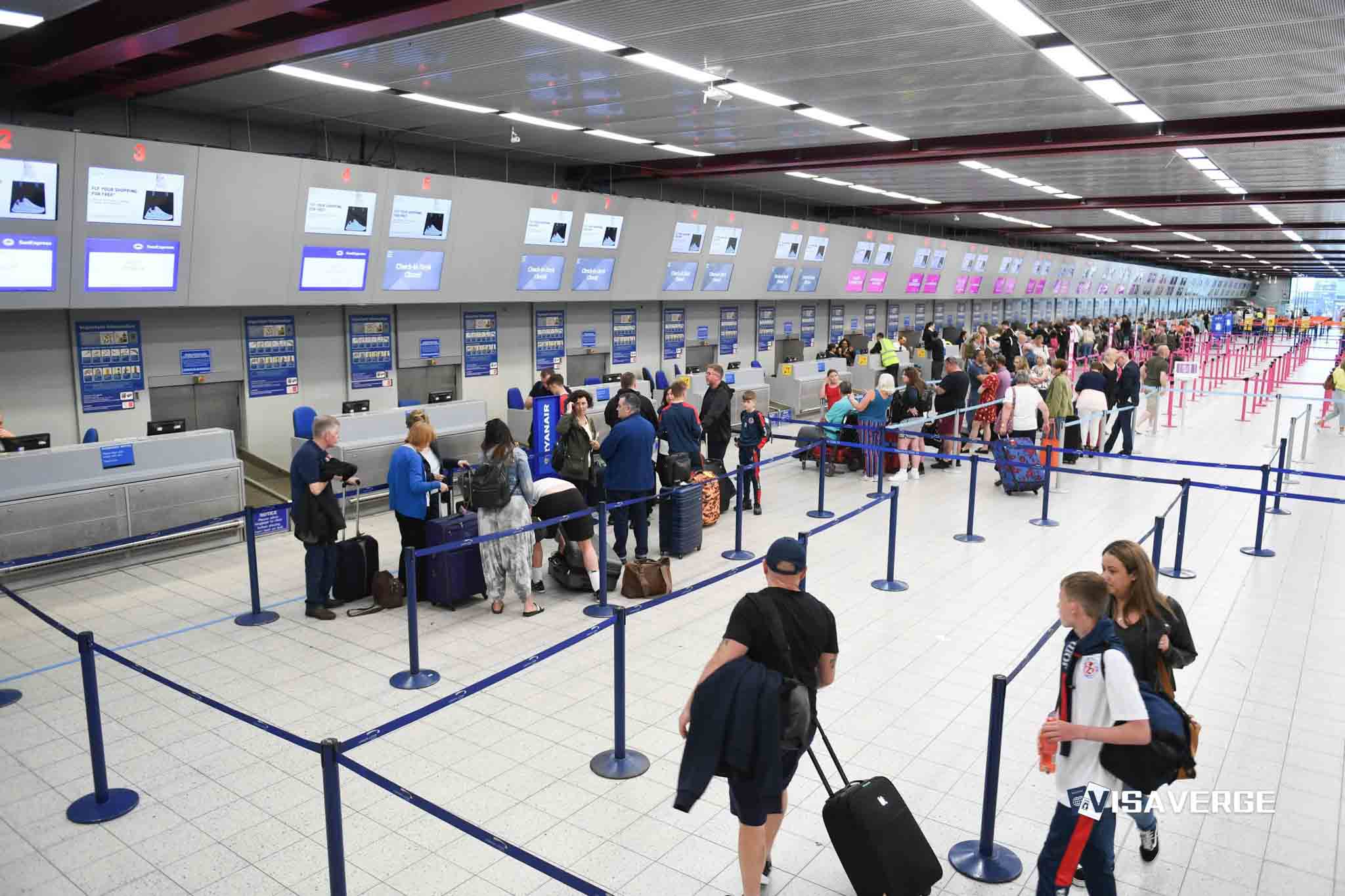
ACI Europe and Airlines for Europe (A4E), travel and airline industry groups, said EES-related queues remained excessive, with routine delays of more than two hours and waits of up to five hours in the most extreme cases. The groups said passengers had missed flights and connections, and that congestion put pressure on border guards, airport staff and airline staff.
Chris Wright said the EES had more impact on travel that year than the US war on Iran. He also said Greece appeared to have “just park[ed] EES” and that media coverage had left customers uncertain; his parents, he said, asked whether they should postpone travel.
TUI chief operating officer Tilman Reinshagen called the delays “a terrible scenario” and said passengers standing on the tarmac was unacceptable. Ryanair chief operating officer Neal McMahon described the system as rushed and said Italian authorities told the airline, “We don’t turn it on.” easyJet chief executive Kenton Jarvis said the EES worked when switched off but not when switched on, and criticized its software and implementation.
UK Border Force director general Phil Douglas said the European Commission had told the UK the system was working fine. Douglas disagreed, blaming contractors’ failure to deliver on time and what he called poor initial design.
Who is covered and what registration involves
The EES applies to non-EU nationals crossing the external borders of participating countries for a short stay of up to 90 days in any 180-day period, whether they need a short-stay visa or are visa-exempt. For those travelers, the system records border crossings and biometric data instead of relying on passport stamps. Children under 12 do not have to provide fingerprints.
The system excludes EU citizens; holders of qualifying residence permits or long-stay visas; certain family members with qualifying residence cards; people exercising specified mobility rights; nationals of Andorra, Monaco and San Marino; and holders of passports issued by the Vatican City State or the Holy See. It also excludes people exempt from border checks or subject to specified special border-check rules.
If a traveler is temporarily physically unable to provide fingerprints, the EES records that fact. The traveler must provide fingerprints on exit or at a later entry. More details on coverage and registration are in the official EES frequently asked questions.
How the rollout led to the current system
The EES began a 180-day progressive rollout on October 12, 2025, at external borders in 29 European countries. During the rollout, countries introduced it at border crossing points in stages, while EES registration and passport stamping operated in parallel. The European Parliament and Council adopted Regulation (EU) 2025/1534, the temporary law setting the rollout rules, on July 18, 2025. The European Commission set the start date on July 30, 2025.
| Rollout point | What the rules required or what happened |
|---|---|
| First 60 days | Countries could operate the EES without biometric functions and create or update individual files without biometric data. |
| Day 30 | Each country had to register at least 10% of its estimated covered border crossings. |
| Day 90 | Each country had to use biometric functions at least half its border crossing points, register at least 35% of estimated covered crossings, and ensure registered individual files contained biometric data. |
| Day 150 | Each country had to use biometric functions at all its border crossing points and register at least 50% of estimated covered crossings. |
| Day 170 | Each country had to use biometric functions at all its border crossing points and register all covered non-EU nationals. |
| March 30, 2026 | The European Commission said the system had recorded more than 45 million border crossings during the rollout and more than 24,000 people had been refused entry. |
| April 10, 2026 | The EES became fully operational at participating Schengen external border crossing points, replacing passport stamps with digital entry and exit records for covered travelers. |
During the rollout, border authorities had to stamp covered travelers’ documents on entry and exit as well as register their information in the EES. A separate transition rule required carriers to keep checking travel-document stamps for 180 days after the rollout ended, in addition to using the EES web service.
What temporary safeguards and suspension rules applied
During the progressive rollout, national authorities and Europol, the European Union’s law-enforcement cooperation agency, could not make a decision against a person solely because an alleged entry or exit had not been recorded in the EES. If a non-EU national in a Member State had neither an entry stamp nor an EES individual file, authorities could presume that the person did not meet the conditions for entry or stay. That presumption did not apply where the person provided credible evidence of free-movement rights, a qualifying residence permit or long-stay visa, or compliance with the short-stay limit.
A person could also challenge the presumption with credible evidence such as transport tickets, proof of being outside Member State territory, or proof of the expiry date of a previous residence permit or long-stay visa. After that, authorities using the EES had to create or update the person’s file, or erase it where the applicable EES rule required erasure. During the rollout, authorities and Europol also had to disregard the automated calculator for maximum authorised stay and the automatically generated list of overstayers and its consequences. Identity and previous-registration checks under the EES were carried out only at border crossing points where biometric functions were operating, including through available self-service systems.
The rollout rules allowed countries to suspend EES operations fully or partly at certain crossing points if a system or communications failure significantly disrupted operations, or exceptional traffic caused excessive waits. A suspension had to be strictly necessary and last for the shortest possible time. Countries had to notify the European Commission and eu-LISA, the EU agency that manages large-scale IT systems in the justice and home affairs area, promptly and within six hours, and inform infrastructure operators and carriers when relevant to local circumstances. During a partial suspension, countries still had to collect required EES data except biometric data; during a full suspension, they had to stop EES operations and collect none of those data.
For 90 days after the progressive rollout ended, countries could partly suspend operations at a crossing point for up to six hours in exceptional circumstances causing excessive waits, including by suspending biometric registration during that period. They had to notify the Commission and eu-LISA promptly and within six hours, giving the reason and expected or actual duration. The rules automatically extended that 90-day period by 60 days if fewer than 80% of individual EES files created during the rollout contained biometric data. A European Commission spokesperson said the temporary flexibility to suspend biometric registration ended on September 6, 2026.
What happens next
Oliver Clarke, ABTA’s public affairs manager, said mitigation measures remained in place and that no launch date had been set for ETIAS, the EU’s separate travel authorisation system.
Keep reading
More in Travel →



Who this affects
Sources
Primary documents and official agency releases referenced in this story.