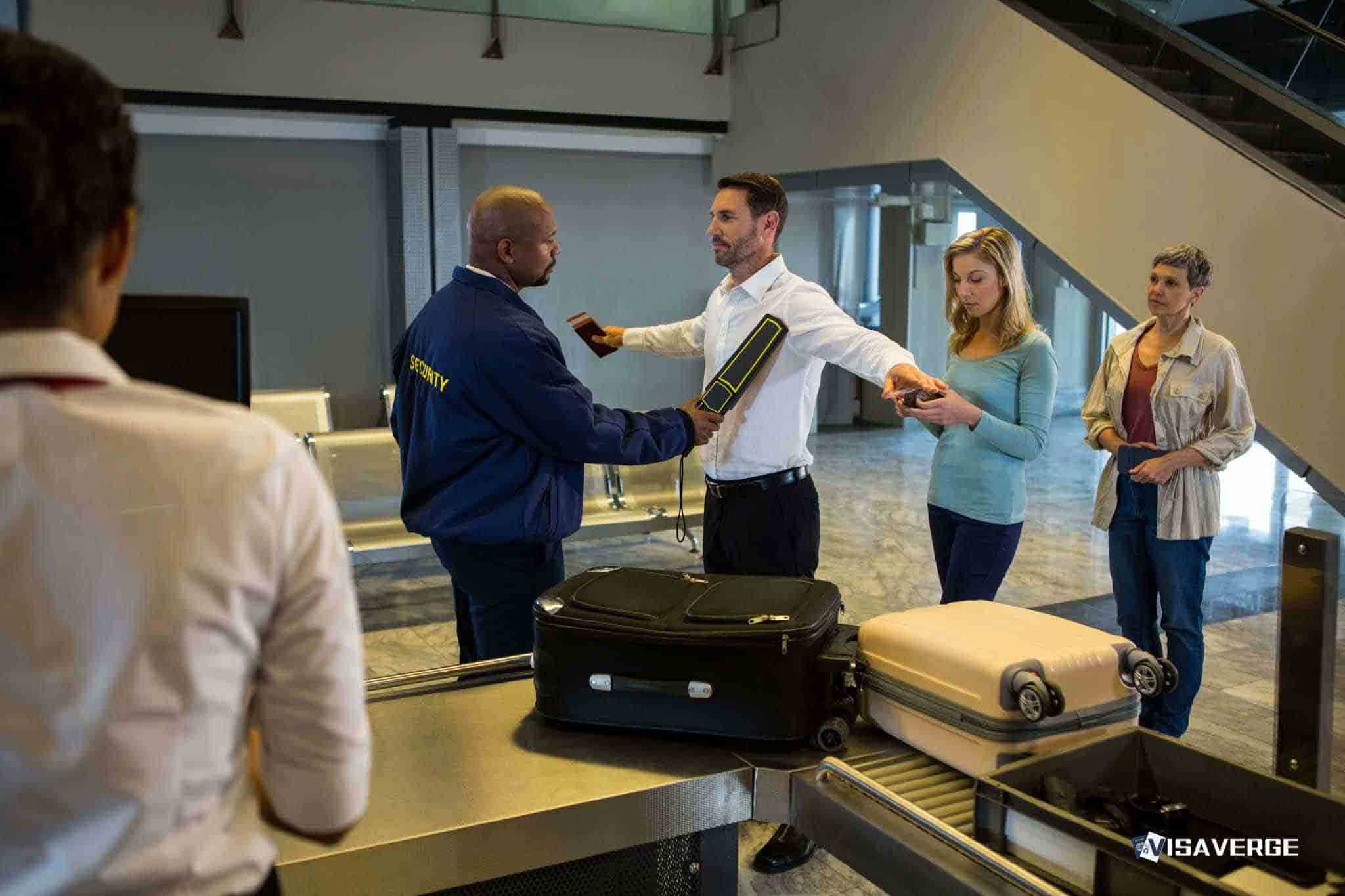
- The U.S. and Australia expanded biometric data sharing to strengthen border security and immigration enforcement.
- Visa-free travel for Australians now depends on EBSP compliance and interoperable identity databases.
- U.S. agencies gained direct access to records including facial images, fingerprints, and passport details.
(UNITED STATES) — The Trump administration expanded U.S. access to Australians’ biometric data and identity documents as part of a border-security push that ties visa-free travel to deeper information sharing between the two allies.
Official reports and recently enacted regulations dated February 4, 2026 indicate the United States and Australia are significantly widening how routinely they share biometric data, with the Enhanced Border Security Partnership (EBSP) at the center of the new approach.
Free toolREAL ID Requirements Checker tool
DHS framed the move as part of a broader effort to strengthen screening across the Visa Waiver Program (VWP), which allows eligible travelers, including Australians, to enter the United States without a visa under the ESTA system.
The Department of Homeland Security (DHS) has described EBSP as a requirement for countries that want to keep their place in the Visa Waiver Program (VWP), linking participation to expanded biometric and identity-data interoperability.
“restoring American airspace sovereignty”
DHS described its broader aim as “restoring American airspace sovereignty” and “safeguarding the nation” through advanced biometric surveillance, signaling that biometric data checks will play a larger role in travel vetting and immigration enforcement.
In a DHS Year in Review 2025 statement, the department said the EBSP is designed to “routinely screen the biometrics of travelers. against the biometric records of the VWP partner.”
A separate internal document set a firm end-of-2026 deadline for VWP partners, including Australia, to conclude EBSP agreements, and warned that DHS would weigh compliance when it evaluates countries for continued participation.
“After this deadline, the DHS will assess each country’s compliance with the EBSP requirement during evaluations for initial and continued participation in the VWP,” the internal guidance said, in Feb 3, 2026 reports.
The U.S. regulatory backdrop includes DHS rulemaking on entry and exit biometrics that expands routine collection, aligning what happens at ports of entry with the broader screening expectations embedded in EBSP.
A final rule titled “Collection of Biometric Data from Aliens Upon Entry to and Departure from the United States” authorized U.S. Customs and Border Protection (CBP) to collect facial biometric data from all noncitizens, including Australians, at all ports of entry, according to a Federal Register notice.
Operationally, the new U.S.–Australia expansion centers on “direct access” for U.S. agencies, meaning U.S. authorities can query Australian records without the traditional “mutual legal assistance” delays described in the reports.
Those early February reports said the Australian government agreed to provide U.S. agencies, including Immigration and Customs Enforcement (ICE), with direct access to biometric databases that contain names, dates of birth, passport numbers, facial images, and fingerprints.
The scope extends beyond airport travelers. The agreement covers “individuals encountered by law enforcement in a border or immigration context in the United States,” a category that reaches into interior immigration enforcement and other encounters where officers seek to verify identity quickly.
DHS’s own description of EBSP also outlines a wider population than short-term visitors. “Through the Enhanced Border Security Partnership (EBSP), DHS seeks to routinely screen the biometrics of travelers. Applicants for immigration benefits or humanitarian protection. and Individuals encountered by law enforcement in a border or immigration context in the United States,” the department said in its Year in Review 2025 statement.
That direct querying model can speed identification when officers face mismatched documents, uncertain biographic details, or suspected use of multiple identities, because it links biographic identifiers to biometric data such as facial images and fingerprints.
The expansion also dovetails with DHS disclosures about using facial recognition away from ports of entry, including in enforcement operations that can involve mobile identity checks.
DHS confirmed it uses a facial recognition app called Mobile Fortify, developed by NEC, as a field tool for identity verification, according to a disclosure in late January.
According to the DHS disclosure, the app uses “trusted source photos” to verify identities in the field, a system that differs from one-off manual document checks by relying on an official reference image rather than an officer’s visual comparison alone.
Reports described that mobile verification capability as part of broader enforcement operations rather than a process limited to border booths, reinforcing that biometric cross-checking can occur during encounters that begin outside an airport or land crossing.
Australia’s policy direction also moved toward broader biometric collection and governance that can support international sharing, including with the United States, as EBSP expectations push partners to make their systems interoperable.
In early February 2026, the Australian government introduced new immigration regulations described as an Australian “Biometrics Act,” granting broader powers to gather biometric data from both citizens and migrants to facilitate international sharing and counter-terrorism efforts.
Such domestic collection authority and governance can expand the universe of data available for matching, potentially increasing how often Australian identity records can be checked against U.S. encounters when EBSP systems connect.
The shift mirrors how DHS has presented EBSP in agreements with other VWP partners. DHS publicized EBSP as a framework in a DHS Newsroom post on Secretary Noem and Bahrain, offering an example of how the department applies the model across participating countries.
For travelers, the changes put biometric data collection and real-time cross-referencing closer to the center of routine movement, with visa-free status explicitly tied to the data-sharing relationship.
Reports described Australia’s continued participation in visa-free travel (ESTA) as contingent on the agreement, turning EBSP compliance into a practical condition for keeping the current VWP pathway intact.
Privacy and surveillance concerns have also followed the expansion. Critics described the EBSP system as creating a “biometric checkpoint society,” arguing that broader sharing and matching can extend beyond the traveler who presented at the airport.
One concern described in the reports involves retention. Data can be held by the U.S. government for up to 75 years, alongside fears that the sharing may include information on “third-country nationals” and family members who have never traveled to the U.S.
The result, the reports said, is that Australian citizens encountered by ICE in the United States can be instantly cross-referenced with Australian national identity documents in real-time, a capability that depends on direct access to partner databases and automated checks rather than case-by-case legal requests.
Australia already participates with the United States in other cross-border data access frameworks, including a U.S. Department of Justice CLOUD Act agreement, as governments widen the pathways for information exchange in security and enforcement contexts.
Australia’s Home Affairs department also describes EBSP publicly, including its national-security framing, in Enhanced Border Security Partnership details, as the two countries expand the infrastructure for biometric matching tied to the Visa Waiver Program (VWP).