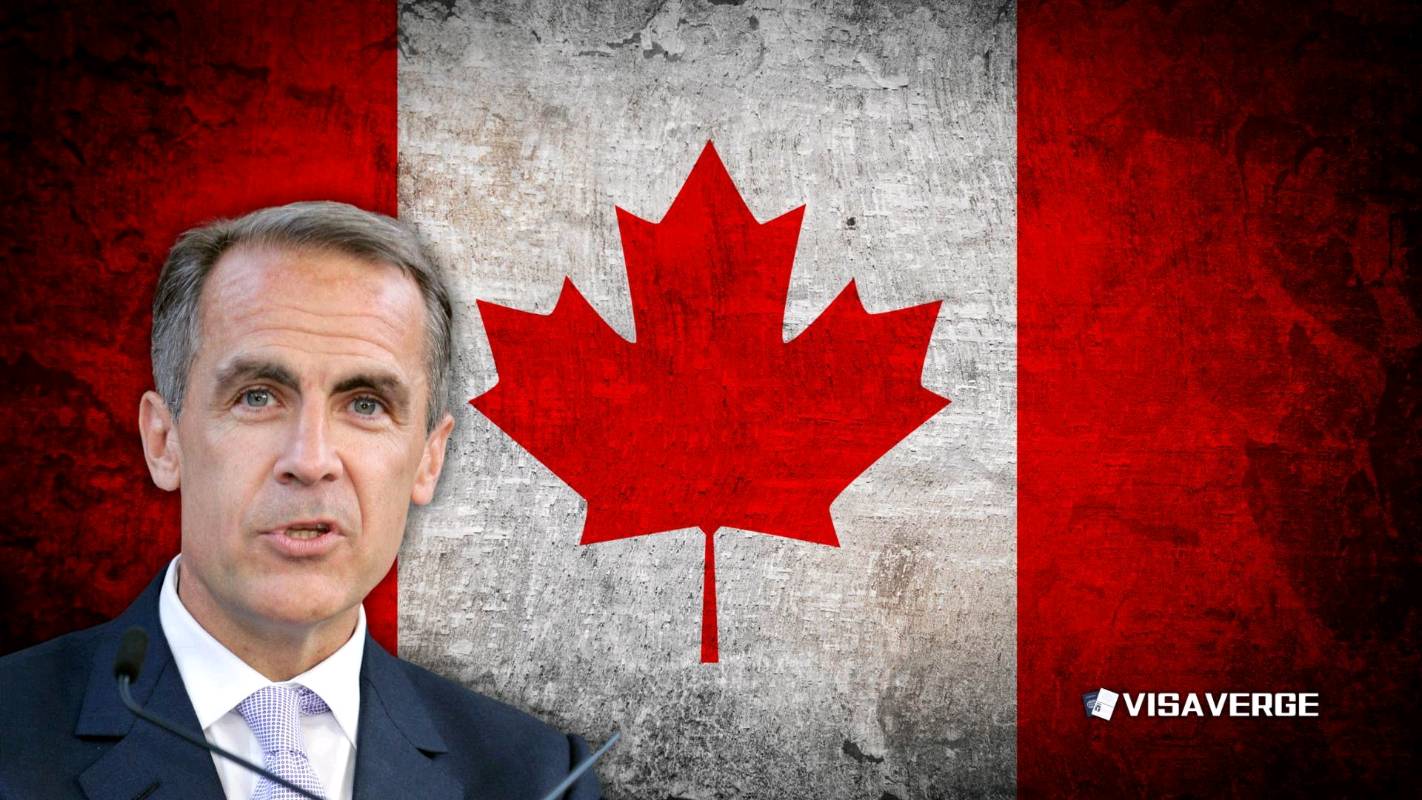
- Prime Minister Mark Carney confirms Canada has taken back control of its immigration system and volumes.
- Arrivals of international students have plunged by two-thirds amid strict new 2026 permit caps.
- The government plans to maintain several more years of restraint to ease housing and infrastructure pressure.
Prime Minister Mark Carney said Canada has taken back control of its immigration system after asylum, temporary-worker and international-student volumes fell sharply. He made the announcement July 29 at a press conference in Red Deer, Alberta.
Asylum seekers entering Canada are down by one-third, Carney said. Temporary foreign workers have fallen by one-half, while foreign-student arrivals are down by two-thirds.

The reductions follow a period of high arrivals that strained housing and other national infrastructure. Carney said immigration levels still pressure the housing market.
More restraint may be coming.
| India | China | ROW | |
|---|---|---|---|
| EB-1 | Feb 01, 2023 | Aug 01, 2023 ▲31d | Current |
| EB-2 | Nov 01, 2013 | Oct 01, 2021 | Apr 01, 2025 ▲90d |
| EB-3 | Jan 22, 2014 ▲21d | Jan 22, 2022 ▲14d | Jun 15, 2024 ▲31d |
| F-1 | Jan 22, 2021 ▲366d | Jan 22, 2021 ▲366d | Jan 22, 2021 ▲366d |
| F-2A | Oct 22, 2026 ▲30d | Oct 22, 2026 ▲30d | Oct 22, 2026 ▲30d |
"We have taken back control of immigration. Asylum claims are down by a third. Temporary foreign workers arrivals down by half. And international student arrivals down by two thirds. We can now carefully rebuild a sustainable immigration system consistent with Canadian values."
Carney said the government is now “on top of the numbers.” He also suggested Canada may need “a few more years of restraint” before expanding parts of the system.
Three major streams have fallen at different rates
The figures cover three different parts of Canada’s temporary and protection-related migration system. Carney presented them as evidence that the government can now consider its next steps more carefully.
| Category | Reported change |
|---|---|
| Asylum seekers | Down by one-third, or 33% |
| Temporary foreign workers | Down by one-half, or 50% |
| International students | Down by two-thirds, approximately 60% to 66% |
The government plans to admit approximately 380,000 new permanent residents in 2026. The target represents a decrease from previous highs and is intended to keep admissions at “sustainable levels” below 1% of the population.
That target addresses permanent residents, while Carney’s three reductions concern asylum seekers, temporary workers and international students. The government has also placed greater emphasis on people already living in Canada temporarily.
The approach prioritizes transitions to permanent status for existing temporary residents rather than bringing in new arrivals. Officials have referred to that approach as the “In-Canada Focus” category.
Student restrictions are reshaping the intake
International students have experienced the steepest reported decline among the three streams. The number of arrivals is down by two-thirds, according to Carney’s figures.
Study permits for 2026 are capped at roughly 155,000. Prospective students, particularly those from India, face much higher refusal rates under the tighter approach.
Indian students previously made up more than 50% of the international-student population. They now account for 8.1% of total international students, according to specific reports cited in the policy context.
The change affects both Canada’s recruitment pipeline and the population of temporary residents who might later seek permanent status. It also narrows the pool available to the government’s in-country transition strategy.
Housing pressure is keeping the brakes on
Carney linked the restraint to continuing pressure on housing. He did not present the reductions as the end of the policy shift.
Canada’s approach followed a technical recession in early 2026 and public outcry over housing affordability. Those pressures helped shape the government’s effort to bring arrivals down.
The permanent-resident target below 1% of the population gives the government a longer-term ceiling. Carney’s comments suggest that ceiling will not immediately lead to renewed growth in temporary or protection-related arrivals.
Federal and provincial leaders now have an opportunity to discuss the next stage of immigration policy, he said. The conversation will take place after the government has reported declines across all three streams.
Border and trade pressures add a cross-border dimension
Canada’s immigration restraint is unfolding alongside worsening economic and security ties with the United States. The U.S. government has been monitoring Canada’s changes in connection with border security and trade negotiations.
On June 17, 2026, U.S. Homeland Security Secretary Markwayne Mullin said the “fracturing” relationship between the countries needed to be restored. He linked pressure from Mexican cartels to criminal activity at America’s northern border.
The United States also expanded scrutiny of immigration and border enforcement. On July 13, U.S. Citizenship and Immigration Services updated its Policy Manual guidance on screening under the Safe Third Country Agreement.
The agreement’s expanded rules, implemented in 2023, apply across the entire U.S.-Canada land border. The stated purpose is to deter irregular crossings.
In January 2026, the agency began strictly controlling TN, or USMCA, visa applications. New documentation requirements and occupation reviews followed deteriorating economic relations with the Carney government.
The cross-border measures do not replace Canada’s domestic immigration decisions. They form part of the surrounding pressure on movement between the two countries.
Washington’s enforcement agenda is raising the stakes
President Trump and Mullin said July 17 that U.S. Department of Homeland Security databases identified 250,000 noncitizens illegally registered to vote in four U.S. states. They cited the claim while supporting further enforcement measures under the Secure America Act.
President Trump signed the Secure America Act, S. 2, on June 10, 2026. The law provided $70 billion in emergency funding for Immigration and Customs Enforcement and Customs and Border Protection.
The funding targets what the U.S. government called “northern border gaps” and supports a mass-deportation agenda. Those measures have added a security component to the bilateral relationship as Canada adjusts its own immigration volumes.
Trade tensions are moving on a parallel track. The United States has threatened 50% tariffs on Canadian goods effective August 19, 2026.
Carney has suggested that Canada could use energy exports as leverage in the negotiations. The immigration announcement therefore arrived amid pressure on both the border and the commercial relationship.
Canada is still courting selected high-skilled workers
The restraint does not apply equally to every prospective migrant. The government has signaled an “accelerated pathway” for U.S. H-1B holders to move to Canada.
That proposal seeks to attract high-tech talent while U.S. restrictions affect the movement of skilled workers. It sits alongside the in-country focus on temporary residents already in Canada.
Together, the measures point to a narrower intake rather than a complete halt. Lower volumes are being paired with selective routes for people Canada wants to retain or recruit.
Carney said federal and provincial leaders can now discuss future immigration steps with the numbers under closer control. The government’s next decisions will come against a 2026 permanent-resident target of approximately 380,000 and a stated need for several more years of restraint.