- Iowa lawmakers are advancing a bill requiring federal database checks to verify U.S. citizenship for voter registration.
- The proposal utilizes the federal SAVE program to cross-check applicant status before approving new voter registrations.
- Current law relies on affirmation under penalty of perjury rather than requiring physical documentary proof of citizenship.
(IOWA, UNITED STATES) — Iowa lawmakers advanced a bill in early 2026 that would require election officials to verify U.S. citizenship through federal databases before approving voter registrations, marking a shift from the state’s current system, which does not require documentary proof of citizenship to register or vote.
The proposal has not become law as of March 29, 2026. Iowa still requires voters to be U.S. citizens, Iowa residents and at least 17 years old, provided they turn 18 by Election Day, but it relies on registrants to affirm citizenship under penalty of perjury rather than present citizenship papers.
Secretary of State Paul Pate began pushing the voter citizenship verification measure on January 13, 2025. After moving through a House subcommittee on February 20, 2025, a Senate bill advanced in early 2026 and would require election officials to use the federal SAVE program, formally known as the Systematic Alien Verification for Entitlements program, to check citizenship before registration approval.
Current Iowa Registration Rules
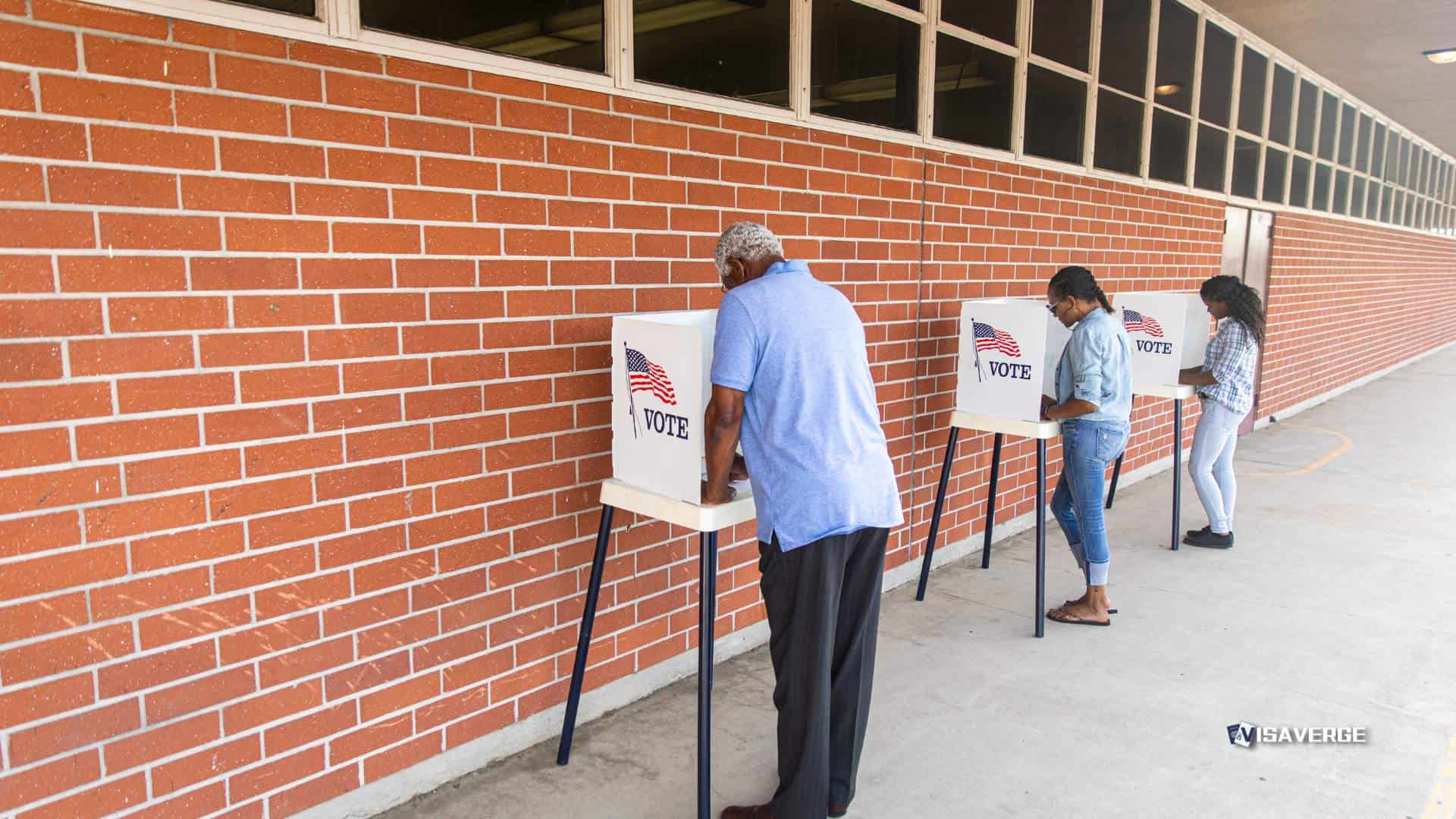
Under current Iowa law, non-citizens cannot vote. The state offers voter registration online through the Iowa Department of Transportation portal, by mail or in person through county auditors, and through Election Day Registration, which Iowa has allowed since 2007.
Election Day Registration lets voters register at the polls or during in-person absentee voting on the same day, but they must show proof of identity and proof of residence. They do not have to present a citizenship document under current rules.
Accepted identity documents for same-day registration include a valid Iowa driver’s license with a current address, other photo IDs with expiration dates such as passports and military IDs, or an oath from a precinct registered voter. Proof of residence can include utility bills, bank statements or government documents showing a name and address, and voters can present those electronically.
If a voter using Election Day Registration cannot provide identity and residence documents, that voter cannot cast a ballot. A person who attests for another voter under oath faces felony penalties for fraud of up to $7,500 fine and 5 years in prison.
Registrations submitted by mail must be postmarked 15 days before an election. Online registrations must be completed by 11:59 p.m. CT on that deadline, and the Iowa Secretary of State’s Voter Ready site says registrations after October 21 for general elections shift to Election Day Registration procedures.
What the Pending Senate Measure Would Change
The pending Senate measure would add a new requirement on top of those rules. Election officials would have to cross-check registration applications against SAVE and other databases, and if those checks do not produce a clear result, the voter could appeal to a judge.
That proposal has drawn criticism inside the statehouse over how it would work in practice, especially for same-day registration and provisional ballots. State Sen. Cindy Winkler warned of “negative impacts” on eligible voters because of the logistics, while Republicans have sought changes to make the bill fit with provisional voting.
National tracking cited in the measure’s status shows the bill has passed one chamber, but it still awaits full Senate floor action and House reconciliation. No enactment date has been set.
Supporters, Opponents and National Context
For now, Iowa remains among the vast majority of states that do not require documentary proof of citizenship for voter registration or voting. The state aligns with 45 states and D.C. that lack those mandates.
Supporters of stricter rules have framed the proposal as a way to strengthen election integrity and public trust. Opponents point to the rarity of documented non-citizen voting and the burden that new paperwork could place on eligible voters.
National research cited in the debate put non-citizen voting incidents at 0.04% of verifications, often because of errors. That figure has become part of the broader argument over whether new requirements would catch fraud or mainly complicate access for citizens.
How the Proposal Could Affect Voters
The Iowa bill would affect new registrants first. Applicants whose citizenship could not be confirmed through the database system could cast provisional ballots while officials verified their status.
Existing voters could also face scrutiny if databases do not confirm their citizenship. Under the proposal, those voters would be notified to affirm their status or risk deactivation.
The measure could hit hardest among voters who rely on same-day registration, including younger voters, people who move often and residents in college towns. Under the proposal, Election Day Registration users would need to provide citizenship proof to cast regular ballots and otherwise would fall back to provisional ballots.
Naturalized citizens and voters who changed their names could face extra paperwork. The proposal’s proof standards mirror language in the federal SAVE America Act debate and list a passport, birth certificate, naturalization certificate, REAL ID indicating citizenship, military ID, or a government-issued photo ID plus a secondary document such as a consular birth report as acceptable proof.
Critics have said those requirements may not work smoothly in real life. Many state REAL IDs do not show citizenship markers, creating the possibility that a document often treated as a gold standard for identification would not answer the question the bill asks officials to verify.
That concern extends beyond Iowa. Brennan Center data from 2023 found that 9% of U.S. citizens, or 21.3 million people, do not have ready access to documents such as birth certificates or passports.
Those gaps do not fall evenly across the population. The groups identified in that research include rural elderly voters, low-income voters, married women whose names have changed, and people of color.
In Iowa, the proposal could create added hurdles for rural voters, naturalized immigrants and young voters who depend on Election Day Registration. Smaller county offices would also have to pay for SAVE access, train workers and manage appeals while preparing for future statewide elections and the state’s first-in-the-nation caucuses.
Pate’s office has said the proposal is meant to work alongside Election Day Registration, not replace it. But the mechanics remain a central issue in the debate, especially if lawmakers want the system ready ahead of the 2026 midterms or the 2028 caucuses.
The legislation would also raise pressure on poll workers and local election staff. Critics say criminal penalties for registering a person without required proof could make workers more reluctant to accept registrations, even from voters they know personally.
Iowa has not faced a lawsuit over its current voter citizenship rules. The proposal, however, could invite challenges under the Voting Rights Act if it becomes law, reflecting battles that have played out in other states over whether proof-of-citizenship rules create unlawful barriers.
Elsewhere, Alabama and Louisiana passed similar laws that remain unimplemented. That history has fed arguments that passing legislation is easier than building the administrative systems needed to make it work.
National Debate Over Citizenship Checks
The Iowa debate comes as states across the country revisit voter citizenship checks. In 2026, 15 states introduced proof-of-citizenship bills, and Florida, South Dakota and Utah passed such measures through both chambers.
Only 5 states — Arizona, Georgia, Kansas, Mississippi and Ohio — require proof of citizenship in some cases, while North Dakota does not have voter registration. Those states account for 4% of Americans, making documentary proof of citizenship far less common than voter identification requirements.
By contrast, 36 states require voter ID. The narrower reach of citizenship-proof laws has made Iowa’s proposal part of a more focused national fight over how far states should go in requiring papers before people can vote.
That national debate also runs through Congress. The federal SAVE America Act passed the House on February 11, 2026, by 218-213, with Iowa Reps. Feenstra, Hinson, Miller-Meeks cosponsoring or voting yes.
Senate debate on the SAVE America Act began March 17, 2026, and remained ongoing as of March 24, with no vote scheduled. The federal bill would require citizenship documents for federal voter registration, require voter roll purges using Department of Homeland Security data, and require photo ID at polls.
It would also bar mail registration without in-person proof and require either the last four digits of a Social Security number or identification for absentee voting. The overlap between the federal bill and Iowa’s proposal has put the state inside a wider test over how citizenship verification should work and who bears the burden of proving status.
What Remains Unchanged for Iowa Voters
For voters in Iowa, the immediate rule is unchanged. People can still register and vote under the current framework, which requires proof of identity and residence in some cases but not documentary proof of citizenship.
That means online registration still depends on an Iowa driver’s license or non-operator ID and the last five digits of a Social Security number. Mail and in-person registration remain open through county auditors, and same-day registration remains available at polling places and during in-person absentee voting.
Felony convictions also do not create a permanent bar under Iowa’s current system. People with felony convictions regain voting rights after completing their sentence through the Governor’s Office process.
The unresolved question is whether lawmakers can convert a proposal built around federal database checks into a system that works at county offices and polling places. Winkler’s warning about “negative impacts” captured the central dispute: whether tighter checks would reassure voters or put eligible Iowans at risk of delay, confusion or deactivation before they cast a ballot.