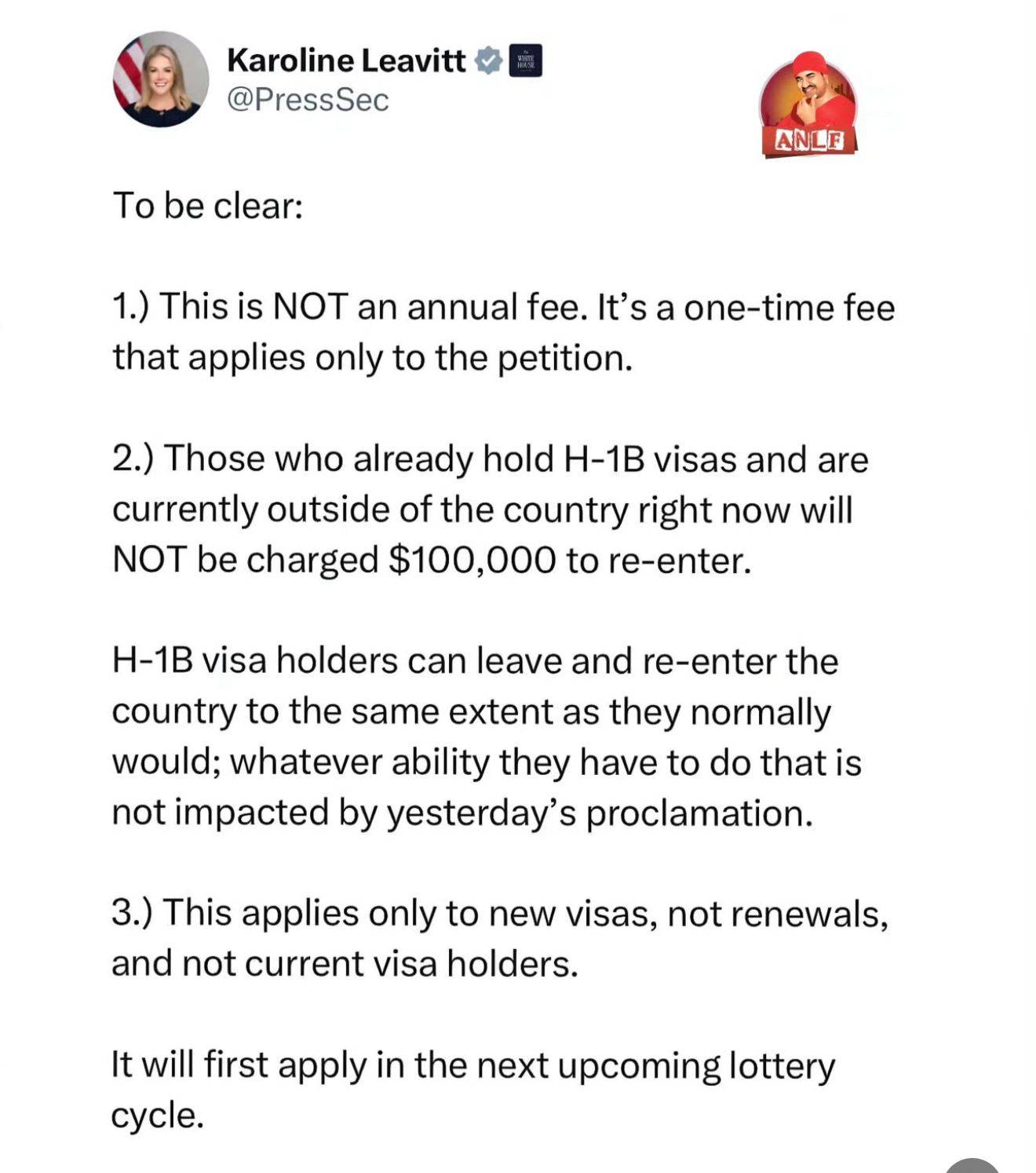
(UNITED STATES) The United States ?? has imposed a sweeping increase to the H-1B visa fee under a new Trump executive order, jolting employers across tech, finance, and healthcare. Signed on September 19, 2025, and effective for filings starting September 21, 2025, the order raises the H-1B cost to $100,000–$152,000 per application for both new petitions and renewals. The White House says the move will push companies to sponsor only “most exceptional” workers and curb misuse of the program.
Companies now face sudden, steep costs compared with previous totals that typically ranged from $1,710 to $6,460 depending on employer size and surcharges. The order took effect immediately, applying to any petition filed on or after September 21. Employers must pay the entire fee up front, and no waivers or reductions are available.
The policy also directs the Department of Labor to rewrite prevailing wage rules, which would raise required salaries for H-1B roles and increase overall sponsorship costs. Immigration lawyers say the combined effect of the new fee and wage rules could sharply reduce the number of petitions and shift hiring toward only the highest-paid roles.
Free toolH-1B Cost Calculator OnlineExecutive and Industry Responses
- Nvidia and OpenAI CEOs have publicly supported the broad aim of keeping the United States open to world-class talent, even as costs rise.
- Jensen Huang (Nvidia): Said immigration is central to his company’s future and to the country’s long-term success.
- Sam Altman (OpenAI): Suggested the change could make the system more selective and keep the “smartest people” in the U.S.
- Major companies are nevertheless warning employees and adjusting plans. Some firms reportedly told H-1B holders abroad to return to the U.S. before the effective date to avoid triggering the new fee on refiled petitions.
- JPMorgan Chase issued urgent guidance for H-1B workers overseas to come back before the deadline.
Immediate Financial Impact (Example)
- If the new fee had applied to all of Nvidia’s 764 petitions in FY2025, the company would have faced roughly $76.4 million in added costs.
- Analysts note that while mega-cap firms can absorb shocks like this, small and mid-sized companies could be effectively shut out of the program.
- Start-ups may decline to sponsor early-career roles when six-figure petition costs make the investment too risky.
Policy Changes Overview
- Effective date: Applies to all H-1B petitions and renewals filed on or after September 21, 2025.
- New cost: $100,000–$152,000 per application, payable by the employer at filing.
- No relief: No fee waivers or reductions under the executive order.
- Scope: Covers new petitions and extensions.
- Prevailing wage rewrite: Department of Labor directed to revise wage levels, raising minimum salary requirements for H-1B roles.
The administration frames the fee as a filter to reserve sponsorship for workers who are “truly irreplaceable.” Supporters say it will push hiring locally and increase U.S. training investments. Critics warn it will reduce competitiveness and price out essential talent.
Short-Term Employer Reactions
Employers are triaging hiring and sponsorship plans immediately:
| India | China | ROW | |
|---|---|---|---|
| EB-1 | Feb 01, 2023 ▲109d | Jul 01, 2023 | Current |
| EB-2 | Nov 01, 2013 | Oct 01, 2021 ▲30d | Jan 01, 2025 |
| EB-3 | Jan 01, 2014 | Jan 08, 2022 ▲7d | May 15, 2024 ▼109d |
| F-1 | Jan 22, 2020 | Jan 22, 2020 | Jan 22, 2020 |
| F-2A | Sep 22, 2026 ▲31d | Sep 22, 2026 ▲31d | Sep 22, 2026 ▲31d |
- Legal and HR teams are reviewing pending hires, active transfers, and upcoming renewals.
- Some firms are prioritizing senior or mission-critical roles where the six-figure fee is justifiable.
- Others are exploring nearshore or offshore options for projects no longer cost-effective to run in the U.S.
- Indian IT companies warn the fee could curtail U.S. operations, especially for budget-sensitive clients.
- Big Tech and Wall Street are preparing to rationalize sponsorship pipelines and limit support to mission-critical hires.
Effects on Workers and Early-Career Applicants
- High earners in niche specialties may still be in demand if their skills are essential.
- Entry-level and early-career applicants will likely see fewer H-1B openings.
- Companies are expected to favor roles with immediate, high-value impact over training hires.
- Immigration attorneys anticipate a stronger emphasis on compensation to align with higher prevailing wages.
Universities and recent graduates face ripple effects: international students transitioning from OPT to H-1B may find fewer sponsorable openings. Career services advise students to document unique skills and target employers with strategic needs.
Industry Reaction and Longer-Term Risks
- Major employers (Amazon, Microsoft, Google, Meta, Apple, TCS, and others) have warned of higher costs, delays, and possible program cuts.
- Economists are split:
- Some say the policy could encourage companies to invest in domestic talent pipelines (internships, apprenticeships, university partnerships).
- Others predict a flight of talent to countries with clearer, lower-cost pathways (Canada, the U.K., parts of Europe).
- Concern exists that future founders and researchers might build and hire abroad rather than bringing jobs to the U.S.
Prevailing Wage Rewrite: Additional Pressure
- Raising wage floors increases the total cost of H-1B hires beyond the filing fee.
- In some regions, higher wage requirements may outpace local pay bands, forcing role regrading or pass-over.
- Smaller hospitals, regional tech firms, and research labs could be disproportionately affected.
- Employers may rely more on remote work or contract arrangements outside the U.S. if budgets cannot stretch.
Legal and Political Fallout
- The policy has prompted talk of lawsuits. Business coalitions and advocacy groups argue the fee appears punitive and could exceed lawful agency charge limits.
- Potential legal challenges will raise questions about statutory authority, reasonableness, and economic harm.
- Congress may receive pressure from affected industries if staffing shortages emerge in healthcare, semiconductor manufacturing, and AI research.
Practical Guidance and Next Steps
For official program details, review the USCIS H-1B overview: USCIS: H-1B Specialty Occupations.
Practical steps employers are taking now include:
– Auditing headcount to identify roles that justify the $100,000–$152,000 outlay.
– Shifting sponsorships toward senior or niche positions with immediate revenue or safety impact.
– Preparing for higher salary obligations as the Department of Labor revises prevailing wages.
– Reviewing active travel and advising H-1B workers to avoid trips that might require refiling during the transition.
– Exploring alternative talent strategies, including domestic training programs and cross-border teams.
For workers, near-term advice:
– Maintain valid status and minimize travel if a renewal or amendment is imminent.
– Collect proof of unique skills, patents, publications, or measurable project outcomes to demonstrate essentiality.
– Discuss timelines early with your employer’s legal team, especially for role or location changes requiring new filings.
The Trump executive order has reshaped the H-1B landscape overnight. Even supporters who welcome a stricter filter concede the price tag is high and will narrow the field. Opponents warn the U.S. could lose ground if cutting-edge work migrates to friendlier markets. As legal challenges develop and agencies move to raise wage floors, employers and workers must adapt to a new reality: fewer filings, higher stakes, and a program focused on the most defensible hires.
This Article in a Nutshell
The Trump administration issued an executive order signed September 19, 2025 that takes effect for filings from September 21 and raises the H-1B visa application fee to $100,000–$152,000 per petition. Employers must pay the fee at filing with no waivers, and the order covers new petitions and renewals. The Department of Labor is directed to revise prevailing wage rules, likely increasing salary requirements for H-1B roles. Industry leaders and employers in tech, finance, and healthcare are reassessing sponsorship strategies, prioritizing senior or mission-critical hires. Analysts warn small and mid-sized firms may be priced out, early-career applicants will face fewer opportunities, and legal challenges are probable. Companies are auditing headcount, advising travel precautions for overseas H-1B workers, and exploring domestic or nearshore alternatives.