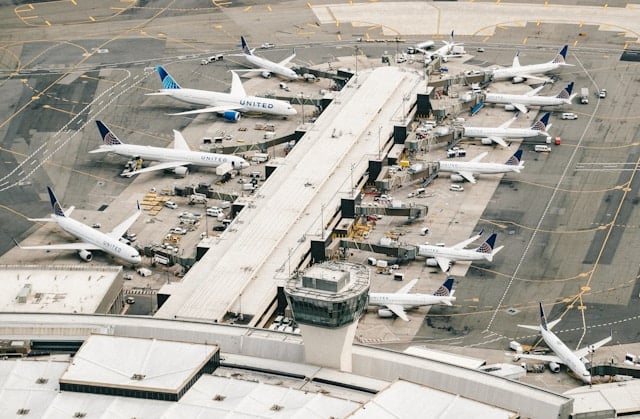
- Secretary Mullin sees no current need to halt international flight processing at Newark Liberty International Airport.
- The FAA extended reduced flight limits of 68 hourly arrivals through October 24, 2026.
- White House officials confirmed no new policy announcements regarding the reassignment of CBP personnel.
(NEWARK, NEW JERSEY) – Homeland Security Secretary Markwayne Mullin sees no need to stop international flight processing at Newark Liberty International Airport, according to a late-May report that cited administration officials and said no final decision had been made.
Mullin had floated reassigning Customs and Border Protection officers away from processing international flights and toward federal immigration operations. That possibility raised concerns in the airline sector because it could disrupt international arrivals and departures at one of the region’s busiest airports.
Free toolB1/B2 Tourist Visa Stay Calculator online
A White House official said there were “no new policy announcements” at that stage and said any decision would ultimately rest with the President. Administration officials had not announced a new policy in the late-May time frame described in the report.
The discussion surfaced as tensions tied to protests near the airport drew attention to how federal agencies might deploy personnel around Newark. Mullin’s position, as described in the report, stopped short of any move to halt the processing of international flights.
Separate from that issue, the Federal Aviation Administration later extended Newark’s reduced arrivals and departures limit through October 24, 2026. The FAA also cut hourly traffic to 68 flights in June.
Those FAA limits address airport capacity and traffic flow. They do not, by themselves, confirm any shutdown of international processing.
That distinction matters inside airport operations because international traffic depends on more than runway slots. Even when the FAA limits total flights, Newark still requires Customs and Border Protection staffing to process arriving international passengers and support departing international service.
Reassigning those officers would affect a different part of the system. Airline concerns centered on whether shifting CBP personnel to immigration enforcement work could interfere with the airport’s ability to handle international arrivals and departures in the normal course.
Mullin’s reported view suggested he did not see a need to go that far. The late-May account said the administration had not reached a final decision and had not announced a policy change.
The White House official’s statement left the matter in a holding pattern. Any decision, the official said, would rest with the President rather than being treated as an immediate operational change already underway at Newark.
That left airlines and airport watchers weighing two separate pressures at once: staffing questions around Customs and Border Protection and the FAA’s broader effort to manage traffic levels at Newark. One concerned federal personnel assignments. The other concerned how many flights the airport could handle each hour.
Newark Liberty International Airport has faced close scrutiny whenever federal staffing or air traffic limits appear likely to affect schedule reliability. In this case, the possibility that CBP officers could be pulled from international flight processing stirred concern because it touched both arriving passengers and outbound international service.
Airline sector worries did not amount to a confirmed policy shift. They reflected the operational risk that follows any suggestion that border-processing staff could be reassigned away from an airport handling international traffic.
The available statements pointed in a narrower direction. Mullin saw no need to stop international flight processing, and the White House said there were no new policy announcements.
That left Newark without a declared change in how international passengers would be processed, even as the broader discussion continued around protests near the airport and possible federal responses. No final decision had been announced in the late-May window described by administration officials.
The FAA action set a clearer timetable. Its reduced arrivals and departures limit runs through October 24, 2026, and the hourly traffic cap stands at 68 flights in June.
Those numbers speak to runway and traffic management, not to whether international screening and admissions processing would continue. The separate report on FAA limits did not establish a link between the capacity cap and any halt in international processing.
Within federal operations, that separation is central. FAA traffic restrictions can slow or limit overall airport throughput, while Customs and Border Protection staffing determines how international passengers move through inspection and entry procedures after arrival.
At Newark, the concern raised by Mullin’s floated idea was that moving officers off airport duties could hit that second function directly. Airlines focused on the prospect of disruption, not on an announced order already in effect.
The administration’s language, at least in the late-May period described, remained cautious and incomplete rather than final. Officials described no new policy announcement, and the White House said presidential approval would be required for any decision.
That kept Newark’s international processing in place while leaving open questions about whether the idea would advance beyond internal discussion. Mullin’s reported stance, however, pointed away from stopping international flight processing at the airport.
What emerged from the two reports was a split picture of Newark’s pressures. The airport faces federal limits on how many flights it can handle each hour through part of the year, while officials also discussed, but did not adopt, a staffing shift that could have affected international operations.
For now, the clearest federal positions remain the ones already stated: Markwayne Mullin saw no need to stop international flight processing at Newark Liberty International Airport, the White House said there were “no new policy announcements”, and the FAA’s cap of 68 flights an hour in June runs on a separate track through October 24, 2026.