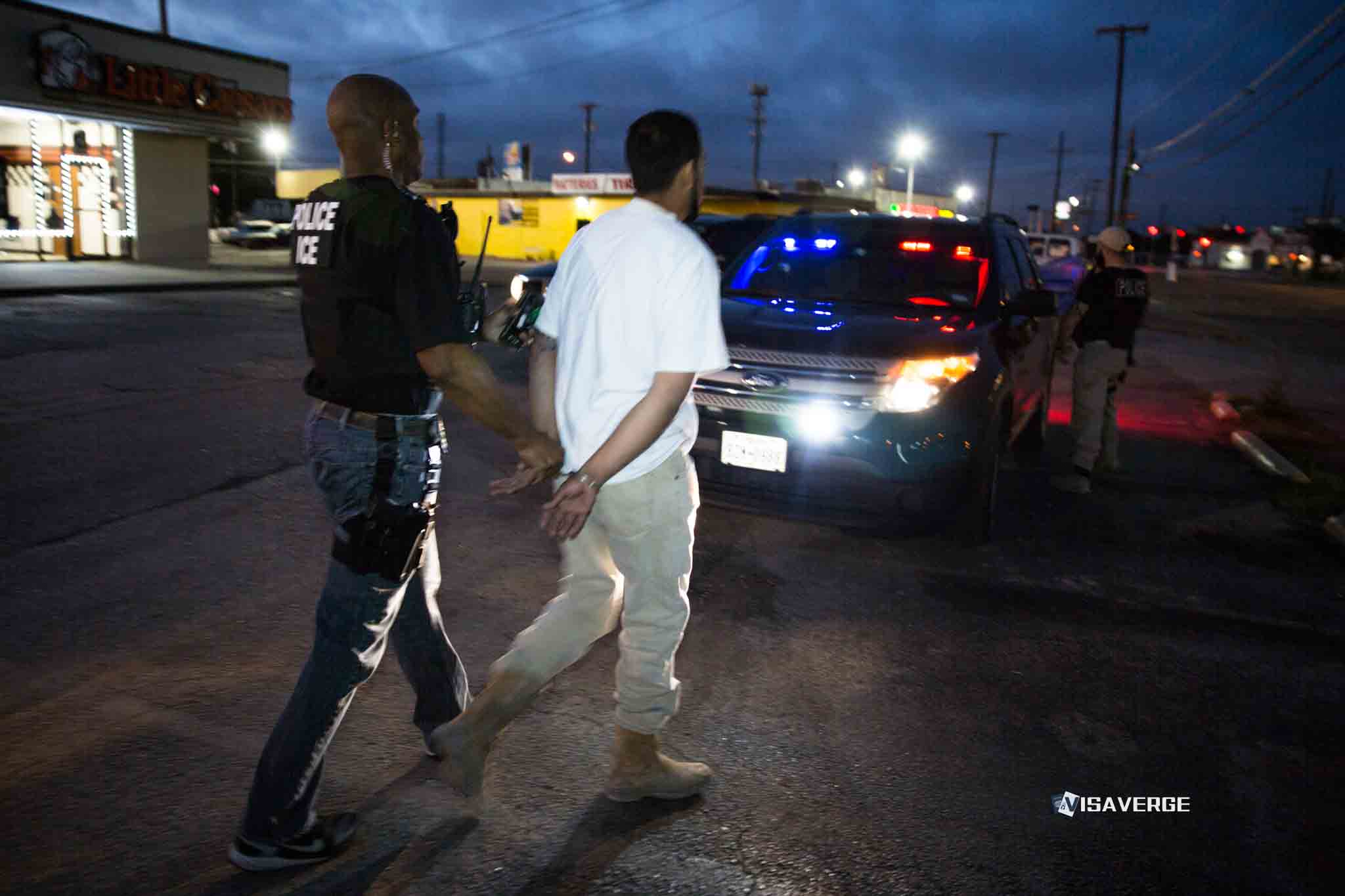
- Mariana began a campaign to bring her deported father home after serving aboard the USS Abraham Lincoln.
- His removal date, destination, immigration status, and case history remain unknown, limiting assessment of return options.
- The carrier returned to San Diego on October 8, 2026, after more than 10 months away.
A U.S. Navy sailor returned from war with a mission at home: bring her deported father back to the United States. Petty Officer 2nd Class Mariana, known as Mari, began that effort after serving overseas aboard the USS Abraham Lincoln.
A CNN report published October 16, 2026, and updated October 17, describes her campaign. Her father was deported while she was deployed.
Free toolCSPA Age-Out Calculator Online
The account identifies CNN anchor Jake Tapper as its author and correspondent Ed Lavandera as a guest on The Lead. It does not establish the father’s removal date, destination country, immigration case number or prior immigration status.
Those records would shape any return request. A removal order, the grounds for deportation and any unlawful-presence or criminal-history issues can affect which options may be available.
The story also leaves open whether the father had a final removal order, was removed through expedited procedures, held lawful permanent residence or had sought immigration relief before. Those are not minor distinctions.
Military service may support a request for prosecutorial discretion, deferred action or parole, but it does not itself establish eligibility for an immigration benefit. The applicable facts and legal standards would have to be assessed in the father’s case.
Any return request would turn on the father’s immigration record
A prior removal can trigger restrictions on returning to the United States. Depending on the removal history, INA § 212(a)(9)(A) may require permission to reapply for admission, often sought through Form I-212.
A separate set of rules addresses unlawful presence. INA § 212(a)(9)(B) can impose a bar in some cases, while INA § 212(a)(9)(B)(v) allows a waiver based on “extreme hardship” to a qualifying U.S.-citizen or lawful-permanent-resident spouse or parent.
A child’s hardship to a parent generally does not, by itself, meet that qualifying-relative requirement for the standard unlawful-presence waiver. That may limit the relevance of Mariana’s relationship to her father under that particular provision, though other facts and potential forms of relief could matter.
Parole under INA § 212(d)(5) is another possible mechanism in some circumstances. The account does not establish that the family is pursuing parole, a waiver, permission to reapply or any other specific procedure. No individual outcome can be assessed without the father’s immigration record and the details of his removal.
The legal possibilities are fact-dependent. The deportation order, if one exists, and the grounds for removal would be central to evaluating them.
The carrier’s return followed an unusually long deployment
The Abraham Lincoln reached San Diego on October 8, 2026, after supporting U.S. operations in the Iran war. One account described 265 consecutive days at sea without a port call. Another put the full deployment at 321 days, including 264 consecutive days at sea.
The strike group included about 6,000 sailors. Navy information provided to lawmakers recorded eight suicide attempts during the deployment.
The citation presented to the crew credited the carrier and its strike group with 3,693 combat missions and 1.37 million pounds of ordnance delivered. It also listed 450 Tomahawk cruise missiles launched, 77 one-way attack drones destroyed, 64 Iranian warships sunk and 21 anti-ship cruise missiles destroyed.
The figures describe the ship’s deployment, not Mariana’s individual role. The carrier’s homecoming followed a ceremony the day before.
Commanders defended the crew’s performance and conditions
Pete Hegseth, then U.S. Secretary of Defense, presented the crew with the Presidential Unit Citation on October 7, 2026. He praised sailors for adapting through the extended mission.
“what makes the U.S. military and the U.S. Navy and all these sailors different is that you adapt and that you’re resilient and you overcome — you finish the mission nonetheless.”
Hegseth also objected to descriptions of the deployment as “some sort of a symbol of dysfunction, a symbol of low morale or a symbol of a failed mission.” Capt. Daniel Keeler, the carrier’s commanding officer, said most crew members were on their first deployment and characterized reported problems as normal during a deployment of that length. He said sailors had access to four meals a day.
Hung Cao, acting Secretary of the Navy, said in August 2026 that the ship had adequate food supplies. He also acknowledged that combat operations limited resupply and temporarily cut meal options from two meals to one.
President Donald Trump said in August that the carrier’s lengthy deployment was “not nearly long enough.” The ship returned to San Diego on October 8, after more than 10 months away.
Any decision on Mariana’s father’s case would depend on his immigration history and the legal grounds for his removal. This article provides general information and is not legal advice. Consult a qualified immigration attorney about your specific case.