- South Korean police raided three government agencies to investigate negligence surrounding the fatal Jeju Air flight crash.
- Investigators are scrutinizing a concrete embankment barrier that simulations suggest made the emergency landing unsurvivable.
- The probe has booked dozens of suspects under the Serious Accidents Punishment Act for public disaster charges.
South Korean police raided the transport ministry, the state-run airport operator and a regional aviation office Tuesday as investigators widened their probe into the Jeju Air crash that killed 179 people. The searches began at about 9:00 a.m. on August 11, 2026.
The National Police Agency’s special investigation team searched the Ministry of Land, Infrastructure and Transport, Korea Airports Corp. and the Busan Regional Office of Aviation. Investigators are seeking evidence tied to suspected professional negligence resulting in death or injury and possible charges under the Serious Accidents Punishment Act for a serious public disaster.
The operation targeted agencies connected to Muan International Airport, where Jeju Air Flight 7C2216 crashed on December 29, 2024. Police said the team had booked 45 people in the case, while another report put the number of suspects at 74.
One investigation official described the searches as a way to gather newly identified material.
“In connection with the existing investigation into charges of occupational negligence causing death or injury, there are additional suspicions, and we are conducting search-and-seizure to secure newly needed materials.”
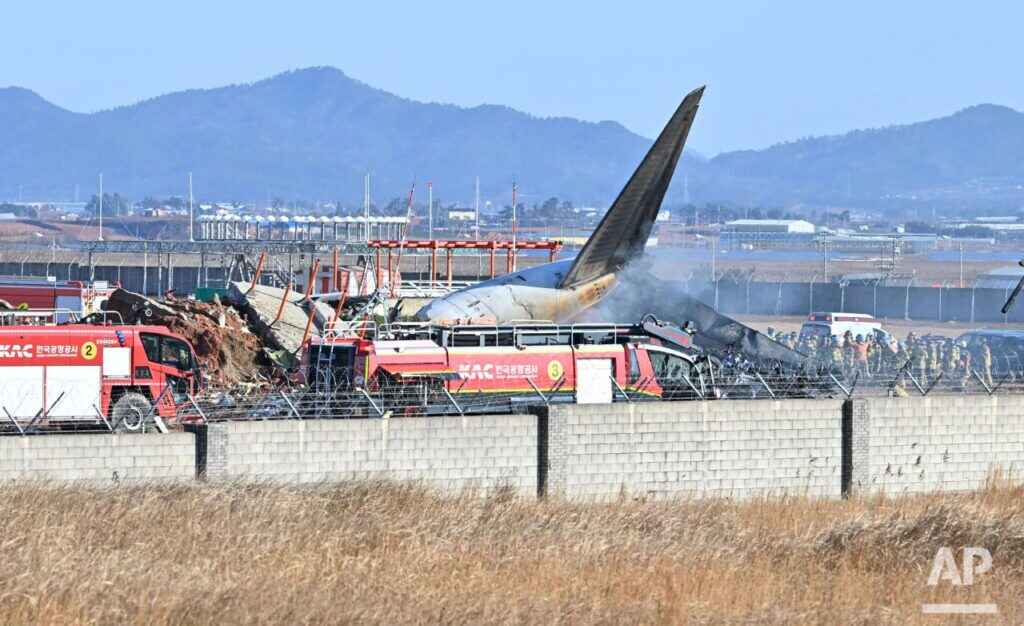
The aircraft departed Bangkok, Thailand, and attempted a belly landing at about 9:03 a.m. The Boeing 737-800 then struck a concrete embankment supporting a localizer antenna at the runway’s end.
Police are examining the barrier and the decisions behind it
The transport ministry search marked the third time investigators had searched that agency. Earlier searches took place in March and June 2026. Police had also searched the airport corporation and the regional aviation office.
Investigators are examining whether officials properly carried out safety duties and whether ministry personnel tried to downplay or conceal problems involving the concrete structure. Officials initially said the structure did not violate regulations.
An airport operating manual from 2024 reportedly acknowledged that the embankment was “too close” to the runway and recommended reassessing its location. A 2026 simulation by the Computational Structural Engineering Institute of Korea concluded that the belly landing would have been survivable, with only minor injuries, if the aircraft had not hit the rigid barrier.
The findings have shifted attention toward infrastructure and oversight as well as the aircraft’s emergency response. Authorities have announced plans to remove the concrete localizer structure.
The preliminary findings from the Aviation and Railway Accident Investigation Board said a double bird strike involving Baikal Teals caused a loss of thrust. The report also highlighted that the pilots reportedly “shut off the wrong engine,” turning off the less-damaged left engine rather than the severely damaged right engine.
Police are now assessing how those events fit together. The criminal inquiry can examine both the emergency and the conditions surrounding the runway.
The crash killed 179 people and left two survivors
Flight 7C2216 carried 181 people. The crash killed 179, including 6 crew members and 175 passengers, while two cabin crew members seated in the rear survived after the tail section detached from the fuselage.
The death toll has driven a widening legal and political response. Families of 73 victims had initiated a state-led damages lawsuit as of August 2026.
On August 7, a law firm representing victims’ families filed for evidence preservation at the Mokpo branch of the Gwangju District Court. The filing sought to secure CCTV footage and personal effects.
Kim Yu-jin, head of the association of bereaved families, criticized what she described as government efforts to shift blame toward the deceased pilots.
“None of us resent the pilots. if they [the government] want to say their investigation was done in a reliable, independent manner, they should have come up with evidence.”
Family members have also staged public protests demanding an independent investigation and greater transparency. Ryu Kum-ji, who lost both parents, took part in protests that included head-shaving demonstrations.
The inquiry now reaches senior officials and agencies
The potential public-disaster charges could expose high-ranking officials to personal liability for alleged safety failures. Investigators are focusing on whether the agencies responsible for the airport and aviation oversight met their duties before and after the crash.
The case has already expanded beyond the airport operator. The ministry sets transport policy, the airport corporation operates the facility, and the Busan regional office handles aviation administration in the area. Police searched all three bodies during Tuesday’s coordinated action.
Jeju Air CEO Kim Yi-bae previously pledged “full cooperation with government investigations” and offered “heartfelt apologies to the victims’ families.” The airline’s flight remains central to the inquiry, but the latest searches place public infrastructure and official conduct at the center of the next phase.
Investigators must now secure records that could show who knew about the embankment, when they knew it, and what action followed. The evidence-preservation filing and the planned removal of the structure add pressure to preserve material before the physical site changes.