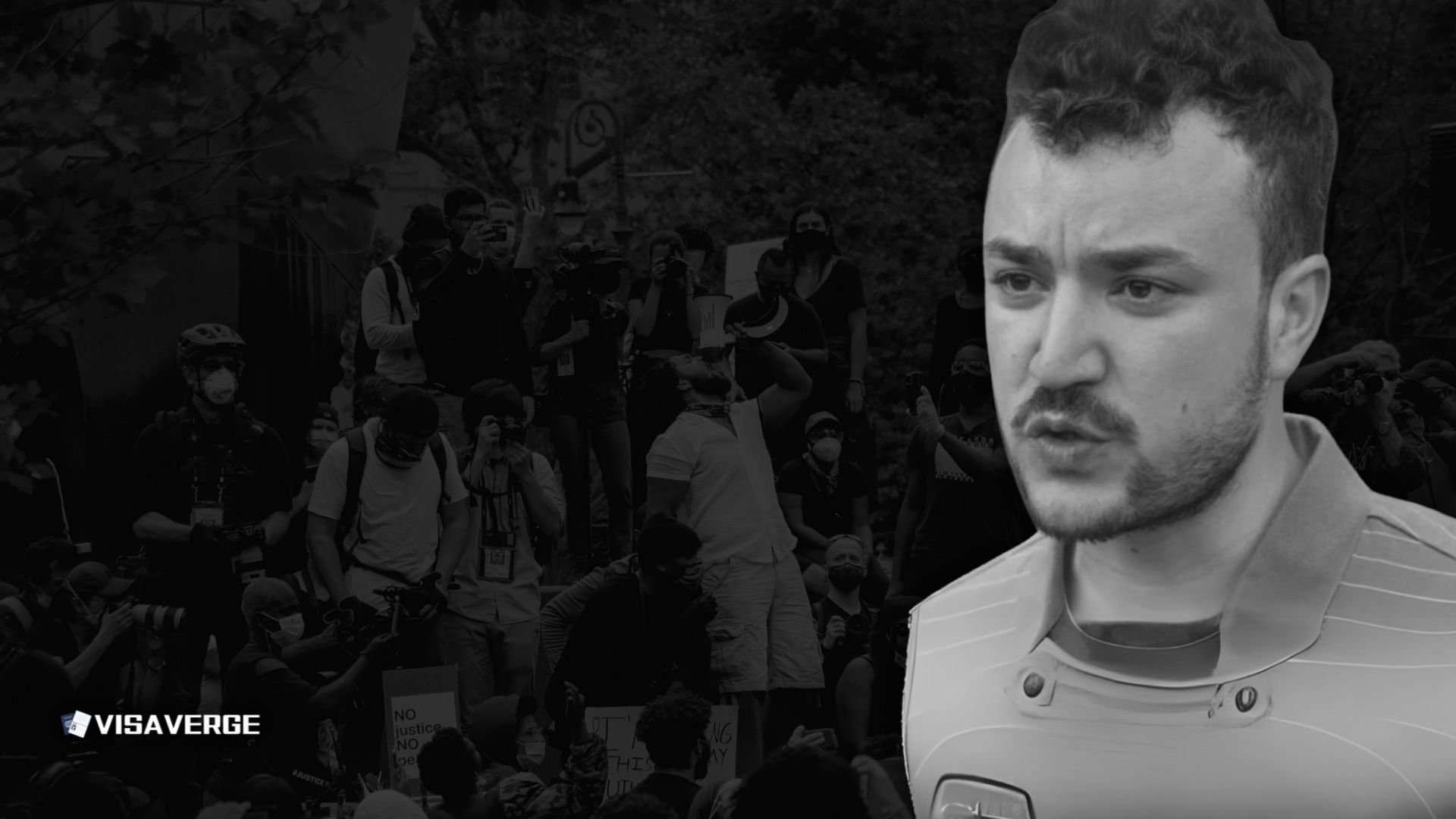
- Lawmakers accuse the administration of expediting Mahmoud Khalil’s deportation in just nine days.
- The case tests the foreign-policy grounds for removal under INA § 237(a)(4)(C) for residents.
- Federal courts have blocked his immediate deportation while constitutional and due process claims are reviewed.
(NEW YORK) – The allegations surrounding Mahmoud Khalil‘s removal case have put unusual attention on a narrow deportation ground that appears infrequently in published decisions, and on whether the Board of Immigration Appeals handled the matter with unusual speed. For lawful permanent residents in politically charged cases, the dispute is less about one ruling than about process: how quickly DHS can press a foreign-policy theory, how much deference immigration judges may give the executive branch, and how federal courts may respond when detention and removal move ahead while constitutional claims remain pending.
No published precedential BIA decision in Khalil’s case appears to be available. The closest established precedent on the government’s legal theory is Matter of Ruiz-Massieu, 22 I&N Dec. 833 (BIA 1999), where the Board addressed deportability under the foreign-policy ground now codified at INA § 237(a)(4)(C). That provision allows removal of a noncitizen whose presence or activities the Secretary of State has reasonable ground to believe would have potentially serious adverse foreign policy consequences for the United States. The statute is rarely litigated in the public eye. Its use against a green-card holder tied to campus protest activity has made Khalil’s case a test of how far that authority reaches.

New York Democratic lawmakers say the Trump administration pushed that authority beyond ordinary practice. In a letter to DHS and the Justice Department, they accused the administration of “secretly engineering” Khalil’s deportation outcome and treating the case as a political example. Their stated concern is twofold: first, that Khalil is being targeted for speech and advocacy tied to pro-Palestinian activism; second, that ordinary appellate procedures were compressed in a way that raises due process concerns.
The signatories place the criticism squarely in the political mainstream of New York’s left wing. State Sen. Jabari Brisport led the letter. Other signers included state Sens. Julia Salazar, Jessica Ramos, and Gustavo Rivera, Assembly member Claire Valdez, and New York City Council members Tiffany Cabán and Chi Ossé. Their intervention does not change the legal standard in immigration court, but it does sharpen the public record around claims that the executive branch leaned on adjudicators in a case already carrying national political weight.
The known facts are unusually stark. Khalil has been described as a former Columbia University student and a lawful permanent resident. The government has argued that his continued presence would harm U.S. foreign policy interests, relying on a determination attributed to Secretary of State Marco Rubio. An immigration judge in Louisiana reportedly found him deportable on that basis. A federal judge in New Jersey later barred the government from deporting him or continuing to detain him on that same theory, and the Third Circuit denied the administration’s request to re-detain him while the appeal continues.
That split posture matters in practical terms. Removal proceedings and federal constitutional litigation often move on separate tracks. A noncitizen can be found removable in immigration court while still obtaining federal court relief against detention or deportation pending review. In Khalil’s case, the immigration ruling did not end the matter. The federal courts have already shown a willingness to slow the government’s enforcement path while broader legal challenges proceed.
Warning: A deportability finding by an immigration judge is not always the final word. Deadlines to appeal to the BIA are short, typically 30 days from the immigration judge’s decision under 8 C.F.R. § 1003.38. Missing that deadline can be fatal to an appeal.
The most contested procedural claim is speed. Lawmakers and Khalil’s lawyers say the BIA reached a decision in nine days. If accurate, that timetable is far faster than the pace many respondents see in routine appeals. Speed alone does not prove impropriety. The Board may expedite matters in detention cases or matters the government identifies as urgent. But a compressed schedule becomes legally significant if it limited briefing, bypassed usual internal review, or reflected pressure from outside the adjudicative chain. The public reporting available so far does not establish those details, and any final assessment will likely depend on court filings rather than political letters.
The underlying statute also deserves careful attention. INA § 237(a)(4)(C) gives the executive branch substantial room to invoke foreign policy, but it is not a blank check. In Matter of Ruiz-Massieu, the BIA treated the Secretary of State’s certification as entitled to significant weight. Even so, the case law leaves room for constitutional challenges, especially where the alleged conduct overlaps with speech, association, or protest. Lawful permanent residents generally have stronger constitutional footing than recent entrants, particularly on due process questions. That does not immunize them from removal charges, but it typically changes the level of scrutiny federal courts are willing to apply.
Khalil’s posture may also invite closer review because the government appears to be using immigration law to respond to domestic political expression. If the record shows the charge rests on protected speech rather than conduct, federal judges may examine whether the executive’s foreign-policy rationale is being used as a pretext. Immigration courts have limited authority to resolve broad constitutional claims. Federal district and circuit courts are usually where those arguments gain traction. The New Jersey order and the Third Circuit’s refusal to re-detain Khalil suggest that at least some judges see enough legal uncertainty to preserve the status quo.
No clear circuit split is apparent yet on Khalil’s specific facts. Foreign-policy removability under INA § 237(a)(4)(C) is too uncommon to produce a large body of conflicting circuit law. The more familiar divide appears in adjacent questions: how much deference courts owe the executive on national security or foreign affairs, and how aggressively they review claims that immigration enforcement burdened protected speech. Those questions vary by context and by circuit. If Khalil’s case reaches a published appellate decision, it may become a reference point well beyond New York.
Procedural point: Parallel cases in immigration court and federal court can produce conflicting short-term outcomes. A person may remain protected from removal or re-detention even after an immigration judge rules against them, depending on injunctions, stays, and the posture of appellate review.
The criticism from lawmakers also speaks to a long-running structural concern. Immigration judges and the BIA sit within the Executive Office for Immigration Review, a Justice Department component, not an independent judiciary. That arrangement has drawn criticism from both parties over the years, especially in high-profile cases where policy officials appear invested in the result. Allegations that the Board influenced a trial-level immigration court, or bypassed normal appeal channels, would be serious if proved. They would also be difficult to establish without internal records or a court finding. At this stage, the public evidence shows an accusation, not an adjudicated conclusion.
Practitioners watching the case will likely focus on three questions. First, what exact administrative record supports the Secretary of State’s foreign-policy determination. Second, whether Khalil received a full opportunity to contest that basis before the immigration judge and on appeal. Third, how federal courts frame the relationship between immigration authority and First Amendment protections for a lawful permanent resident. Those answers will shape similar cases involving student activists, permanent residents, and noncitizens whose speech becomes a proxy for foreign-policy conflict.
Anyone facing a charge under INA § 237(a)(4)(C), or any allegation tied to speech, protest activity, or national security, should treat the matter as high-risk from the first hearing. These cases typically require coordinated immigration and federal-court strategy, fast filing decisions, and close attention to detention issues, bond posture, and appellate deadlines. Consultation with a qualified immigration attorney is not optional in any practical sense; it is the only responsible course.
Official legal materials are available through the Executive Office for Immigration Review at [justice.gov/eoir](https://www.justice.gov/eoir), the INA and federal regulations through Cornell’s Legal Information Institute at [law.cornell.edu](https://www.law.cornell.edu), and USCIS policy materials at [uscis.gov](https://www.uscis.gov). Lawyer referral resources include [AILA Lawyer Referral](https://www.aila.org/find-a-lawyer) and the Immigration Advocates Network.
⚖️ Legal Disclaimer: This article provides general information about immigration law and is not legal advice. Immigration cases are highly fact-specific, and laws vary by jurisdiction. Consult a qualified immigration attorney for advice about your specific situation.