- A viral video shows workers escaping across rooftops during a January 2026 immigration enforcement visit in Montebello.
- Suppression of evidence requires proving egregious constitutional or regulatory violations under the Matter of Barcenas precedent.
- Operations like the California Surge increase encounter risks for mixed-status families despite no reported arrests in Montebello.
(MONTEBELLO, CALIFORNIA) — The viral “rooftop escape” video from a January 14, 2026 immigration enforcement visit in Montebello is already shaping how lawyers prepare Fourth Amendment and suppression arguments in workplace and neighborhood encounters, under the long-standing BIA rule that suppression is available in removal proceedings only when respondents can make a strong, fact-supported showing of an “egregious” constitutional or regulatory violation. That rule—set out in Matter of Barcenas, 19 I&N Dec. 609 (BIA 1988)—does not turn on how dramatic an operation looks on camera; it turns on what agents did, why they did it, and what evidence they obtained.
What makes Montebello different is not a reported arrest total at that specific site (local accounts say none occurred), but the combination of visibility, fear-driven work disruption, and the broader enforcement push described as the California Surge and Operation Metro Surge. Those conditions tend to generate more street and worksite encounters, more disputed stops, and more litigation over how information was collected and used.
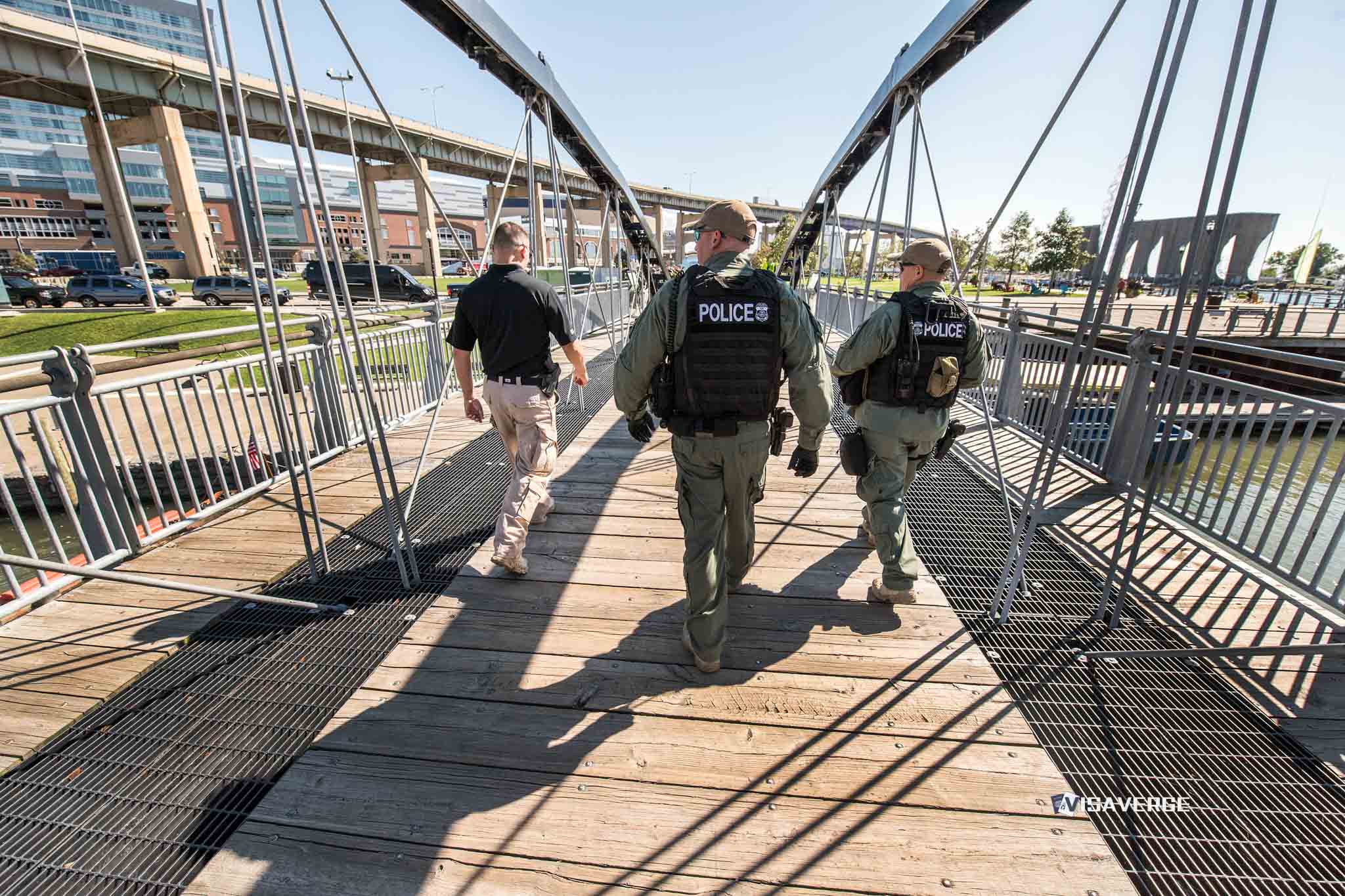
1) Incident overview: Montebello rooftop escape (Jan. 14, 2026)
Video circulated online shows workers at or near a residential construction site on Wilbur Street moving across rooftops as federal agents approached. Witnesses and local reports described workers climbing up and jumping between structures to avoid contact.
Several key points remain unclear based on publicly available information. It is not confirmed who the target was, whether the visit involved a judicial warrant, an administrative warrant, or a consent-based approach, or whether agents planned arrests at that address. A contractor identified in local reporting (described as “Manny”) said no one was detained at the Montebello location, even as the scene disrupted the block and interrupted work.
Even without on-site arrests, the community impact can be immediate. Contractors may lose crews for days. Neighbors may change routines. People may avoid school drop-offs, medical visits, or errands out of fear of incidental contact. Prior regional episodes have shown similar ripple effects, including the swap meet raid concerns that prompted questions about presence-based arrests and community spillover.
2) Broader context: California Surge and Operation Metro Surge
The Montebello video landed in a moment when DHS messaging and field activity signaled an intensified tempo. “Surge” language generally implies multi-site planning, added staffing, and deliberate visibility. These operations are often structured to run across several neighborhoods in the same day, sometimes with overlapping teams handling surveillance, approach, transport, and processing.
For mixed-status families, that structure matters. A multi-location day can raise encounter risk well beyond the “headline” site. People may face contact during commutes, at worksites, or near routine appointments. For employers, the uncertainty can be acute in sectors that rely on day-of labor availability, including construction, landscaping, and roofing.
Reporting on enforcement patterns has highlighted how surges can vary by region and tactics. Readers tracking Northern California dynamics have looked to analysis of Bay Area surge scenarios to compare how quickly activity can spread beyond initial target lists.
3) Official statements and quotes
DHS officials have framed early-2026 operations as public safety enforcement. DHS Assistant Secretary Tricia McLaughlin stated on January 2, 2026 that ICE “secures our streets” and emphasized removals of people described as serious criminals. After Midwest and California operations, Secretary Kristi Noem defended “highly visible tactics,” arguing ICE is enforcing the law and should not be “intimidated by sanctuary politicians.” White House Press Secretary Karoline Leavitt, responding to questions about the Montebello footage, urged focus on “facts” tied to violent crime attributed to “illegal aliens.”
Those statements influence behavior even when they do not describe the operational details that matter in court. People may assume every encounter involves a criminal warrant. They may believe they must open a door. They may avoid reporting crimes as witnesses or victims.
A practical way to read official messaging is to separate three categories: (1) rhetoric about objectives, (2) policy directives that may change priorities, and (3) operational facts that determine legal exposure, such as the legal basis for a stop, entry, questioning, or seizure. DHS has also pushed back on misinformation in ways that affect public perception, including its fake narrative list.
Warning: Viral video rarely captures the legal details that control suppression claims, such as whether there was consent to enter, the basis for a stop, or what documents were signed.
4) Key facts and statistics: what the numbers show—and don’t
Civil rights groups estimated numerous Southern California operations occurred on January 14, spanning areas from East Los Angeles to downtown. Separately, ICE announced earlier-January arrests tied to a targeted California operation, and DHS has described significant growth in agency manpower.
These figures help illustrate scale and tempo. But they do not, by themselves, prove the legality of any particular stop or arrest. A high number of operations can amplify the chance of collateral encounters. It can also increase the odds of inconsistent adherence to internal rules. At the same time, large numbers do not establish that any given person was unlawfully stopped.
In removal defense, the key statistical question is usually narrower: what happened in this individual encounter, and what evidence did ICE obtain from it? Multi-site operations can cause “visibility effects” even where there are no arrests at a specific address. But immigration court litigation focuses on the evidence in the record, often anchored by a Form I-213, statements, or identity documents.
Note: This section is designed to introduce an interactive tool that presents detailed counts, locations, and trends. The tool will provide the visual and structured data presentation; use the narrative above to frame the figures and interpret what they mean (or do not mean) for suppression and removal-defense strategy.
5) Significance and policy context: identification rules, federal challenges, and the suppression standard
California’s No Secret Police Act and federal preemption
California’s “No Secret Police Act,” effective January 1, 2026, reportedly requires visible identification and restricts mask use by federal agents during certain enforcement activity. The Department of Justice has sued to block it, arguing the law endangers federal personnel and interferes with federal functions. That is a classic preemption posture: the federal government asserting supremacy over state regulation that affects federal operations.
Even if identification rules are litigated, the practical courtroom question often becomes evidentiary: if agents violated a state visibility rule, does that translate into a federal constitutional violation, a violation of federal regulations, or neither? In immigration court, suppression usually requires more than showing a state-law defect.
The controlling immigration-court precedent: Matter of Barcenas
In Matter of Barcenas, 19 I&N Dec. 609 (BIA 1988), the BIA held that a respondent seeking to suppress evidence must present a supported motion that makes a prima facie case of an unlawful search or seizure. Conclusory allegations are not enough. If the respondent makes that showing, the burden may shift to the government to justify how it obtained the evidence.
Applied to incidents like Montebello, Barcenas means the drama of a rooftop escape is not the legal test. The test is whether ICE obtained evidence through conduct that was unconstitutional or violated required procedures, and whether the violation was serious enough to justify suppression in removal proceedings.
Circuit variation, especially in the Ninth Circuit
Outcomes can vary by jurisdiction. Montebello sits in the Ninth Circuit, where suppression claims have historically been more developed than in some circuits, particularly when a stop is tied to racial profiling or other “egregious” misconduct. A commonly cited Ninth Circuit decision is Gonzalez-Rivera v. INS, 22 F.3d 1441 (9th Cir. 1994), which recognized suppression where a stop was based solely on Hispanic appearance. Other circuits apply stricter approaches, and standards can differ on what qualifies as “egregious.”
Stops, questioning, and regulations
ICE enforcement authority is rooted in INA § 287 and implemented through regulations, including 8 C.F.R. § 287.8 (limits on interrogation, arrest, and use of force). If litigation over late-2025 rulings on stops and searches changes field practices, it may also change the factual record lawyers can develop when challenging evidence.
Deadline: If a loved one is detained, bond, custody review, and court filing windows can move quickly. Evidence preservation is time-sensitive. Contact counsel as early as possible.
6) Impact on affected individuals: preparedness without panic
Fear often spikes because people do not distinguish between a targeted arrest effort and collateral contact. Even if Montebello saw no detentions at that address, the visibility of the operation can fuel rumors, reduce workforce turnout, and push people into high-risk decisions like fleeing across rooftops.
Practical steps that may reduce harm include:
- Keep key phone numbers written down. Include an attorney, a trusted family contact, and childcare backups.
- Store copies of important documents in a safe place. Do not carry unnecessary originals to a jobsite.
- Make a plan for payroll, rent, and school pickups if a household earner is suddenly unavailable.
- If approached, stay calm and limit physical movement. Disputes about flight and “resistance” can escalate quickly.
In worksite-adjacent sectors like roofing and construction, interruptions can be abrupt. Consider arranging a check-in protocol with a supervisor or family member. If someone does not return by a set time, a designated person can begin locating them.
Warning: Do not sign papers you do not understand. Some signatures can affect your ability to seek bond or relief. Ask to speak with an attorney.
7) Official government sources: how to verify fast-moving claims
When enforcement stories move quickly, primary sources matter. Agency “newsroom” posts can confirm what the government says it is doing, even when they omit operational specifics. Congressional materials can confirm whether impeachment articles or resolutions were introduced, but not whether they will change enforcement immediately. Court filings and orders are often the most concrete sources when legal limits are in dispute.
A good cross-check method is to compare: (1) DHS and ICE newsroom statements, (2) congressional text for resolutions, and (3) court dockets or published orders when available. Also compare those with credible local reporting, while treating social media video as partial evidence that may lack context.
For broader enforcement atmosphere in Southern California, ongoing coverage has tracked how raids and deployments affect community behavior. And for how operations are framed online, readers have followed debate about a DHS social campaign.
Practical takeaways for Montebello-area cases and beyond
- Suppression is possible but demanding. Under Matter of Barcenas, you typically need detailed facts and corroboration. Video helps, but it must connect to how evidence was obtained.
- Jurisdiction matters. Ninth Circuit law may be more receptive to certain suppression theories, especially racial-profiling claims, but outcomes remain fact-specific.
- “Surge” operations increase encounter risk. Even if a specific address has no arrests, multi-site activity can produce collateral detentions and more contested stops.
- Plan early, not after a detention. Family safety plans, document organization, and vetted legal contacts are most effective before an incident.
Given the stakes—possible detention, loss of work authorization eligibility, and long-term bars—anyone affected by California Surge or Operation Metro Surge activity should consult a qualified immigration attorney promptly, especially if there is a potential suppression issue, an outstanding removal order, or prior criminal history.
This article provides general information about immigration law and is not legal advice. Consult a qualified immigration attorney for advice about your specific situation.
Resources: