(UNITED STATES) Former President Trump’s move to add a $100,000 fee on each new H-1B petition filed after September 21, 2025 has drawn swift pushback from employers, worker groups, and policy veterans. Critics call the decision a costly “own goal” that will disrupt hiring and slow growth across the United States ??.
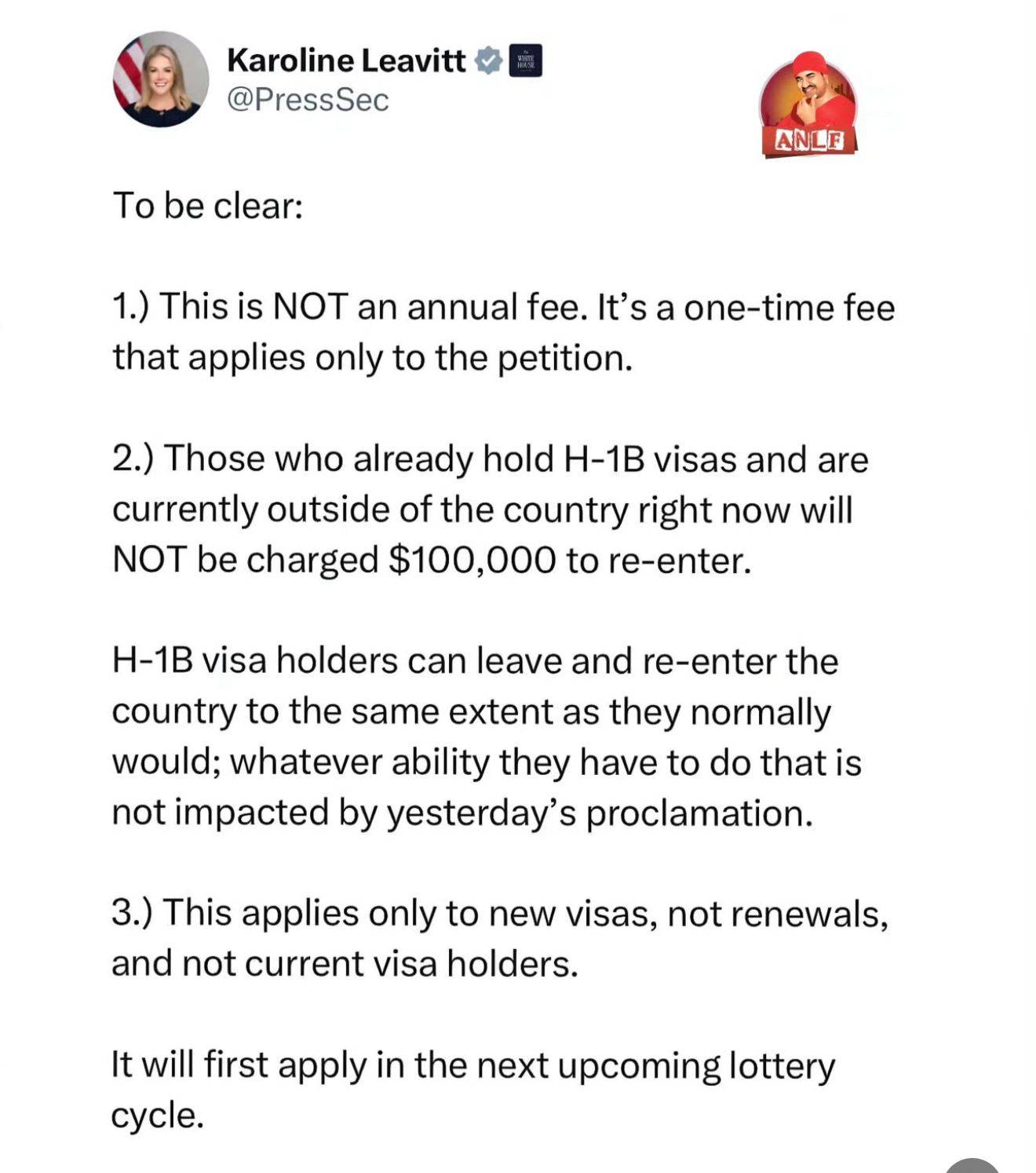
The supplemental charge, which does not apply to renewals, stacks on top of existing H-1B visa fee totals that previously ran roughly $2,800–$3,600 per case, instantly multiplying the price of sponsoring skilled foreign workers.

Policy details and timing
- The proclamation applies only to first-time H-1B petitions submitted on or after September 21, 2025.
- The policy is set for 12 months, through September 21, 2026, unless the White House extends it.
- The administration framed the step as a way to curb abuse in the H-1B program and protect U.S. jobs.
- Employers argue the $100,000 fee far exceeds normal processing costs and will force hiring pauses or cancellations for engineers, analysts, and specialist roles.
Industry impact: logistics, tech, healthcare, startups
Forwarders and logistics firms — industries that depend on technical planners, supply chain analysts, and software specialists — warn the fee will deepen staffing gaps.
Free toolH-1B Cost Calculator Online- Smaller logistics providers and PEOs say they will struggle most; large firms can absorb shocks more easily.
- Example: A mid-size forwarder planning to onboard three H-1B candidates this fall would face an additional $300,000 in upfront costs, on top of regular fees and onboarding expenses.
Critics say the fee will ripple well beyond tech:
- Healthcare systems that rely on H-1B professionals for health IT, cybersecurity, and analytics expect longer vacancies.
- Startups fear reduced cash for R&D, sales, and training as funds get reallocated to cover fees.
- Former diplomat KP Fabian called the measure an “atrocity” and a “self-goal,” saying it will hit Indian IT professionals especially hard and thereby harm the wider U.S. economy.
Legal challenges and procedural concerns
Worker groups and companies have filed lawsuits arguing the president exceeded executive authority by imposing a massive new H-1B visa fee without congressional approval.
| India | China | ROW | |
|---|---|---|---|
| EB-1 | Feb 01, 2023 ▲109d | Jul 01, 2023 | Current |
| EB-2 | Nov 01, 2013 | Oct 01, 2021 ▲30d | Jan 01, 2025 |
| EB-3 | Jan 01, 2014 | Jan 08, 2022 ▲7d | May 15, 2024 ▼109d |
| F-1 | Jan 22, 2020 | Jan 22, 2020 | Jan 22, 2020 |
| F-2A | Sep 22, 2026 ▲31d | Sep 22, 2026 ▲31d | Sep 22, 2026 ▲31d |
- Historically, fee levels in immigration law have involved Congress or formal agency rulemaking with public comment.
- Plaintiffs argue the proclamation short-circuits that process and imposes a barrier that undermines statutory purpose.
- Possible outcomes:
- Courts block or delay implementation — fee is paused or withdrawn.
- Courts uphold the proclamation — employers face a year of higher costs and chilled hiring.
Exemptions, uncertainty, and planning risk
The Department of Homeland Security may grant exemptions when a petition serves the national interest, but officials have not provided a clear test or timeline.
- Immigration counsel warn the lack of criteria makes planning around exemptions risky.
- Employers with critical infrastructure upgrades don’t know whether H-1B roles tied to safety, cybersecurity, or logistics continuity will qualify.
- Many employers expect to hold off on filings rather than gamble on undefined relief.
Broader workforce and economic effects
While the fee targets new petitions only, the consequences are broader:
- Many employers build pipelines around graduates on Optional Practical Training (OPT) and candidates who have cleared the H-1B lottery.
- For those who planned to file after September 21, 2025, the cost swing may force:
- Withdrawal of offers
- Reassignment of projects overseas
- Leaving roles unfilled
Former officials and business groups warn the fee functions less like a charge and more like a deterrent. If the administration’s aim is to reduce H-1B usage, it may succeed — not by fixing abuse but by freezing out legitimate hiring.
- Sectors likely to feel the sharpest pain: small and mid-size employers in logistics, tech services, and advanced manufacturing.
- Potential market effects: diminished competition for talent, increased market power for large incumbents.
Effect on Indian professionals and families
Indian professionals, who receive the largest share of H-1B approvals, face steep personal impacts:
- Families expecting to settle in the U.S. may now encounter delays or cancellations as employers recalculate costs.
- Attorneys report clients considering:
- Deferring travel
- Shifting to Canada
- Staying with employers abroad while monitoring court cases
For many, whether a petition is filed before or after September 21, 2025 has become decisive.
Employer responses and tactical moves
Employers and attorneys emphasize practical steps while litigation unfolds:
- Companies that can file before September 21, 2025 are rushing to complete cases to avoid the new fee.
- Other responses under consideration:
- Shifting project timelines
- Distributing roles across foreign affiliates
- Moving work to nearshore hubs to avoid the $100,000 fee
- Using internal transfer programs or other visa categories where possible
These moves aim to preserve projects and budgets while avoiding the supplemental charge.
Official guidance and program basics
Employers are monitoring official sources for authoritative information, including the USCIS H-1B page: https://www.uscis.gov/working-in-the-united-states/temporary-workers/h-1b-specialty-occupations-dod-cooperative-research-and-development-project-workers-and-fashion-models.
- Attorneys stress the proclamation does not change who qualifies for H-1B or the base eligibility rules.
- It adds a large, time-bound supplemental charge on top of existing fees for first-time filings after the effective date.
Key legal and policy questions ahead
As lawsuits advance, the central questions are:
- Did the executive branch have authority to impose a fee of this size without Congress?
- Can such a charge stand when it effectively blocks access to a long-standing statutory visa?
Until courts answer, employers must make hard choices: trim hiring, shift work offshore, or wait to see whether the policy is paused or the September 21, 2026 sunset arrives unchanged.
“If the proclamation’s aim is to reduce H-1B usage, it will likely succeed — not by fixing abuse, but by freezing out legitimate hiring.”
Operational consequences for logistics and supply chains
Logistics business leaders warn of direct operational impacts if planned specialist hires do not arrive on schedule:
- A lean compliance team can’t easily reassign tariff specialists or systems analysts when cross-border rules change daily.
- Expected consequences:
- Longer transit times
- Missed handoffs
- Higher costs passed to customers
In an already tight-margin sector, stakeholders say the timing and size of the $100,000 fee could not be worse.
This Article in a Nutshell
The White House announced a $100,000 supplemental fee on first-time H-1B petitions filed on or after September 21, 2025, effective for 12 months unless extended. The charge adds to existing H-1B fees (about $2,800–$3,600) and excludes renewals. Employers across logistics, technology, healthcare, and startups warn the fee will cause hiring freezes, project delays, and offshore shifts, especially hurting small and mid-size firms. Legal challenges argue the executive exceeded authority by imposing such a fee without congressional approval. DHS may offer national-interest exemptions, but undefined criteria create planning risk. Courts could block, delay, or uphold the policy, shaping near-term hiring decisions.