- TSA tests remote and self-screening technology to reduce airport congestion and improve checkpoint efficiency.
- A 2024 pilot in Las Vegas introduced self-checkout style security where passengers manage their own screening.
- New workflows utilize automated bag diversion and remote agents to maintain security standards without bottlenecks.
(LAS VEGAS) – The Transportation Security Administration has been testing remote and self-screening technology aimed at easing airport congestion, including a temporary PreCheck fast-lane concept that shifts part of the screening process away from a standard checkpoint interaction.
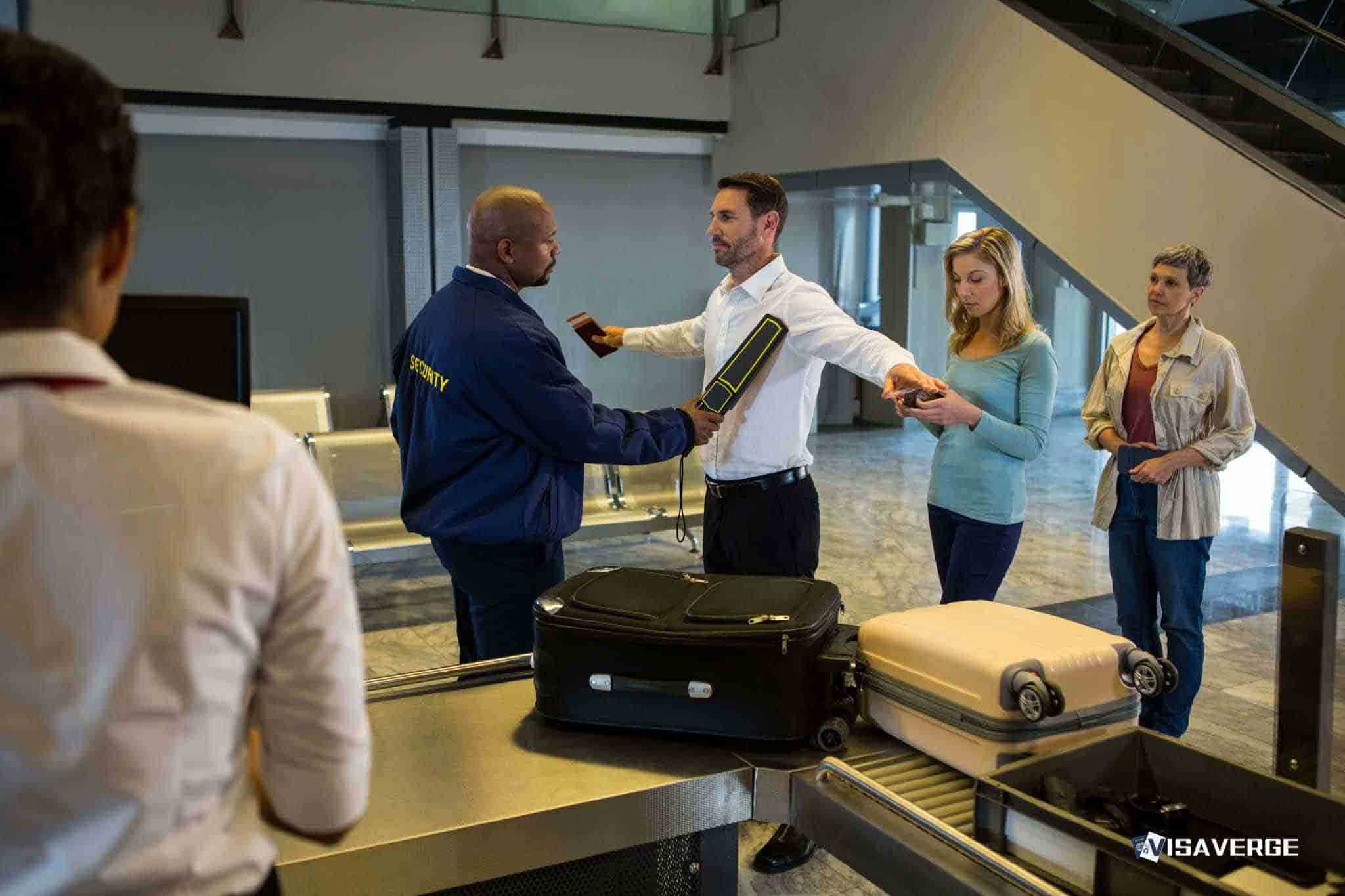
The agency’s experiments include a system that routes passengers through on-screen instructions, uses a remote agent, and automatically diverts bags for rescreening or hand inspection. The concept targets bottlenecks that build as travelers and carry-on items move through the same physical space at the same time.
Free toolB1/B2 Tourist Visa Stay Calculator online
One of the most visible tests took place on March 6, 2024, when a temporary fast lane for PreCheck passengers used a remote agent and a secure scanner workflow intended to speed screening. That test offered a practical look at how TSA could separate some officer functions from the checkpoint itself while keeping bags and passengers inside a controlled process.
A separate self-screening pilot was publicly unveiled in Las Vegas in 2024. The concept moved travelers through security in a way that resembled self-checkout, with passengers taking a more active role in the process instead of relying on a TSA officer at each step.
Together, the two efforts showed the same broad direction. TSA was testing whether technology, remote oversight and automated bag handling could move people through checkpoints faster without eliminating security controls.
The off-site and self-service ideas also pointed to a change in how screening could be organized. In the fast-lane test, passengers followed instructions on a screen while a remote agent monitored the process, and the system sent bags aside when they needed another look or a hand inspection.
That bag diversion detail matters inside the mechanics of screening. It suggests TSA was not testing speed alone, but also whether automation could sort routine items from those that still required human review.
The Las Vegas pilot pushed the concept further by making the traveler a more direct participant. Instead of the familiar model in which an officer stands beside each stage, the pilot presented security as something closer to a guided, self-directed transaction.
Both efforts fit the same problem statement: airport checkpoints can become chokepoints when passenger volume rises. TSA’s tests, as described, sought to cut that pressure by redesigning the checkpoint workflow rather than simply adding more of the same lanes.
The March 6, 2024 test centered on a temporary lane for travelers already enrolled in PreCheck, a group that typically moves through screening under a separate, expedited process. Using that population for a fast-lane test would allow TSA to examine the technology in a lower-friction environment before considering any broader use.
Remote agent support formed a core part of that design. Rather than placing every screening interaction face to face at the lane, the test used a secure scanner workflow and an officer positioned remotely, a setup that could let airports redistribute staff if the model proved workable.
Las Vegas became the public stage for the agency’s 2024 self-screening pilot. The airport setting gave travelers, airport operators and the broader security industry a chance to see how far TSA was willing to push an idea that had long been discussed more as a concept than as a visible checkpoint experiment.
The phrase self-checkout captured the practical shift. Passengers, under that concept, would move themselves through more of the process, while TSA and its systems would continue to control the screening environment in the background.
No operational rollout was announced in the material describing the tests. What emerges instead is a timeline of pilots and demonstrations: the temporary PreCheck fast-lane test on March 6, 2024, and the public unveiling of the Las Vegas self-screening pilot in 2024.
That leaves 2026 as a natural point for a status check on whether any airport has moved from pilot programs to regular deployment. The open questions are concrete ones: which airports, on what dates, and which TSA officials backed the decision to move beyond a limited test.
Those details would determine whether the agency’s work remains experimental or has entered daily operations. They would also show whether TSA sees off-site screening and self-screening as niche tools for selected lanes or as a broader redesign of how checkpoint security works.
The basic metrics are already visible from the tests that have been described. They include the dates of the pilots, the specific screening methods used, the airports involved, and the role of TSA officials and agencies in approving or overseeing each step.
Method matters as much as location. A test built around a remote agent and secure scanner workflow measures something different from a pilot built around passenger-led self-screening, even if both aim at the same outcome of reducing crowding.
Bag handling also sits at the center of the concept. The automated diversion of carry-ons for rescreening or hand inspection shows where TSA continues to rely on direct intervention, even as it experiments with reducing the number of routine interactions that happen in front of the traveler.
What TSA has shown so far is a set of controlled experiments rather than a finished model. The fast lane for PreCheck passengers and the Las Vegas self-screening pilot offered early evidence of how checkpoint screening might be broken into separate tasks, with some handled by passengers, some by remote officers, and some by automation built to catch what still needs a closer look.