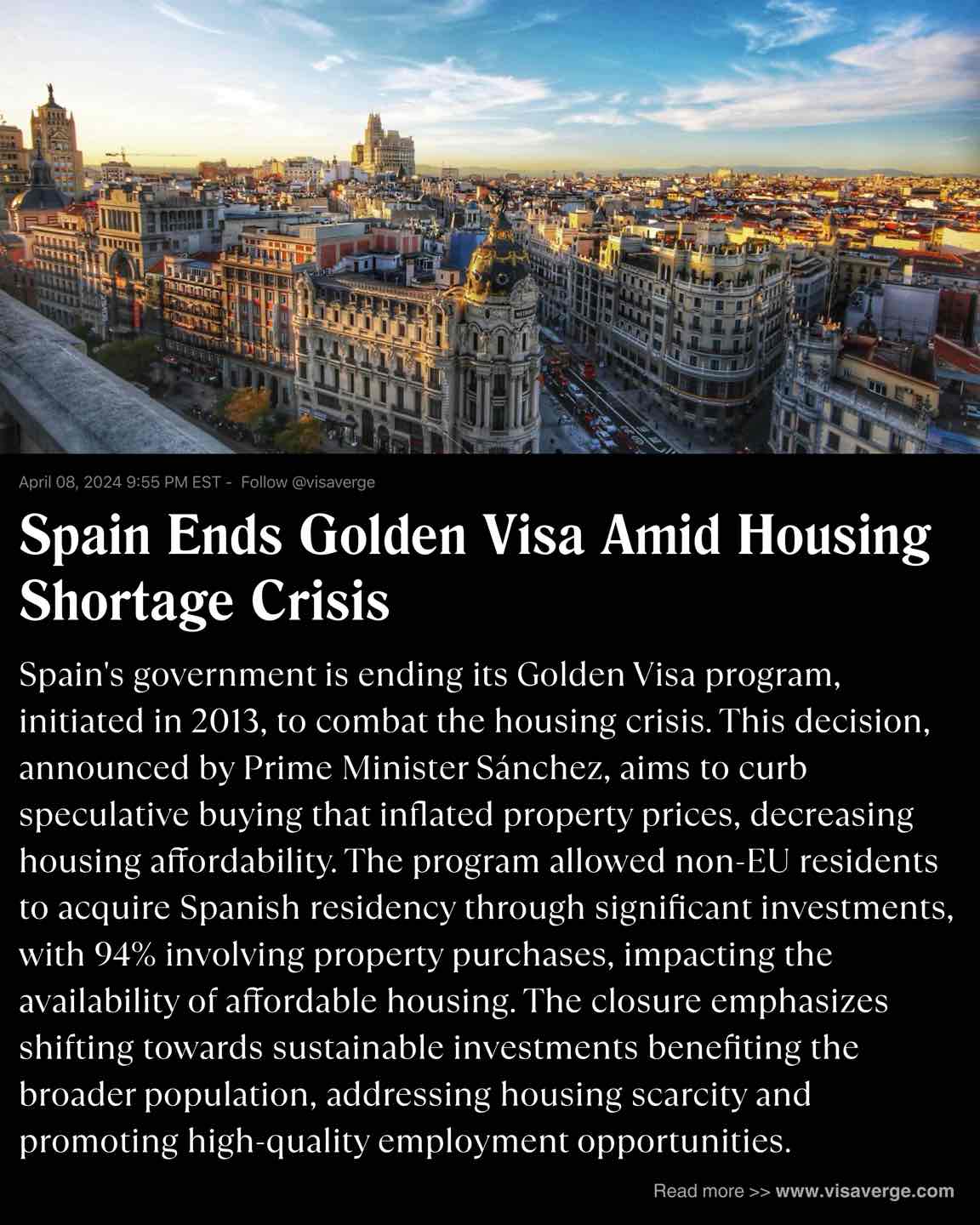
In an effort to tackle the pressing issue of the Spain housing shortage, the country’s left-wing central government has announced a decisive step: putting an end to the Golden Visa programme for property investors from non-EU countries. This move, unveiled by Prime Minister Pedro Sánchez in Seville, aims to address the escalating problem of speculative buying that has exacerbated the housing crisis.
What is the Golden Visa Programme?

Since 2013, the Golden Visa programme has offered a pathway for citizens outside the European Union to acquire residency in Spain through significant financial investment. Specifically, it required a minimum property purchase worth at least €500,000 ($543,000). Additionally, potential investors could qualify by investing at least €1 million in companies or purchasing €2 million in government bonds.
Why End the Golden Visa Programme?
The primary motivation behind this significant policy shift, as outlined by Prime Minister Sánchez, is to curb speculation on the property market. “We will take the necessary measures to ensure that housing is a right and not a speculative business,” Sánchez stated, emphasizing the government’s commitment to transforming the housing market into a more accessible and equitable space for all residents. This initiative reflects a broader understanding that the programme has largely served to inflate property prices and restrict access to affordable housing, particularly for local residents.
The Impact of Property Investment on Housing Access
A startling statistic shared by Prime Minister Sánchez highlights that 94% of all Golden Visas issued in Spain have been linked to property investments. This trend underscores how the programme has inadvertently contributed to making housing less attainable for everyday Spaniards, especially in major urban areas and tourist hotspots. In cities like Madrid, Barcelona, Málaga, and Valencia, and regions such as the Balearic Islands (including Mallorca), the influx of wealthy foreign buyers has placed immense pressure on the local housing markets.
The Future of Investment in Spain
With the phasing out of the Golden Visa programme, Spain signals a strategic pivot toward attracting “productive investment that creates innovation and high-quality employment,” as per Sánchez’s vision. This recalibration aims to foster a more sustainable and inclusive economic model that benefits the broader Spanish population, rather than catering predominantly to affluent international investors.
The Housing Crisis in Major Spanish Cities
The Spain housing shortage has reached critical levels in several urban and coastal areas, making it extremely challenging for locals who “live, work, and pay taxes there to find decent accommodation,” according to Sánchez. The government’s decisive action to end the Golden Visa scheme is a direct response to these challenges, seeking to alleviate the scarcity and unaffordability of housing that plagues many communities across the country.
The International Context of Golden Visa Programmes
Spain’s decision to close its Golden Visa programme does not occur in isolation. Similar initiatives have been introduced across the European Union, particularly during the euro crisis, as countries sought to attract foreign investment. However, the controversy surrounding investor visas – largely due to their impact on property prices and local housing markets – has spurred debate about their appropriateness and long-term sustainability.
What’s Next for Potential Investors?
For individuals from non-EU countries who have been considering the Golden Visa programme as a route to Spanish residency, this development signifies a major shift. The exact timeline for the programme’s discontinuation remains unclear, as the government finalizes the necessary legal amendments. However, the closure of this pathway emphasizes the need for potential investors to explore alternative routes for investment and residency in Spain.
The Role of Legal and Policy Adjustments
In his announcement, Prime Minister Sánchez indicated that the Council of Ministers would be finalizing the amendment to the law to officially end the Golden Visa programme. This legislative change marks a critical step in reforming Spain’s approach to housing and investment, ensuring that future policies align more closely with the needs of the Spanish populace and the economy at large.
The Broader Implications for Spain
By ending the Golden Visa programme, Spain takes a bold step towards addressing the complex issue of housing affordability and access. This policy shift reflects a broader commitment to reimagining the country’s economic priorities, focusing on sustainable growth and the well-being of its residents. Moreover, it serves as a reminder of the intricate relationship between immigration, investment, and housing policy – a balance that governments must carefully navigate to foster healthy, equitable communities.
For those seeking more detailed information on Spain’s residency options and investment opportunities following these changes, refer to the official Spanish government immigration portal. This resource provides authoritative and up-to-date information on a range of related topics, helping readers navigate the evolving landscape of Spanish residency and citizenship.
This Article In A Nutshell:
In response to Spain’s housing shortage, the government ends the Golden Visa for non-EU investors to curb speculation and prioritize affordable housing. This policy shift aims to create a fair housing market for locals. Those eyeing residency must explore new investment avenues. The change reflects a national strategy for sustainable growth.
— By VisaVerge.com
Read More:
- Spain Travel Update: New EU Entry-Exit System and Visa Regulations for Brits
-
Navigating Post-Brexit Life: A Guide for UK Retirees Living in Spain
-
Understanding the Rules for Working on a Student Visa in Spain
-
Spain Golden Visa: How to Apply, Eligibility, and Required Documents