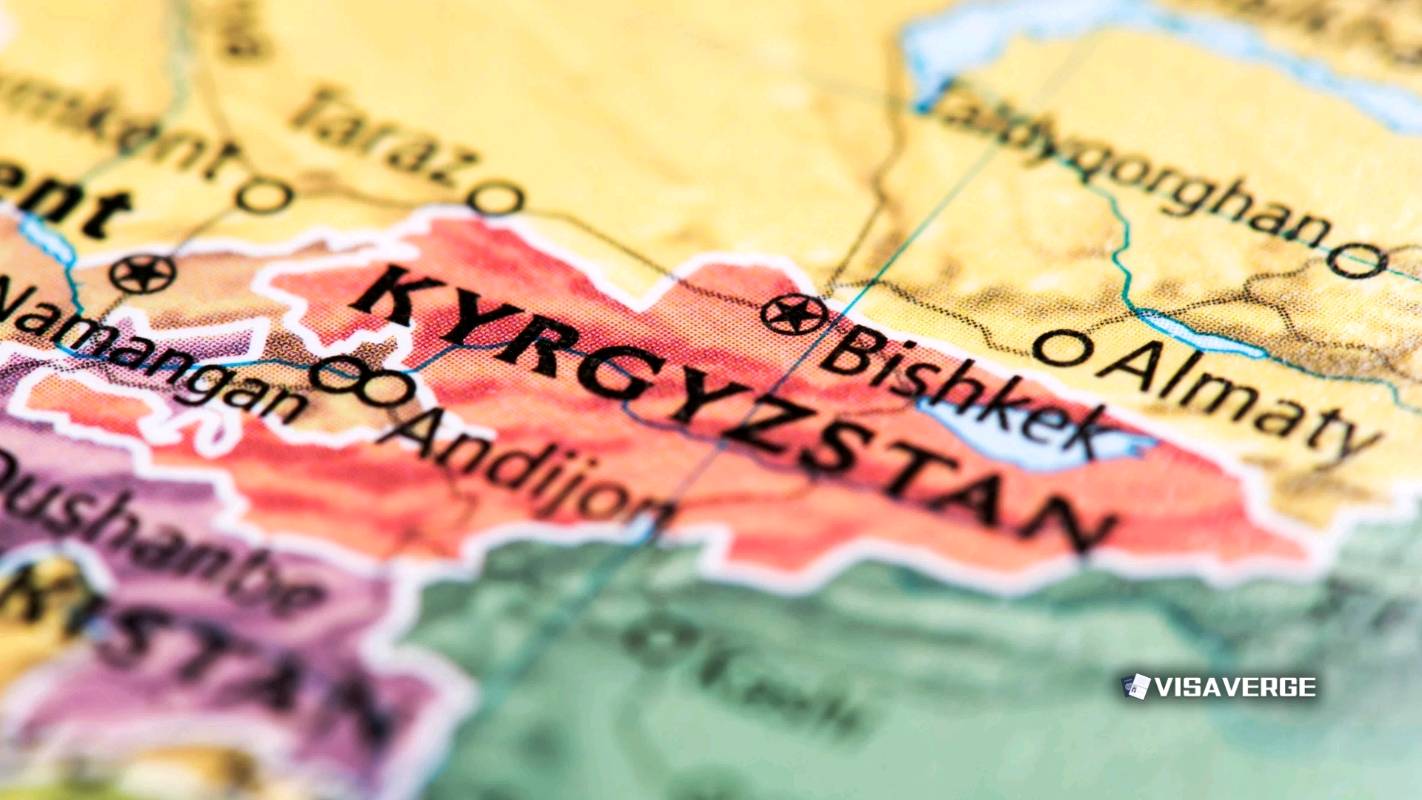
(KYRGYZSTAN) — Kyrgyzstan’s Deputy Chairman of the Cabinet of Ministers Edil Baisalov warned on Thursday that his government could revisit visa-free entry for U.S. citizens after Washington expanded a policy requiring Kyrgyz visitors to post refundable security deposits of up to $15,000 for short-term visas.
“I believe that we should initiate a review of our visa-free regime for U.S. citizens following the new visa requirements. under which kyrgyz citizens are required to pay a visa deposit of up to $15,000. Visa policy is a matter of parity and mutual respect. If such high barriers are introduced for our citizens, we cannot pretend that nothing has happened,” Baisalov said in a formal response dated January 8, 2026.

What the U.S. announced
The U.S. state department announced the expansion of the visa bond pilot program on January 6, 2026, and it is scheduled to take full effect for kyrgyzstan on January 21, 2026.
Free toolUSCIS Receipt Number Decoder
- The program requires that any citizen or national traveling on a passport issued by [Kyrgyzstan], who is found otherwise eligible for a B-1/B-2 visa, must post a bond for $5,000, $10,000, or $15,000.
The amount is determined at the time of the visa interview, according to the State Department update. -
The requirement applies only to B-1 (business) and B-2 (tourism) non-immigrant visas. Student, work, and exchange visas are exempt for now.
-
The expansion covers 38 countries, including Kyrgyzstan and regional neighbors such as Tajikistan (effective Jan 21, 2026) and Turkmenistan (effective Jan 1, 2026).
How the bond works
- Applicants covered by the program must submit DHS Form I-352 (Immigration Bond).
- Consular officers set the bond at $5,000, $10,000, or $15,000 based on travel purpose, income, and ties to the home country.
- The bond is refundable only if:
- The traveler departs the United States on or before the expiration of their authorized stay; and
- The traveler enters and exits exclusively through one of three designated ports of entry: Boston Logan (BOS), New York (JFK), or Washington Dulles (IAD).
These refund conditions add both a financial and logistical constraint for visitors from Central Asia, where itineraries commonly involve long transit routes and multiple connections.
Practical and economic concerns for Kyrgyz travelers
- With GNI per capita in Kyrgyzstan approximately $2,700, a top bond of $15,000 represents a significant barrier to travel for ordinary citizens, small business owners, and those visiting family.
- The combination of high bond amounts and restricted refund routes can:
- Increase costs,
- Lengthen transit times, and
- Limit feasible itineraries for many travelers from Kyrgyzstan and neighboring countries.
“Visa policy is a matter of parity and mutual respect. If such high barriers are introduced for our citizens, we cannot pretend that nothing has happened.” — Edil Baisalov, January 8, 2026
U.S. rationale and framing
- U.S. officials describe the program as an enforcement tool rather than a blanket denial policy.
- DHS officials said the primary goal is to “reinforce the administration’s commitment to U.S. immigration law while deterring visa overstays” by using financial guarantees rather than outright refusals.
- The U.S. rationale cites the DHS Entry/Exit Overstay Report and targets nations with high visa overstay rates or those offering “Citizenship-by-Investment” schemes.
Sources and where to find official information
- The State Department directed travelers to information published on its Travel.gov website, including a list of affected countries at Countries Subject to Visa Bonds.
- DHS published a summary of the expansion at Visa Bond Pilot Program Expansion Details.
- The bond payment portal is hosted at Official Bond Payment Portal.
The $5k/$10k/$15k bond can be non-trivial to recover and restricts travel routing. Expect longer trips with limited airport options and ensure you meet refund conditions before relying on a visa bond.
Diplomatic and policy implications
- Kyrgyz officials framed the measure as a sharp new hurdle for ordinary travel and highlighted a mismatch between the two countries’ entry rules.
- U.S. citizens currently enjoy 30-day visa-free entry to Kyrgyzstan. Baisalov connected the new U.S. requirement to possible reciprocal steps, raising the prospect of reviewing Kyrgyzstan’s visa-free regime for U.S. citizens.
- The deputy chairman’s warning stopped short of announcing a specific change but directly linked the U.S. bond requirement to potential reciprocal measures.
Operational details and traveler impact
- Even applicants who qualify for a B-1/B-2 visa and are issued one under the program still must post the bond set at the interview.
- Refund eligibility is constrained by:
- Timely departure (on or before the authorized stay), and
- Use of the three designated East Coast airports for both entry and exit.
- These constraints may disproportionately affect travelers from Central Asia by forcing specific routing through distant airports, which can add both cost and complexity.
Broader context
- The visa bond expansion comes amid other U.S. immigration policy moves cited in the U.S. policy summary, including the pause of the Diversity Visa (DV-2026) program announced by DHS Secretary Kristi Noem in early 2026.
- The expansion has complicated diplomatic discussions aimed at easing travel barriers, including a September 2025 meeting between Kyrgyz Foreign Minister Zheenbek Kulubaev and U.S. Deputy Secretary of State Christopher Landau.
Quick reference table
| Item | Details |
|---|---|
| Effective date for Kyrgyzstan | January 21, 2026 |
| Visa classes affected | B-1 (business), B-2 (tourism) |
| Bond amounts | $5,000, $10,000, $15,000 |
| Refund conditions | Depart on/before authorized stay; enter/exit via BOS, JFK, IAD only |
| Forms required | DHS Form I-352 (Immigration Bond) |
| Official info links | Countries Subject to Visa Bonds, Visa Bond Pilot Program Expansion Details, Official Bond Payment Portal |
Final note on reciprocity and next steps for Kyrgyzstan
Kyrgyz officials emphasize parity and mutual respect in visa policymaking. Edil Baisalov’s January 8 statement explicitly links the U.S. bond requirement to the possibility of a reciprocal review of Kyrgyzstan’s 30-day visa-free entry for U.S. citizens, signaling that Bishkek may consider policy responses if the measure remains in place.
Kyrgyzstan is threatening to revoke visa-free entry for U.S. citizens in response to a new U.S. policy requiring Kyrgyz travelers to pay bonds of up to $15,000. The U.S. expansion of the Visa Bond Pilot Program aims to reduce visa overstays. Kyrgyz officials contend the high costs and strict travel route requirements through specific East Coast airports create unfair barriers for their citizens.