January 3, 2026
- Updated entry-into-force date to January 8, 2026 (replacing proposed Spring 2025)
- Clarified effective requirement: 6 years continuous residence as the new standard path
- Added concrete operational deadlines: unfinished online applications deleted if not submitted by 11:59 p.m. January 7, 2026
- Specified language test requirement: National Certificate of Language Proficiency as accepted proof
- Detailed benefit-use cap: unemployment/social assistance limited to three months during qualifying period
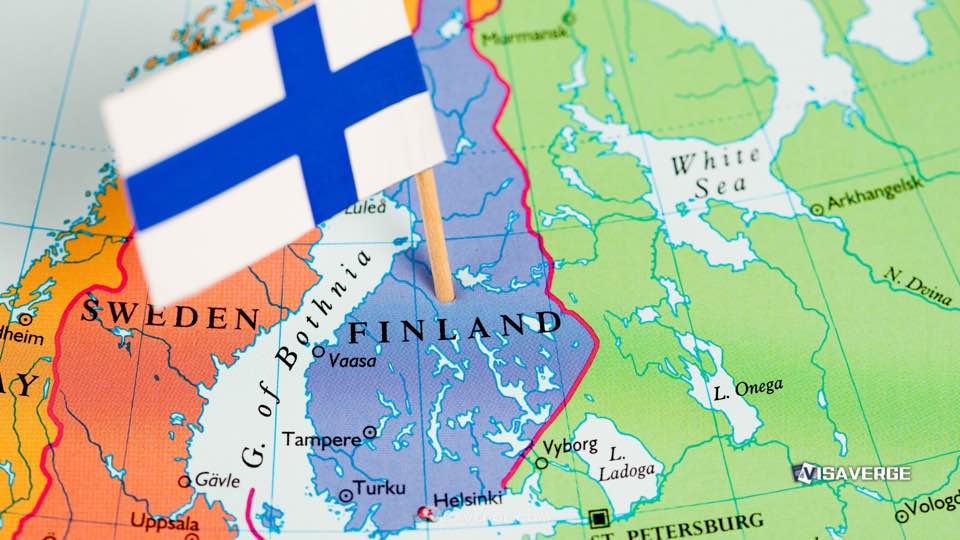
(FINLAND) — Finland enacted amendments to the Aliens Act that tighten the route to permanent residence, raising the standard continuous residency requirement to 6 years and adding language and work-history conditions from January 8, 2026.

The changes set new national rules for third-country nationals seeking an open-ended right to live and work in Finland, while keeping some faster pathways for higher earners, graduates and others who meet stricter integration measures.
Political framing and legislative process
Interior Minister Mari Rantanen linked the overhaul to the government’s broader migration agenda, describing the new approach as promoting
“responsible, rules-based migration”
that prioritises labour-market participation.
Parliament approved the amendments after public consultations that concluded in early 2025. The law’s entry into force on January 8, 2026 marked a shift from a previously proposed spring 2025 timeline.
Core changes to permanent residence eligibility
- The main continuous residence requirement moved from 4 years → 6 years for the standard path.
- A new language condition requires applicants to demonstrate sufficient knowledge of Finnish or Swedish.
- Most applicants must show a two-year work history in Finland immediately before applying.
- Language proficiency must be demonstrated through the National Certificate of Language Proficiency test or an equivalent route.
- The standard path requires a “satisfactory” level.
- Some fast-track routes require “particularly good” Finnish or Swedish.
Integrity and criminal-conviction rules
- An unconditional prison sentence, whether served in Finland or abroad, interrupts continuous residence and resets the residency clock after the sentence is fully completed.
- These integrity rules apply to both permanent permits and P‑EU permits.
Benefit-use limits during qualifying period
- Reliance on unemployment benefits or social assistance is capped at three months total during the qualifying period.
- Exceptions exist for health reasons and for retirees with prior qualifying work.
Retained and revised eligibility features
Applicants must still meet existing criteria referenced in the material, including:
- Having valid grounds for a continuous A‑permit such as work or family ties.
- Holding a national passport (waived for international protection recipients).
Fast-track / accelerated routes
Finland preserved accelerated routes for those who can show quicker integration. The summary provides these notable fast-track options:
| Accelerated route | Continuous residence threshold | Additional key requirement |
|---|---|---|
| High Earner | 4 years | Annual income €40,000 |
| Advanced education | 4 years | Recognised Master’s or postgraduate degree in Finland + 2 years work history |
| Strong language + work | 4 years | “Particularly good” Finnish or Swedish + 3 years work history |
- Some applicants can qualify after 4 years instead of 6 if they meet additional criteria.
- A separate fast track allows eligibility after 4 years for applicants with particularly good language skills and 3 years of work.
Special rules for graduates and family members
- Finnish university graduates can in many cases bypass residency entirely, except:
- A Bachelor’s from universities of applied sciences still requires the full period.
- Family-related provisions for minors:
- Children under 18 can obtain permits without residency periods if a parent/guardian holds a permanent permit, a P‑EU permit, or Finnish citizenship.
- Specific P‑EU permit rules for children:
- Requires 5 years of A‑permit residence and proof of financial resources.
- Exempts language and work rules for child applicants in certain cases.
- For standalone children, the material describes a requirement of 4 years continuous A‑permit residence.
P‑EU permits for adults
- The P‑EU permit for adults was brought closer to national rules, with mandatory Finnish or Swedish proficiency listed as a requirement.
Administrative and operational changes — Migri (Finnish Immigration Service)
- Migri warned that the application process in its online service will change on January 8, 2026, at 12:00 a.m. Finnish time.
- The online service for permanent and P‑EU permits will be unavailable during the renewal.
- Unfinished applications will be deleted unless submitted by 11:59 p.m. January 7, 2026.
- Paper forms will be updated at the same time.
- Transitional rules:
- Applications submitted before January 8, 2026 will be processed under the old rules, even if an identity appointment happens after the deadline.
- Applicants can file up to three months early without waiting for their current permits to expire.
Important operational deadline: unfinished drafts are wiped from the system if not submitted by 11:59 p.m. January 7, 2026.
Fees
- Electronic permanent permit applications are now listed at €380 (tied to 2026).
- The summary described increases of €50–250 across categories, without detailing prior fees for each category.
Wider policy context
- The changes were presented as focusing on integration through:
- Longer residence, language proficiency, stable employment, and stricter integrity checks.
- The amendments were framed as aligning with the Government Programme and broader migration policy.
- Citizenship residency was extended to 8 years effective October 1, 2024.
- The material said potential tests and reciprocity principles were under review, without a timetable or outcome.
Other reform elements and trends
- The summary pointed to tighter rules in other areas, including:
- Family reunification, detention, and entry bans.
- Stricter refugee rules and a new visa partner announced in 2024.
- It placed Finland’s changes within a Nordic trend, saying the approach now echoes Sweden and Denmark’s emphasis on integration while noting different directions elsewhere in Europe (no comparative figures given).
Statistics, impacts and critiques reported in the material
- A statistic attributed to Migri: “85% of long-term residents with work history report higher life satisfaction.”
- Warnings from critics about barriers for low-wage workers, spouses, or manual labourers who may struggle to balance shift work and classes.
- On asylum and backlogs, the material said that in 2025 there were “600+ Russian asylum cases pending.”
- The summary said permanent permits issued “dropped 15% year-over-year pre-reform,” without giving base numbers or specific comparison years.
Practical effect for applicants
- For those applying after January 8, 2026, the new standard track requires:
- 6 years continuous residence,
- language proficiency (Finnish/Swedish),
- 2 years recent work history,
- limits on benefit dependence and integrity checks.
- Fast-track options remain for applicants who meet higher income, education, language, or work-history thresholds.
- For applicants close to eligibility under the earlier rules, the online form deadlines create a hard cutoff — unfinished drafts will be erased if not submitted by 11:59 p.m. January 7, 2026, and applications filed before January 8, 2026 will use the old (4-year) standard.
Takeaway
By extending the baseline residence period to 6 years and adding language and recent-employment requirements, Finland shifted the permanent residence test from a primary focus on time spent in-country toward a combined standard of residency plus measurable integration. The framework retains accelerated routes that reward higher earnings, stronger credentials, or superior language skills, while also tightening integrity controls and administrative processes.
Finland’s new migration policy shifts the focus toward measurable integration. By January 2026, permanent residency will require six years of residence, language skills, and recent employment. These changes align Finland with stricter Nordic migration trends seen in Sweden and Denmark. Despite the longer standard wait, the law preserves four-year ‘fast-track’ routes for individuals with high incomes, master’s degrees, or exceptional language skills.