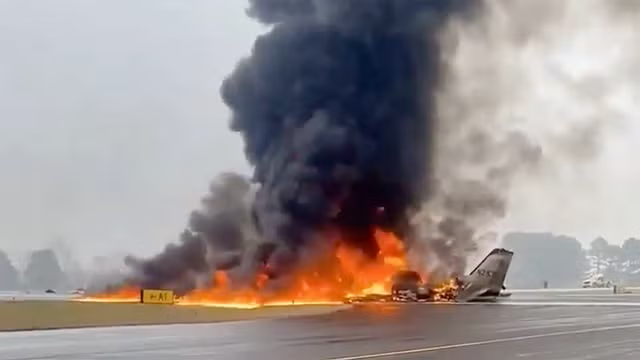
(KALISPELL, MONTANA) A Socata TBM 700 turboprop suffered engine trouble before crashing at Kalispell City Airport on Monday, August 11, 2025, at about 2:08 p.m., federal officials said. Four people were on board; all survived, and two were treated for minor injuries at the scene. The airplane hit several parked planes during landing, and the impacts set off multiple fires that emergency crews contained within an hour. No bystanders were hurt, according to local authorities.
Incident overview

Early reports and official statements indicate the following key facts:
- Date/Time: August 11, 2025, at about 2:08 p.m.
- Aircraft: Socata TBM 700, single‑engine turboprop, built in 2011
- Owner/Origin: Registered to Meter Sky LLC of Pullman, Washington; flight departed Pullman
- Occupants: 4 on board; 2 treated for minor injuries; all survived
- Preliminary cause: Engine trouble on final approach followed by a loss of control and runway impact
- Airport operations: Resumed later the same day after the scene was secured
- Public evidence request: The NTSB requested photos/video at [email protected]
The airplane reportedly approached Kalispell from the southwest and made a sharp turn above downtown before the attempted landing. The aircraft struck parked planes, setting multiple fires that were controlled by responding fire crews within about an hour.
Emergency response and local officials
City officials confirmed there were no fatalities and only minor injuries among the occupants. Key local officials involved:
- Kalispell Police Chief Jordan Venezio
- Kalispell Fire Chief Jay Hagen
Fire crews from Kalispell and neighboring departments contained the fires quickly, preventing spread beyond a grassy area near the runway and limiting further airport damage. Families and bystanders were kept back as crews extinguished burning fuel and secured the scene.
Investigation: FAA and NTSB actions
The Federal Aviation Administration (FAA) and the National Transportation Safety Board (NTSB) opened a formal investigation and are collecting flight data, photos, witness statements, and physical evidence. Preliminary information points to engine trouble on final approach.
Investigators will examine a range of factors, including:
- Pilot actions and decision‑making
- Aircraft systems and engine components
- Recent maintenance history and component records
- Weather and airport conditions at the time
- Flight tracking data and any onboard recorders
The NTSB asked the public to send images or video to [email protected]. The agency typically posts a preliminary report within 30 days, with a final report — including probable cause and safety recommendations — expected in one to two years.
For federal updates, the FAA directs the public to its newsroom: https://www.faa.gov/newsroom. As of August 13, agencies had not released the pilot’s name or the identities of the other occupants.
Preliminary findings point to engine trouble on final approach. Officials will not assign a cause until they gather and verify all evidence.
Standard investigative steps (as described by FAA/NTSB)
- Secure the wreckage and map debris
- Interview the pilot, passengers, ground staff, and witnesses
- Review flight tracking data and any onboard recorders
- Examine maintenance logs and component histories
- Assess pilot training and recent flight experience
- Test engine and airframe parts as needed
Expert commentary and context
Aviation experts following the case urged patience while the investigation proceeds.
- Robert Katz, a commercial pilot and flight instructor who reviewed available flight data, suggested the crash appeared preventable and may involve pilot error, although he emphasized only the NTSB can determine cause.
- Jeff Guzzetti, an aviation safety consultant, noted that collisions with parked aircraft occur a few times each year in general aviation and often involve loss of control during landing.
Those comments align with patterns in public accident data where loss of control following power issues can rapidly lead to collisions or overruns, especially during late turns or unstable approaches near the ground.
Damage, operational impact, and community response
The crash caused major damage to several parked airplanes and minor damage to airport infrastructure. Quick action by firefighters, police, and airport staff limited losses and injuries.
- Mutual aid from neighboring departments helped contain the fires within an hour.
- Kalispell City Airport, a city‑owned field serving general aviation in northwest Montana (separate from Glacier Park International Airport), was secured and resumed operations by late afternoon.
- Insurers and city staff will assess and coordinate repairs to damaged parked aircraft and airport property.
Residents and pilots praised the rapid response led by Fire Chief Jay Hagen and Police Chief Jordan Venezio, noting that mutual aid agreements and coordinated emergency plans can be decisive at small municipal airports.
Safety implications and next steps
This event highlights ongoing safety concerns for general aviation during approach and landing — times of high workload and limited options. Key focal points for safety and potential future recommendations include:
- Engine health monitoring and maintenance practices
- Recurrent training on stabilized approaches and go‑around decisions
- Emergency procedures and checklists for single‑engine turboprops
- Runway and ramp layout considerations to reduce risk to parked aircraft
Officials will await the NTSB’s full analysis before implementing policy changes. The final report may address mechanical condition, pilot experience, fuel state, control inputs, and airport environment.
Anyone who witnessed the approach, crash, or has security footage facing the runway or ramp should send that material to [email protected] to assist the investigation.
Quick facts (summary table)
| Item | Detail |
|---|---|
| Date/Time | August 11, 2025, at about 2:08 p.m. |
| Aircraft | Socata TBM 700, single‑engine turboprop (built 2011) |
| Registered to | Meter Sky LLC, Pullman, Washington |
| Occupants | 4 (all survived; 2 treated for minor injuries) |
| Preliminary cause | Engine trouble on final approach |
| Investigating agencies | FAA and NTSB |
| Evidence request | [email protected] |
| FAA updates | https://www.faa.gov/newsroom |
| Report timeline (typical) | Preliminary: within 30 days; Final: 1–2 years |
Kalispell City Airport remains open as repairs and insurance assessments proceed. The federal investigation is ongoing, and officials urge patience while they gather and verify facts before naming a cause.
This Article in a Nutshell
Engine trouble on August 11, 2025 forced a Socata TBM 700 into a Kalispell runway crash. Four occupants survived, two treated for minor injuries. The airplane hit parked planes, ignited multiple fires extinguished within an hour. FAA and NTSB opened an investigation; public asked to send photos to [email protected].