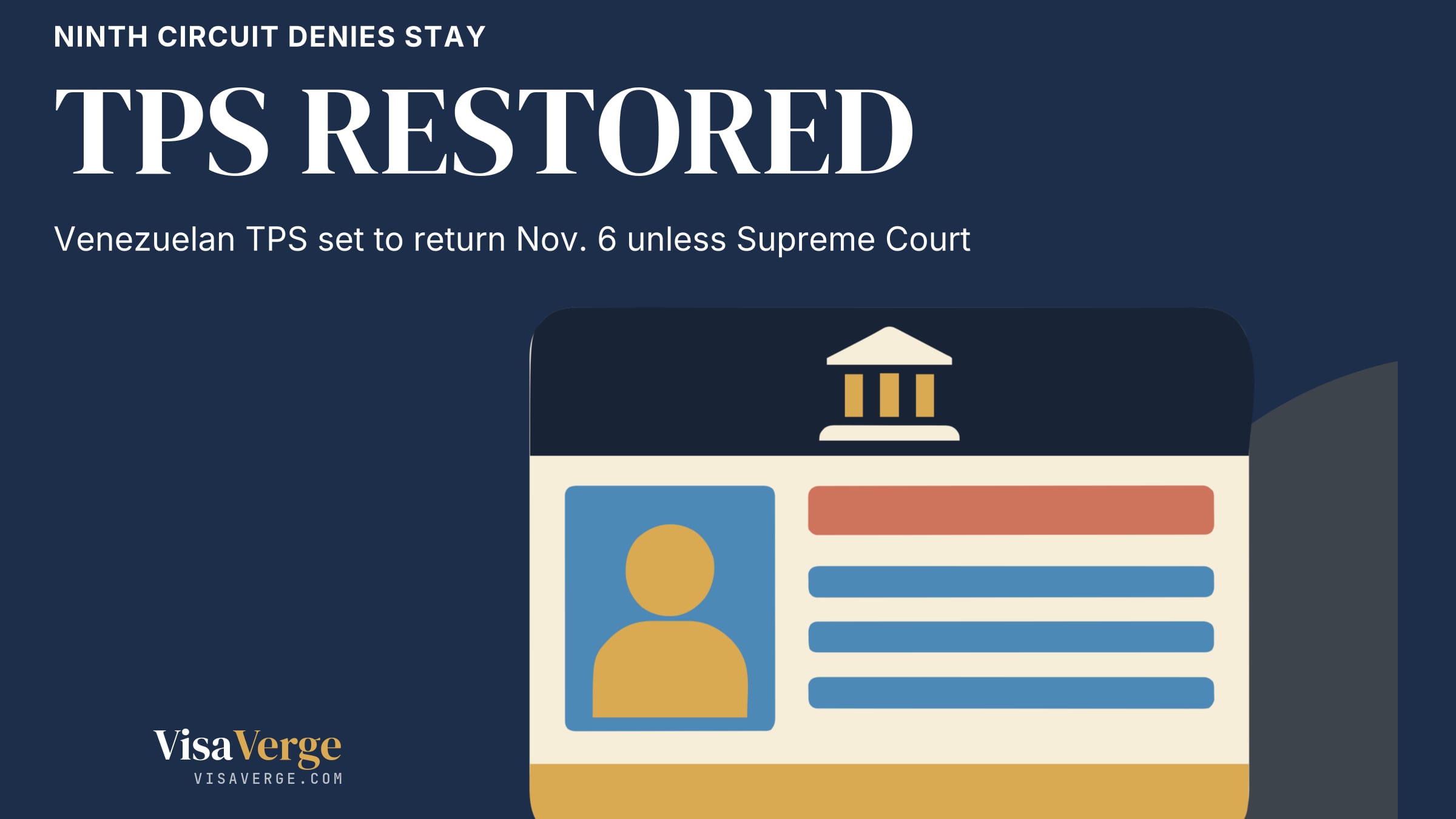
The U.S. Court of Appeals for the Ninth Circuit denied the government’s request on October 29, 2026, to keep a district court order on hold. The order is set to restore Temporary Protected Status protections for Venezuelans on November 6, unless the Supreme Court intervenes.
Background: 9th Circuit Maintains Venezuelan TPS as Litigation Continues
The case, National TPS Alliance v. Mullin, concerns the federal government’s decision to end Venezuela’s 2023 TPS designation and cancel an extension. Hundreds of thousands of Venezuelans could regain protections under the district court order.
The litigation continues. The stay denial does not resolve the government’s challenge to the underlying ruling.
The date follows the expiration of an earlier high-court stay. That order had blocked parts of the district court judgment concerning Venezuela.
The ruling addresses the 2023 designation, while other TPS records followed separate rules
U.S. District Judge Chen issued the order at issue on September 5, 2025. He set aside the Department of Homeland Security’s action and allowed the 2023 designation to continue, finding former DHS Secretary Kristi Noem exceeded her authority by vacating an extension and terminating the designation.
The order concerns the 2023 designation, not every Venezuelan TPS record. A separate 2021 designation ended at 11:59 p.m. on November 7, 2025. Beneficiaries without an Employment Authorization Document or Form I-94 showing an October 2, 2026, expiration date lost TPS and work authorization under that designation.
Some older employment cards had narrower extensions. EADs in categories A12 or C19, with card expiration dates of September 10, 2025; March 10, 2024; or September 9, 2022, were extended only through November 7, 2025.
A May 30, 2025, district court order separately protected certain documents connected to the 2023 designation. It covered beneficiaries whose TPS-related EADs, Forms I-797, Forms I-94 or Notices of Action had October 2, 2026, expiration dates and were issued on or before February 5, 2025. Those records and work authorization remained valid through October 2, 2026.
Judge Chen’s December 10, 2025, declaratory order said the vacatur of Venezuela’s January 17, 2025, TPS extension and the termination of its 2023 designation were unlawful. DHS does not consider that declaration a restoration of TPS benefits. Its protection applied to people who properly re-registered and belonged to the National TPS Alliance class.
The statute, INA § 244(d)(4), says TPS beneficiaries shall not be detained or removed from the United States. The litigation record described declarations from people who said they suffered detention, deportation, family separation and removal to countries where they had no prior connection.
The government challenged the courts’ power to review Noem’s actions
The government argued that the June 2026 decision in Mullin v. Dahlia Doe deprived federal courts of jurisdiction to hear the Venezuelan plaintiffs’ challenge. TPS holders argued that courts still had authority to decide whether Noem’s orders exceeded the power granted under the statute.
A three-judge panel, with Judges Kim McLane Wardlaw, Salvador Mendoza, Jr., and Anthony D. Johnstone, affirmed the district court on January 28, 2026. The panel said the extension remained in effect until October 2, 2026, and that Noem’s attempt to terminate TPS effective April 7, 2025, conflicted with the statute.
The panel also said the remedy under APA § 706(2) was to set aside the challenged actions and restore the status quo. On October 5, 2026, the justices granted the government’s petition for certiorari, vacated the panel judgment and sent the case back for consideration in light of Mullin v. Doe.
The court history includes several separate orders and stays:
| Date | Court action or agency step |
|---|---|
| February 5, 2025 | DHS issued a notice terminating the 2023 designation, with termination effective April 7, 2025. |
| March 31, 2025 | A federal judge in San Francisco ordered DHS to continue TPS for Venezuelans. |
| May 19, 2025 | The justices granted an emergency stay while the government pursued its appeal. |
| September 5, 2025 | Judge Chen set aside DHS’s decision and allowed the 2023 designation to continue. |
| October 3, 2025 | The justices stayed portions of the district court judgment concerning Venezuela. |
| December 10, 2025 | Judge Chen declared the vacatur and termination unlawful. |
| January 14, 2026 | The appeals court heard oral argument. |
| January 28, 2026 | The three-judge panel affirmed the district court order. |
| October 5, 2026 | The justices vacated the panel judgment and remanded the case. |
| October 29, 2026 | The appeals court denied the government’s request for a stay. |
The October 3 stay was issued while the government pursued its appeal and a possible timely petition for review. Justices Sonia Sotomayor and Elena Kagan would have denied the application; Justice Ketanji Brown Jackson dissented from the grant. The stay is set to expire November 6, 2026.
Declarations in the case describe deportations to countries with no prior ties
Carlos Sanchez Villa said he was deported to Liberia after losing TPS, despite having no connection to Liberia or anywhere else in Africa. Rita di Peri Castellano described being sent to Mexico, driven across the country by bus and left near the border with Guatemala.
“I was given no shelter or assistance and left to fend for myself in a dangerous country that is not my own.”
The statement came from Castellano’s declaration. Sanchez Villa described his own deportation as “something out of a horror movie,” adding that “for me it was real.”
The filing also described Venezuelan TPS holders being killed and separated from their American children. Some, it said, were sent to third countries with which they had no prior connection.
Advocates framed the stay denial as a test of the district court order
Jose Palma, coordinator of the National TPS Alliance, said the ruling renewed advocates’ resolve to defend immigrants’ ability to live and work without fear. Jessica Bansal, TPS counsel with the National Day Laborer Organizing Network and counsel for the plaintiffs, said Noem’s termination stripped over half a million refugees of lawful immigration status.
Emi MacLean, a senior staff attorney at the ACLU of Northern California, said the district court recognized limits on the administration’s authority. She said, “This country was built on checks and balances; that court order must mean something.” Ahilan Arulanantham, plaintiffs’ counsel and faculty co-director of the UCLA Miñana Family Center for Immigration Law and Policy, also commented.
The plaintiffs are represented by the National Day Laborer Organizing Network, the ACLU Foundations of Northern and Southern California, the UCLA Miñana Family Center for Immigration Law and Policy, and Haitian Bridge Alliance. The appeals court’s October 29 action leaves the November 6 expiration of the existing stay as the next scheduled change in the case.