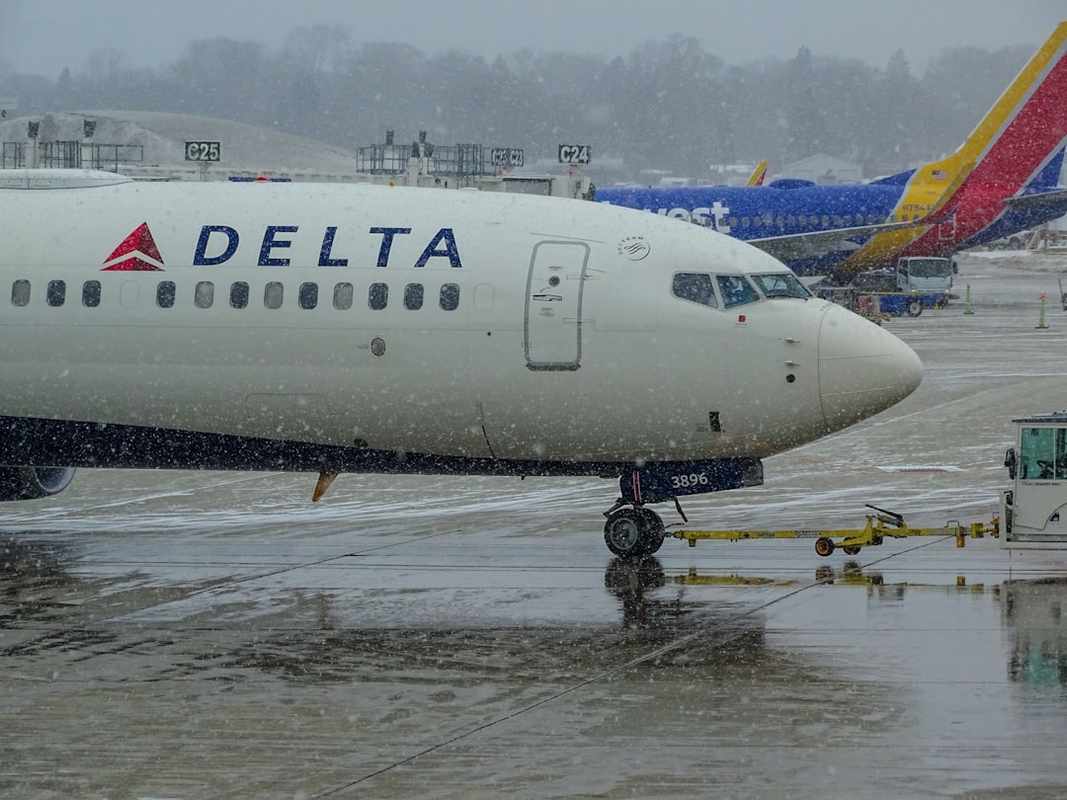
- Delta is pre-canceling Midwest flights due to a major snow and wind event this weekend.
- Minneapolis-St. Paul (MSP) remains the primary disruption hub for connecting and local travelers.
- Passengers should rebook through the app immediately to secure limited alternative seat inventory.
(MINNEAPOLIS-ST. PAUL, MINNESOTA) — Delta Air Lines is pre-canceling select flights across the Midwest ahead of a snow-and-wind event this weekend, and that means your itinerary could change before you even leave for the airport. If you’re traveling to, from, or through Minneapolis–St. Paul (MSP) on Saturday, March 14, or Sunday, March 15, expect earlier rebookings, tighter seat inventory, and longer lines for the same-day options. Move quickly now, and you’ll usually get better routings than if you wait for the day-of scramble.
Delta’s warning is aimed at Midwest Winter Weather, with forecasted snow and strong winds creating the classic mix of de-icing backups and air-traffic flow restrictions. MSP is the big story because it’s one of Delta’s most important connecting hubs. When MSP slows down, the ripple can hit flights well beyond Minnesota, including coast-to-coast itineraries that rely on MSP for connections.
Overview: why Delta is canceling flights, and why MSP matters
This isn’t just about snow on the runway. Winter ops can break down in several ways at once.
- Ground stops and spacing programs can limit how many flights can arrive or depart.
- De-icing can create long taxi-out lines, even when visibility looks “fine.”
- Crew and aircraft displacement stacks up when earlier flights cancel.
- Missed connections multiply fast at a hub airport.
MSP is the pressure point. A single aircraft that doesn’t make it into Minneapolis can strand the next day’s schedule. That can affect travelers connecting through MSP, even if their origin city is dry and calm.
What Delta has announced so far (and why timing matters)
Delta began messaging customers and the public on Friday, March 13, with an initial announcement at 12:30 p.m. ET. Later that day, Delta followed with an update at 5:00 p.m. ET confirming that cancellations would extend through the weekend window.
Delta’s advisories page also matters here. It’s the closest thing to a “master” timestamp for what the airline considers current guidance. Delta’s advisory for “Midwest Winter Weather” showed a timestamp of March 13, 2026, at 10:41 a.m. ET.
Airlines publish rolling updates for a simple reason. Forecast confidence changes, and so do airport conditions. Delta also needs time to position aircraft and crews. Pre-canceling earlier can protect the rest of the network.
For you, the timing affects your odds of getting a good alternative. The earlier you shop options, the more seats exist on:
- Earlier departures ahead of the snow
- Later departures after the weather window
- Nonstops that disappear first during disruptions
Rebooking and change options: what Delta typically allows during weather events
When Delta cancels your flight, the airline typically automatically rebooks you on the next available itinerary. That can be helpful, but it’s not always the best option.
If your trip falls under the advisory or waiver, Delta generally lets you change your flight at no charge in the Delta app or on delta.com. In many cases, the self-service tools show the same menu of options an agent can access, within the waiver rules.
Here’s how to think about rebooking during Midwest winter disruptions.
Start by checking what you were auto-assigned
Auto-rebookings can produce:
- Longer itineraries with two connections
- Connections that look legal on paper but are risky in winter
- Overnight layovers when the next bank of flights is full
If you see a tight connection at MSP during a snow-and-wind event, treat it as fragile. A 20-minute de-icing delay can erase your buffer.
Compare these alternatives before you click “accept”
Prioritize in this order:
- Nonstop options, if they exist.
- Single-connection routings that avoid the most weather-exposed hubs.
- Earlier flights ahead of the worst part of the window.
- Later flights after conditions stabilize and aircraft reposition.
Also consider nearby alternate airports if it’s practical. In the Twin Cities, that can mean thinking beyond MSP if you’re flexible on ground transport. In other Midwest cities, a drive of 60–120 minutes can sometimes unlock seats.
When calling or messaging support still makes sense
Self-service can hit limits on complex trips. Reach out if you have:
- Partner airline segments or separate tickets
- Unaccompanied minors
- Special service needs
- Large groups or mixed-cabin itineraries
- International trips where one canceled segment breaks the whole chain
Advisory details and what “safety first” means in practice
Delta’s advisory language is plain: Midwest Winter Weather is expected to disrupt travel across multiple Midwest locations. MSP is a focal point, but it’s rarely the only domino.
“Safety first” can also mean preemptive cancellations even before the first flakes fall. That frustrates travelers, but it can be the least-bad option. If Delta waits until the airport is in gridlock, you can end up with three bad outcomes:
- You arrive at the airport and wait hours before the cancellation posts.
- Crews time out, and the next flight also cancels.
- Aircraft end up in the wrong cities, and tomorrow’s schedule breaks too.
Operationally, these are the big winter disruptors you’ll feel as a customer:
- De-icing queues that cause rolling delays all day
- Runway condition limits that reduce arrival and departure rates
- ATC flow programs that hold aircraft on the ground in other cities
- Crew legality rules that prevent crews from working past limits
- Gate changes and last-minute swaps as aircraft rotate irregularly
Watch your app for more than “Canceled.” In a weather event, you’ll often see a pattern of delays that worsen through the day. If your first leg is late, your connection can disappear quickly at a hub.
Before/After: what changed for travelers this weekend
Delta didn’t change its long-term fare rules here. The “policy change” is the short-term operational shift that happens during an advisory window.
| Before (normal weekend ops) | After (Midwest Winter Weather window) | |
|---|---|---|
| Flight schedule | Full published schedule | Proactive cancellations and rolling delays |
| Rebooking | Usually manual if you want a different flight | Automatic rebooking if your flight is canceled |
| Change fees | Depends on ticket rules | Typically no-charge changes when covered by a waiver |
| Airport experience | Standard lines and connections | Longer lines, missed connections, de-icing holds, gate changes |
Who’s affected — and who isn’t
You’re most likely affected if you are:
- Flying to, from, or through Minneapolis–St. Paul on March 14–15, 2026
- Connecting via MSP, even if your origin is outside the Midwest
- Booked on tighter connections that rely on on-time inbound aircraft
You’re less likely affected if you are:
- Traveling outside the Saturday–Sunday weather window
- On an itinerary that avoids Midwest hubs entirely
- Already booked on the first departures of the day, before delays stack up
Refunds, credits, and compensation: what you can (and usually can’t) claim
Weather is generally treated as outside the airline’s control. That matters because it often limits compensation. You should plan for rebooking help and possibly a refund option, but not automatic cash payouts.
Here’s the practical decision tree.
If Delta cancels and you still want to go
Take the best rebooking you can find, ideally outside the disruption peak. If you accept a reroute, you’re typically choosing transportation over a refund.
If Delta cancels and you don’t want to travel
In many cases, when the airline cancels and you choose not to fly, you can request a refund back to your original form of payment. Timing varies by purchase method.
Protect yourself by saving documentation:
- Screenshot the cancellation in the app.
- Save the emails and push alerts with timestamps.
- Keep your receipt and fare details in your Delta account.
If you booked through a third party
Refunds and credits can become slower and more complicated. Online travel agencies may require processing through their channels first.
Competitive context: how this compares to other airlines
Delta isn’t alone in pre-canceling ahead of major winter systems. United and American regularly do the same around their Midwest and Northeast hubs when forecasts show high disruption odds. The main difference is your rerouting flexibility.
Delta’s hub structure means MSP disruptions can push you into connections through other Delta hubs. If you’re comparing options last-minute, look at whether another carrier can offer a true nonstop, or a routing that avoids the weather zone entirely.
Key dates and times to keep on your radar (March 13–15, 2026)
📅 Key Date: Delta’s disruption window runs Saturday, March 14, through Sunday, March 15, 2026.
⚠️ Heads Up: Delta’s communications moved quickly on Friday, March 13. The initial notice posted at 12:30 p.m. ET, with a 5:00 p.m. ET update confirming weekend cancellations.
Delta’s advisory timestamp of 10:41 a.m. ET on March 13, 2026 is also useful. When you’re rebooking or requesting a refund, those timestamps help show you acted within the advisory window.
Mileage and points angle: if you’re chasing Medallion status, a canceled trip can mean lost MQD earning you expected from flying. If you rebook, confirm your new itinerary preserves cabin and routing. If you decide to cancel for a refund, you’ll usually earn nothing because you won’t fly.
The smart move today is simple: if your itinerary touches Minneapolis-St. Paul during the March 14–15 storm window, open the Delta app now and shift to an earlier departure or a post-storm flight before remaining seats disappear.
Live Government Data
State Dept • CBPBusiest Border Crossings
- Hidalgo/Pharr 45 min
- Otay Mesa 45 min
- San Ysidro 45 min