- Official records show no evidence of naturalization shutdowns in Columbus despite viral online rumors of crackdowns.
- Nearby federal court calendars in Ohio and Missouri confirm ongoing citizenship ceremonies through April 2026.
- Applicants should rely exclusively on mailed USCIS notices and official government portals for ceremony scheduling.
(COLUMBUS, OHIO) — As claims of a nationwide ‘crackdown’ swirl, this report separates verified Columbus status from unverified online chatter by examining official court calendars, the lack of USCIS notices, and a recent ceremonial video that illustrates standard naturalization steps.
Section 1: Status of Columbus naturalization ceremonies amid claims of a Trump-era crackdown
Online posts have fueled a narrative of a “Trump-era crackdown” reaching citizenship events. In Columbus, Ohio, the verifiable picture is narrower.
As of January 22, 2026, no official notice from USCIS and no court posting has confirmed that naturalization ceremonies in Columbus have been halted, disrupted, or restricted.
Naturalization ceremonies are the formal, last step in becoming a U.S. citizen after application approval. In many cases, they are hosted either by USCIS (administrative ceremonies) or by federal courts (judicial ceremonies).
A judge or another authorized official administers the oath of allegiance, and applicants typically make a renunciation of prior allegiances as part of that oath process. These events can occur in courtrooms, jury rooms, or community venues when courts partner with civic sites.
Columbus-specific scheduling can also be hard to track for reasons that do not imply a crackdown. Ceremony information may appear in different places depending on who is hosting.
Some courts post limited calendar details. Venues can change with short notice for security, space, or staffing needs. That can create gaps in public-facing listings, even when ceremonies continue normally.
Public chatter often treats the absence of a widely shared listing as proof of cancellation. That logic does not hold.
The most reliable proof for an individual applicant is still the mailed ceremony notice and any updates in an official USCIS account.
Section 2: Nearby court schedules with dates and locations
Federal courts commonly post ceremony dates on district calendars or public schedules. Those listings can change.
Courts sometimes consolidate ceremonies, adjust rooms, or move an event offsite for a special program. A schedule also may list a city that is not the same as where a reader lives, which matters in Ohio.
Nearby court calendars show that ceremonies are continuing in practice in other districts, even as Columbus-specific public listings remain difficult to confirm from common secondary sources.
For example, the U.S. District Court for the Eastern District of Missouri posts a steady Friday pattern at 10:00 a.m. across late January through April, plus one special event date at a museum venue in St. Louis. Separately, the U.S. District Court for the Northern District of Ohio lists multiple ceremony dates, including a January event and additional ceremonies into February, in Cleveland.
Out-of-district schedules are useful context. They are not proof of what is happening in Columbus, Ohio. Still, they can help readers judge whether “nationwide halt” claims match observable court operations.
A true stop would usually show up broadly across calendars, paired with formal notices. Most applicants should treat their own ceremony notice as the controlling document.
Court calendars help confirm timing and venue, but mailed notices and official account updates carry the operational details.
| District | Dates (examples) | Venue/Room | Notes |
|---|---|---|---|
| Eastern District of Missouri | January 23, 2026; February 13, 2026; April 24, 2026 | USBC / Courtroom 3 (Thomas F. Eagleton Courthouse) | Regular Friday 10:00 a.m. naturalization ceremonies listed on the district schedule. Also shows a special-event venue on a separate date. |
| Eastern District of Missouri | April 9, 2026 | St. Louis Art Museum | Offsite ceremony format. Venue changes like this can cause confusion when readers expect only courthouse locations. |
| Northern District of Ohio | January 16, 2026; February 20, 2026 (OH schedule) | Carl B. Stokes U.S. Courthouse Jury Assembly Room | Cleveland-based schedule, with listed start times such as 9:00 and 11:30. The district is not Columbus, but it signals continued operations nearby. |
Section 3: January 16, 2026 citizenship ceremony video details
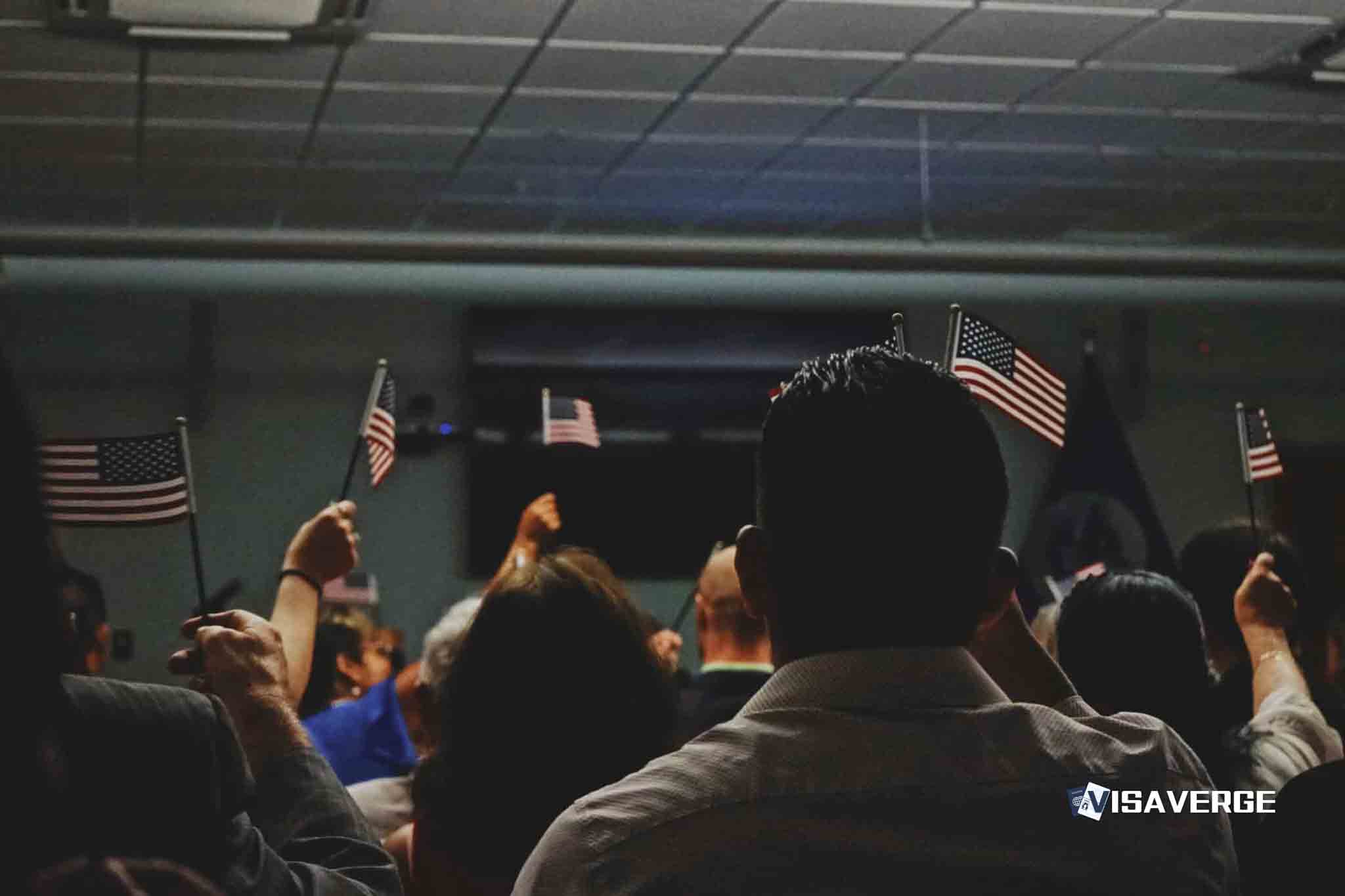
A January 16, 2026 citizenship ceremony video offers a grounded view of what a standard ceremony looks like. It shows 26 applicants from a range of countries completing the final step: taking the oath of allegiance and making the required renunciation.
Those legal acts are not symbolic add-ons. They are the formal commitments that complete naturalization after approval.
Ceremonies also often include public acknowledgments. In that video, the presiding official thanked USCIS staff and recognized community and legal participants, including Attorney Trabel, Attorney Treybold, Mayor Develin, and Miss Bloom.
That type of recognition is routine in many judicial ceremonies and does not, by itself, signal any policy shift. Video evidence can help readers know what to expect at their own event.
It can also counter sensational claims that ceremonies have been broadly suspended. Yet one recording cannot prove what is happening in Columbus, Ohio on a specific date. Local scheduling is still verified through notices and court calendars.
Section 4: Official coverage and statements on ‘Trump-era crackdown’
A real nationwide “crackdown” affecting naturalization ceremonies would usually leave official footprints. Readers would typically see one or more of the following: a USCIS announcement on uscis.gov, updated operational guidance, court operational changes, or formal publication through federal channels.
A broad halt would also likely be reflected across multiple court calendars at once. As of January 22, 2026, those signals have not appeared for Columbus ceremonies.
No USCIS announcement has stated that ceremonies are being stopped in Columbus or elsewhere. Court calendars in other districts continue to show scheduled events. That pattern fits ordinary operations, not a documented shutdown.
Confusion also grows when ceremony scheduling gets mixed up with other legal topics. Naturalization ceremonies are the endpoint of a successful application.
Denaturalization, by contrast, is a separate legal process that generally involves alleged fraud or ineligibility and requires a different set of legal triggers and procedures. News about proposals related to denaturalization does not automatically translate into ceremony cancellations.
Readers should treat claims of motive or future enforcement plans with caution unless they are tied to official action. Calendar entries and ceremony notices remain the strongest near-term indicators of what is actually happening.
⚠️ Verify Columbus ceremony details directly from the correct district court site and USCIS notices; do not rely on secondary listings or social media claims alone
Section 5: Gaps and what to verify (data gaps to watch)
Columbus-specific uncertainty often comes down to missing public postings, not confirmed disruption. Public calendars may not show every ceremony. Venue assignments can shift. Frequency can vary by staffing and courtroom availability.
Those gaps can be frustrating, but they are not proof of a “Trump-era crackdown.” Applicants waiting for ceremony scheduling can take steps that do not require guesswork:
- Check your mailed ceremony notice for the date, time, and location.
- Confirm through your USCIS account at my.uscis.gov or case tools at egov.uscis.gov when updates are posted.
- Compare your notice to the relevant court calendar if the ceremony is a judicial ceremony.
- If you see suspicious posts claiming cancellations, save screenshots and URLs, then compare against official postings and your notice.
For an individual applicant, the best evidence is personal and direct: the ceremony notice plus confirmation through official channels. That approach also avoids conflating nearby schedules in Cleveland or St. Louis with what is happening in Columbus, Ohio.
✅ If you have a Columbus ceremony notice, check the official notice for date, time, and venue and confirm via the district court calendar or USCIS account updates
This article provides information based on official court calendars and publicly posted notices. It does not constitute legal advice.
Readers should consult official sources and an attorney for individualized guidance.