- A severe winter storm grounded 12,000 to 15,000 flights across the United States between January 24 and 26.
- Dallas–Fort Worth emerged as the most severely disrupted hub, recording over 1,500 cancellations in a single day.
- Sunday set a record with over 8,200 single-day cancellations, the highest volume since the March 2020 pandemic onset.
(UNITED STATES) — Airlines canceled approximately 12,000 to 15,000 flights between January 24 and 26 as a winter storm pushed across the central U.S. and into the East Coast, disrupting major connecting hubs and leaving carriers with a weekend-long recovery effort.
Operational impacts clustered first along a Texas-to-Oklahoma corridor and the Mid-South on Saturday, before shifting into the Southeast and Northeast on Sunday, when cancellations surged nationally. The concentration at major hubs mattered because missed connections and displaced aircraft spread delays well beyond the storm’s core.
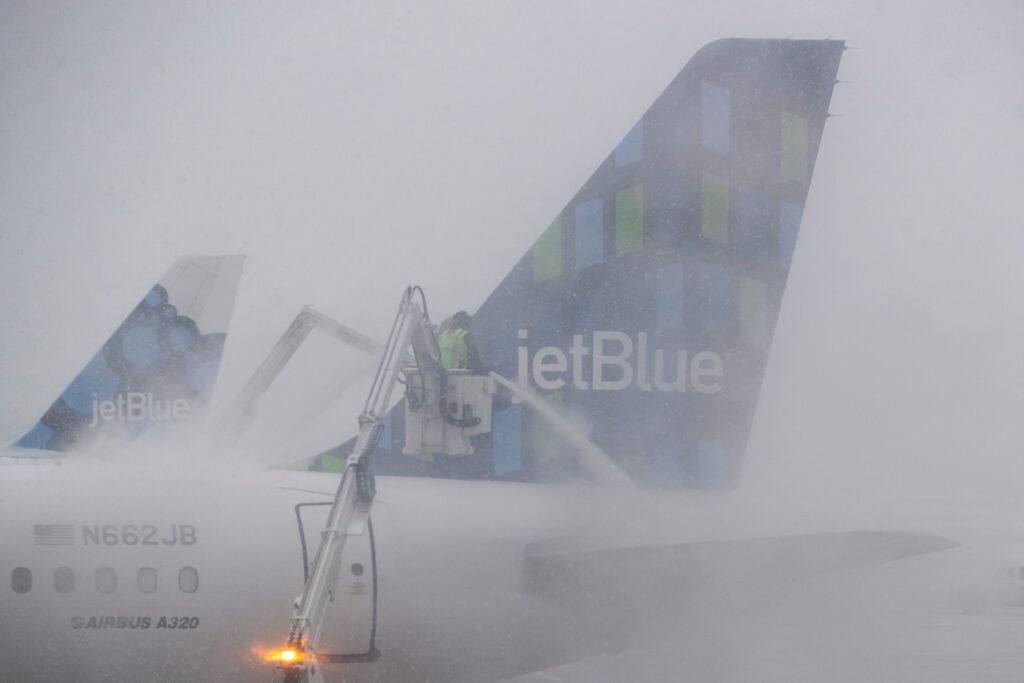
By Saturday afternoon, nearly 700 flights had been canceled on Friday, more than 3,800 on Saturday, over 8,500 on Sunday, and almost 1,500 on Monday. Sunday, January 25, saw the highest single-day cancellations since March 2020, with over 8,200 flights canceled.
Dallas–Fort Worth International (DFW) emerged as the most severely disrupted airport nationally, with cancellations at points reaching up to roughly 75% of flights on Saturday in some snapshots. The airport logged 1,581 cancellations on Saturday, January 24.
American Airlines’ hub operation at DFW amplified ripple effects, because the airline uses the airport to connect domestic routes at scale. American Airlines alone canceled more than 900 flights at DFW on Saturday.
Sunday brought additional disruption at DFW, which recorded 777 cancellations on January 25. The carryover compounded rebooking pressure as aircraft and crews struggled to reposition.
Across the metro area, Dallas Love Field (DAL) also posted heavy losses, underscoring how concentrated weather disruption can strain two nearby but very different network models. DFW and Dallas Love Field combined accounted for more than half of all Saturday cancellations in the U.S.
Dallas Love Field recorded 214 cancellations on Saturday and 246 on Sunday. Southwest Airlines, headquartered at Love Field, canceled over 570 flights during the storm period.
The storm’s effect in the Mid-South proved severe in airports that operate with fewer options to absorb large-scale disruption. Memphis International (MEM) saw around 90% of flights canceled on Jan 24, among the highest cancellation rates nationally.
Reports also listed Memphis International and Nashville International (BNA) among the most affected airports, with both experiencing 50–60% operational losses. In markets like these, high cancellation rates can quickly snowball when inbound aircraft cannot arrive and de-icing capacity becomes strained.
Oklahoma City Will Rogers World (OKC) offered another sign of how quickly operations can collapse when aircraft positioning breaks down. OKC had all flights scheduled for Saturday canceled, with all Sunday morning departures also called off.
As the system moved east, the pattern shifted from a concentrated Texas and Mid-South shock to wider network disruption across hubs that support transcontinental and international schedules. That change set up Sunday as a flashpoint day, with cancellations spreading through the Southeast and into the Northeast corridor.
Charlotte Douglas International (CLT) emerged as one of the hardest-hit airports on Sunday, with American Airlines canceling large portions of its schedule through this hub. Charlotte was among the airports with 50–60% of operations lost.
Hartsfield–Jackson Atlanta International (ATL) experienced heavy cancellations as the storm shifted eastward on Sunday. Delta Air Lines, which uses ATL as its primary hub, made extensive preemptive cancellations.
The Northeast saw widespread impacts as snow and wind increased, and as earlier disruptions left aircraft and crews out of place for scheduled rotations. In the New York region, John F. Kennedy International (JFK), Newark Liberty International (EWR) and LaGuardia (LGA) appeared in reports of heavy cancellations as conditions worsened.
JFK and EWR each had more than half of Sunday’s scheduled flights canceled during peak disruption. Washington Dulles International (IAD) also recorded more than half of Sunday’s scheduled flights canceled.
In the Washington region, Washington Reagan National (DCA) faced delay programs and potential ground stops, with high cancellation levels reported. Baltimore/Washington (BWI) sat in the same DC/Baltimore corridor of heavy cancellations tied to the storm.
Boston Logan International (BOS) faced extensive cancellations and was listed in FAA advisories for possible ground stop and delay programs. Philadelphia International (PHL) appeared among Northeast hubs with high cancellation percentages Sunday into Monday.
Chicago O’Hare International (ORD) also saw significant cancellations as the storm’s northern fringe brought snow and operational constraints. The combination of limited visibility, runway treatment demands and air traffic flow programs added friction just as carriers tried to unwind the weekend’s earlier disruptions.
The same dynamic also played out in smaller markets that feed major hubs, where canceled departures can stall recovery even after conditions improve locally. Regional airports from Arkansas, Louisiana, and across Tennessee and the lower Midwest were identified as seeing clusters of cancellations, especially on Saturday.
In Texas beyond Dallas, Austin–Bergstrom International (AUS) was reported as “hit hard” with elevated cancellation counts as the storm passed through. Houston Bush Intercontinental (IAH) and Houston Hobby (HOU) were part of winter-weather travel waivers and experienced notable disruptions, though not as extreme as DFW and DAL.
The storm’s timing meant airlines had to manage two different operational peaks: a Saturday hit centered on the Texas and Mid-South corridor, and a broader Sunday impact extending into the Southeast and the Northeast. That sequencing can complicate recovery, because aircraft and crews displaced on the first day are often needed for flights in a different region on the second.
DFW’s Saturday totals illustrated the scale of the early disruption in the Texas corridor, with 1,581 cancellations and American’s share topping more than 900. The same airport still recorded 777 additional cancellations on Sunday, a reminder that hub recovery can lag even when the worst weather shifts elsewhere.
Dallas Love Field’s pattern showed a heavy two-day impact, with 214 cancellations on Saturday and 246 on Sunday. Southwest’s over-570 cancellations across the storm period highlighted how large network carriers can spread the downstream effects when aircraft rotations break.
OKC’s near-total shutdown on Saturday, and the cancellation of all Sunday morning departures, pointed to the constraints smaller and medium airports can face when ice, limited de-icing resources and inbound aircraft disruptions combine. That kind of stoppage can also slow restoration of feeder flying that helps hubs rebuild their schedules.
In the East, the heavy Sunday losses in Charlotte and Atlanta came as airlines tried to protect safety and reduce gridlock by trimming schedules. Charlotte’s 50–60% operational losses and Atlanta’s extensive preemptive cancellations pushed disruption into routes that typically provide frequent connections across the Southeast and beyond.
The New York and Washington regions then compounded the strain as more than half of Sunday’s scheduled flights were canceled at JFK, EWR and IAD. Boston’s extensive cancellations and FAA advisories for possible ground stop and delay programs added to the congestion for carriers operating dense Northeast networks.
The weekend total reflected both the storm’s breadth and the network knock-on effects from large hubs. One summary of aggregated cancellation data put the combined January 24–26 total at roughly 13,000–15,000 canceled U.S. flights, with the highest concentration at DFW, DAL, MEM, OKC, CLT, ATL and key Northeast hubs including JFK, EWR, IAD and BOS.
Sunday remained the peak day nationally, with over 8,500 cancellations by Saturday afternoon’s count and over 8,200 cancellations cited as the highest single-day total since March 2020. That surge set up a Monday backlog even as the storm moved through the Northeast.
Airlines faced continued pressure into Monday and Tuesday because aircraft and crews needed to return to their scheduled positions, while passengers competed for limited open seats after large blocks of flights were removed. Full flights, rolling delays and uneven airport recovery patterns could persist even after local weather improves, as carriers work through the weekend’s displacement across hubs from DFW and DAL through MEM and OKC and into the East Coast corridor.