- The Trump administration increased Venezuelan deportation flights from two to three per week by early 2026.
- U.S. authorities utilized the Alien Enemies Act to target alleged gang members for expedited removal.
- Verified reports confirm deportations to Venezuela and El Salvador, but no evidence supports claims regarding Iran.
(UNITED STATES, VENEZUELA) — The Trump administration stepped up removals of Venezuelan migrants while a claim circulated online linking U.S. deportations to both Iran and Venezuela, even though documented deportation activity described publicly centers on Venezuela and transfers tied to El Salvador.
The claim suggests the United States deported migrants to Iran and Venezuela amid talk of military interventions, but the documented deportations described in the same information environment involve Venezuelan and Salvadoran migrants being sent to Venezuela and El Salvador, not Iran.
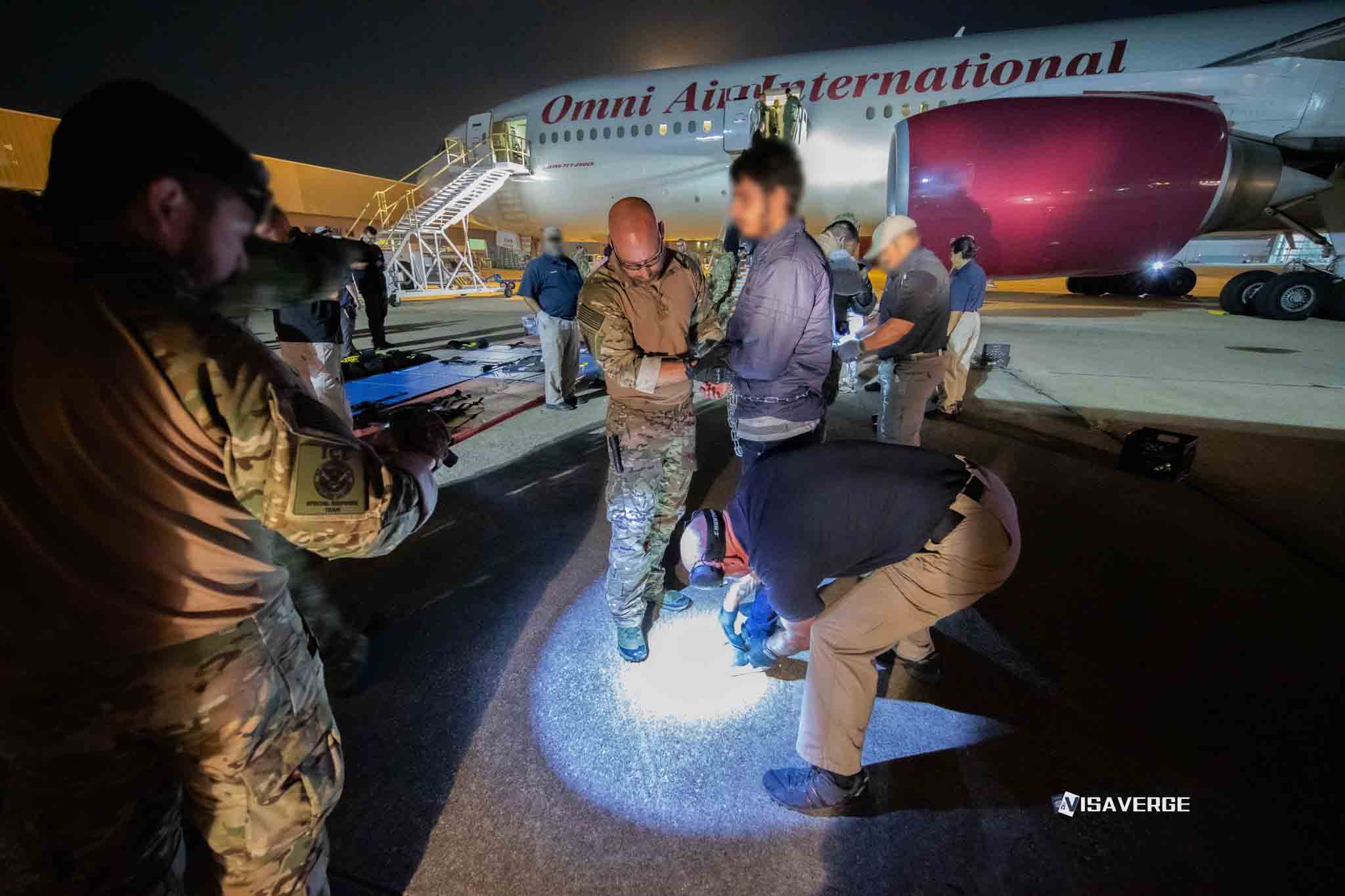
Publicly described enforcement actions also include moving some detainees into El Salvador’s detention system, which differs from deporting someone to their home country.
That distinction matters because “deportation” or “removal” describes sending a person out of the United States to another country, typically their country of citizenship, while transfers for detention abroad describe custody arrangements in a third country.
Military actions are separate from immigration removals, even when they unfold in the same political moment and are discussed in the same stream of headlines.
The acceleration in Venezuela-related removals followed early-2026 events described as shifting the operational pace of flights and the receiving country’s cooperation.
On January 3, 2026, a military operation captured President Nicolás Maduro, and the administration significantly increased deportations of Venezuelans afterward.
Venezuela’s interim government agreed to accept more deportation flights under U.S. pressure, as described in the accounts that track removals.
In 2025, Maduro accepted 76 flights with a maximum of two flights per week.
By early 2026, the pace increased to three deportation flights per week, and immigration experts projected that tempo could result in nearly 30,000 Venezuelan deportations annually—roughly double the previous year’s rate.
Flight cadence matters because it signals how quickly the enforcement system can move people from detention and processing to departure, and how much coordination occurs between U.S. authorities and a receiving government.
More frequent flights can compress timelines for families trying to locate relatives and for lawyers trying to prepare filings, even when the underlying legal process for a person’s case remains contested.
Cadence also points to capacity constraints and logistics, including how many people can be placed on a plane and how consistently those planes can depart.
Projections tied to weekly flight frequency translate that tempo into an annual figure, but realized outcomes can diverge if arrests, detention capacity, or diplomatic cooperation changes.
Cooperation from a receiving country can drive sudden shifts in removal pace, and the described jump from two flights per week to three flights per week reflects a change in that cooperation.
At the center of the legal debate described in the accounts sits the Alien Enemies Act and the use of a presidential proclamation alongside standard immigration-law removals.
On March 14, 2025, Trump signed Presidential Proclamation 10903, invoking the Alien Enemies Act to authorize deportation of Venezuelans aged 14 or older deemed to be members of Tren de Aragua.
Invoking that authority differs from routine immigration enforcement because it relies on a separate legal basis and turns on the government’s assessment of who falls into the targeted category.
The same day also featured removals under standard immigration law, which operate under different statutes and procedures than an Alien Enemies Act action.
A single deportation operation on March 14, 2025 involved three flights carrying 137 Venezuelans deported under the Act, 101 deported under regular immigration law, and 23 Salvadorans accused of MS-13 membership.
Those categories underscore how allegations of gang affiliation can become determinative in the government’s narrative about who is subject to which authority.
Such allegations can also become contested points in legal proceedings, especially when the government’s characterization shapes where a person is sent and under what legal framework.
Separate from deportations to Venezuela, the administration also used El Salvador as part of its custody and public-safety approach, according to the described accounts.
In March 2025, the administration sent 17 Venezuelan alleged members of Tren de Aragua and MS-13 to a maximum-security prison in El Salvador.
By that point, 238 Venezuelans and 23 Salvadorans had been incarcerated there.
Sending people into a maximum-security facility in El Salvador differs from deportation to a home country because it involves detention and incarceration abroad rather than a direct return.
The practical effect of third-country detention can include obstacles to communication, legal access, and outside scrutiny, because custody occurs beyond U.S. territory and outside the U.S. court system’s usual reach.
Family contact can become harder when a person is not only removed from the United States but also placed into a detention structure in another country.
Transparency can also shift, because the public record that might exist around a deportation flight does not automatically provide the same visibility into conditions of confinement abroad.
The claim’s Iran element, however, is not supported by the documented deportation activity described alongside Venezuela and El Salvador.
The described material contains no information about deportations to Iran.
Iran appears in the same broader information environment only in connection with U.S. military buildup and potential military strikes, separate from the deportation operations.
That separation matters because readers can conflate unrelated foreign-policy reporting with immigration enforcement destinations, especially when both involve the United States and the language of intervention.
The documented pattern described in these accounts instead centers on removals to Venezuela and detention-linked actions tied to El Salvador.
Precision about what happened, where people were sent, and under what authority matters for accountability and for assessing due process concerns.
It also matters for the public’s ability to verify claims, because deportation destinations typically require corroboration through agency statements, court filings, flight data, or confirmation by receiving countries.
The documented details described here point to Venezuela removals increasing in pace after early-2026 events and to a March 2025 mix of Alien Enemies Act removals, standard immigration-law deportations, and transfers into El Salvador’s custody system.
As debates over deportations continue, the verified thread in the described activity remains focused on Venezuela flights and El Salvador detention, not deportations to Iran.