- President Trump threatened to deploy ICE agents to airports starting Monday if DHS funding remains unresolved.
- The move creates uncertainty for visa holders, international students, and green card travelers during spring break.
- Security currently remains a TSA-regulated function, separate from the immigration enforcement roles typically handled by ICE.
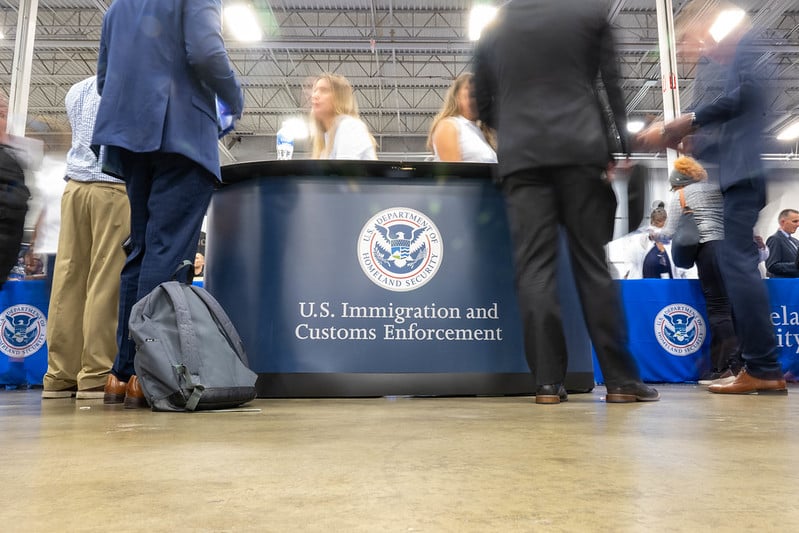
President Trump threatened on Saturday, March 21 to deploy Immigration and Customs Enforcement agents to airports beginning Monday, March 23 if Democrats do not agree to restore Department of Homeland Security funding, raising new concerns for visa holders, international students and green card travelers heading into a heavy spring break travel period.
“I look forward to moving ICE in on Monday, and have already told them to, ‘GET READY.’ NO MORE WAITING, NO MORE GAMES!”
Trump said ICE agents would conduct security operations “like no one has ever seen before, including the immediate arrest of all Illegal Immigrants who have come into our Country,” with particular emphasis on Somalian immigrants.
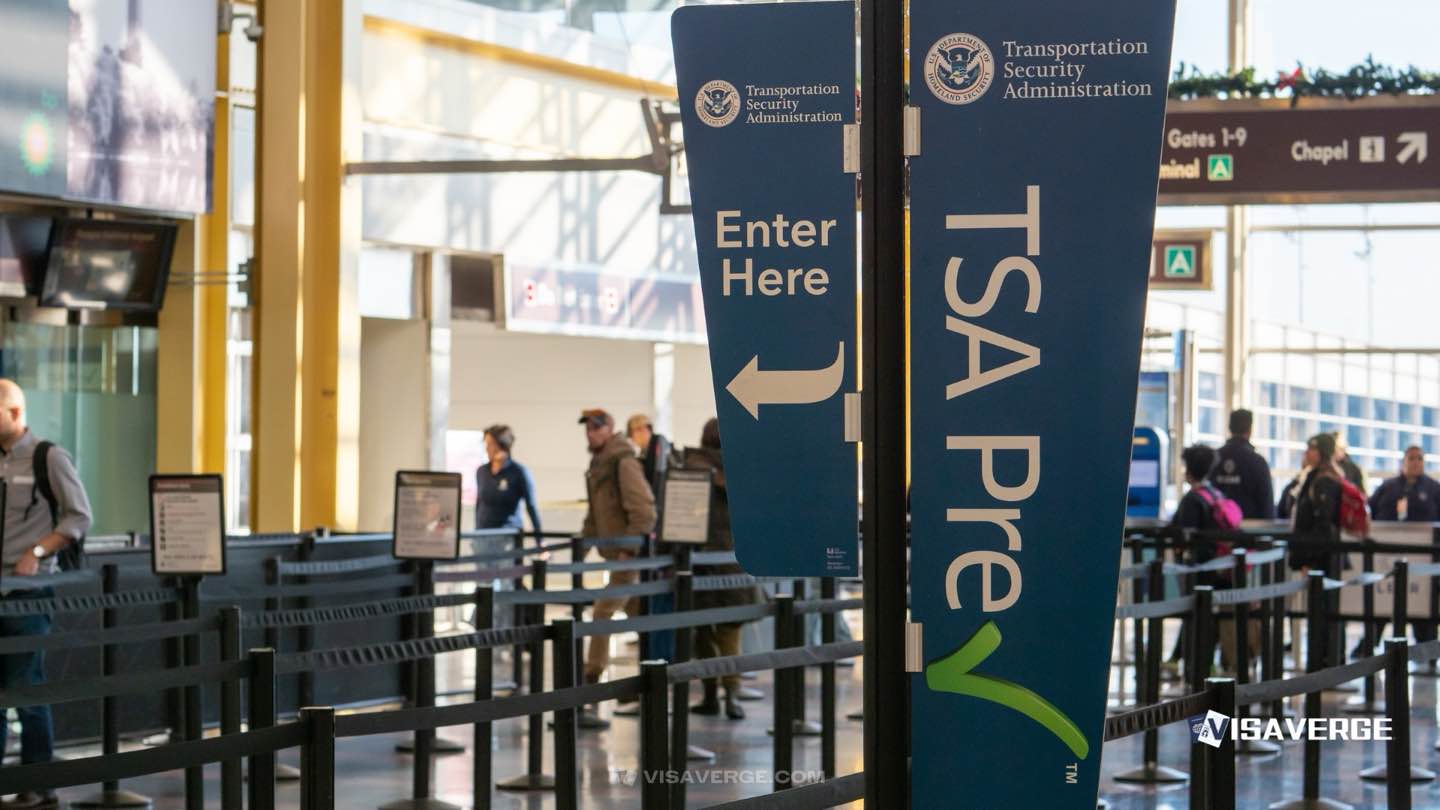
The threat lands at a point when airport security screening remains a Transportation Security Administration function under federal law, not an immigration enforcement role. That distinction has drawn attention because any move that places ICE more visibly in airport screening spaces could blur the line between passenger safety screening and immigration enforcement for millions of travelers.
TSA governs passenger and property screening before boarding, and screening at U.S. airports must be supervised by uniformed TSA personnel. The agency also runs a specialized officer workforce with checkpoint-specific training, including formal academy training for Transportation Security Officers.
That separation matters for mixed-status families, visa holders, students and lawful permanent residents who often view a domestic flight as a TSA identity and security matter rather than an immigration encounter. Even without a formal nationwide policy change, talk of ICE at airports can shift how travelers prepare, how officers use discretion and how much time passengers allow before a flight.
TSA’s checkpoint system already operates at enormous scale. TSA materials say officers screen roughly 2 million or more passengers a day across hundreds of airports, which means even perceived changes in how airports function can affect traveler behavior far beyond the small share of passengers who expect any immigration-related questioning.
The immediate backdrop is a partial DHS shutdown that has strained airport operations. TSA officers have gone 36 days without pay, and the shutdown has led to staffing shortages, mass resignations and extended waits at major airports during spring break travel season.
At airports including JFK, Atlanta, and Houston’s Bush Intercontinental, no-shows have mounted and wait times have reached approximately 80 minutes. Those delays have turned the funding fight in Washington into a visible problem at checkpoints, where long lines, lower morale and thinner staffing can intensify public concern about any proposal to add another federal enforcement presence.
As of March 22, no deal has been reached between Republicans and Democrats. A Senate funding vote failed on Friday, March 21, and Democrats rejected White House concessions as insufficient, leaving Trump’s Monday, March 23 threat tied directly to congressional action over the weekend.
For noncitizens, the concern is not that TSA screening rules have already changed nationwide. The concern is that a greater ICE role at airports could create overlap between routine screening and immigration-related questioning, especially for travelers whose lawful status depends on several documents rather than a single ID card.
International students face some of the most document-heavy travel routines. ICE’s SEVP guidance says students need a current Form I-20 endorsed for travel, and students are expected to keep SEVIS records accurate.
USCIS also says noncitizens generally must report a change of address within 10 days, and the agency’s alien registration guidance says many noncitizens age 18 or older must carry proof of registration. For an F-1 student, an outdated address, an unsigned Form I-20, or missing status records can turn a routine airport trip into a prolonged disruption if scrutiny rises.
Employment-based visa holders face a different version of the same problem. For H-1B workers and other nonimmigrants, airport stress does not begin and end with a driver’s license if questions move beyond the ordinary TSA checkpoint routine.
USCIS materials repeatedly use the foreign passport, Form I-94, and approval records as core evidence in nonimmigrant status contexts. Students and temporary workers often travel with multiple records that together show identity, admission, program authorization, work authorization and current lawful status, and uncertainty alone can cause them to arrive earlier, reorganize travel documents or postpone trips.
Lawful permanent residents have a clearer documentation rule, but they also face practical airport risks if records are expired, delayed or hard to retrieve. USCIS states that lawful permanent residents age 18 or older are required to carry valid proof of permanent residence, and USCIS separately says evidence of registration must be carried by many noncitizens.
For green card holders, that means a domestic trip is not the time to leave the green card at home. If the physical card has expired and the traveler relies on an extension notice or ADIT-based proof, that evidence needs to be easy to reach if questions arise during travel disruption.
Naturalized U.S. citizens stand in a different legal position because they are not traveling as noncitizens, but they still must meet ordinary TSA identity rules. TSA says travelers without acceptable ID may have to use the new TSA ConfirmID process, which includes a fee, making identity compliance the first point of friction even when immigration status is not at issue.
A more enforcement-heavy airport atmosphere can still affect naturalized citizens in mixed-status families, foreign-born U.S. citizens with accents or unfamiliar names, and travelers carrying foreign passports alongside U.S. naturalization histories. The practical issue at airports remains readiness: current identification, current immigration records where relevant, and enough time to absorb delays at large hubs.
“wrongfully detained, beat up, and harassed by ICE.”
Senator Patty Murray warned that Trump’s plan could lead travelers to be “wrongfully detained, beat up, and harassed by ICE.” Her criticism reflected the broader concern that ICE is an immigration enforcement agency and deportation force, not a checkpoint screening workforce trained for TSA operations.
That argument has become more pointed because the White House has framed airport deployment as leverage in the wider DHS funding fight. The administration has proposed limited reforms to ICE operations, including expanded body camera use, restrictions on enforcement at sensitive locations such as schools, hospitals and places of worship, and visible identification requirements.
Democrats have pushed for broader limits, including warrant requirements before forceful home entries and a ban on maskless patrols. Republicans have rejected some of those demands, which is why the dispute over DHS funding remained unresolved on March 22.
The airport threat also sits inside a larger political clash over ICE operations following January 2026 incidents in Minnesota, where ICE agents killed two protesters, Alex Pretti and Renee Good, during immigration enforcement operations. Those deaths have become part of the current negotiations, though the immediate effect for travelers is the possibility that airports become another stage for that conflict.
For passengers, the bottom line is narrower than the rhetoric. Airport security and immigration enforcement remain separate functions, but travelers now have reason to prepare for heavier document scrutiny and operational disruption without assuming that every person at a checkpoint will face immigration questioning.
At a minimum, travelers should confirm that their identification meets TSA requirements before leaving for the airport. That step matters for citizens and noncitizens alike because a missed flight can start with an ID problem long before any immigration issue enters the picture.
Noncitizens with lawful status have an added layer of preparation. Students should keep identity, admission and school authorization records accessible, especially if they are traveling on OPT or CPT, while temporary workers should be ready to show a passport, an admission record and recent approval documentation tied to their status.
Green card holders should travel with valid proof of permanent residence or official replacement evidence if the physical card is unavailable. Those steps are about readiness for travel disruption and status verification, not a prediction that routine immigration questioning will occur at every checkpoint.
The same logic applies at crowded airports where staffing issues already slow the line. Longer waits at JFK, Atlanta and Houston’s Bush Intercontinental show how quickly an already stressed system can compound problems for travelers who need extra time to resolve an ID question, retrieve records from a phone or explain why a document set includes multiple immigration forms.
For many passengers, the fear lies less in a formal rule than in uncertainty. A domestic trip that once felt like a standard TSA interaction can feel different when ICE enters the public conversation around airports, especially for travelers whose status is lawful but not easy to explain in 30 seconds.
Congress assigned screening to TSA, and TSA built a workforce, training pipeline and checkpoint rules around that mission. As Trump presses his threat and lawmakers remain deadlocked, students, skilled workers, permanent residents and mixed-status families are left to prepare for the interaction they expect at the airport and the one they hope never happens.