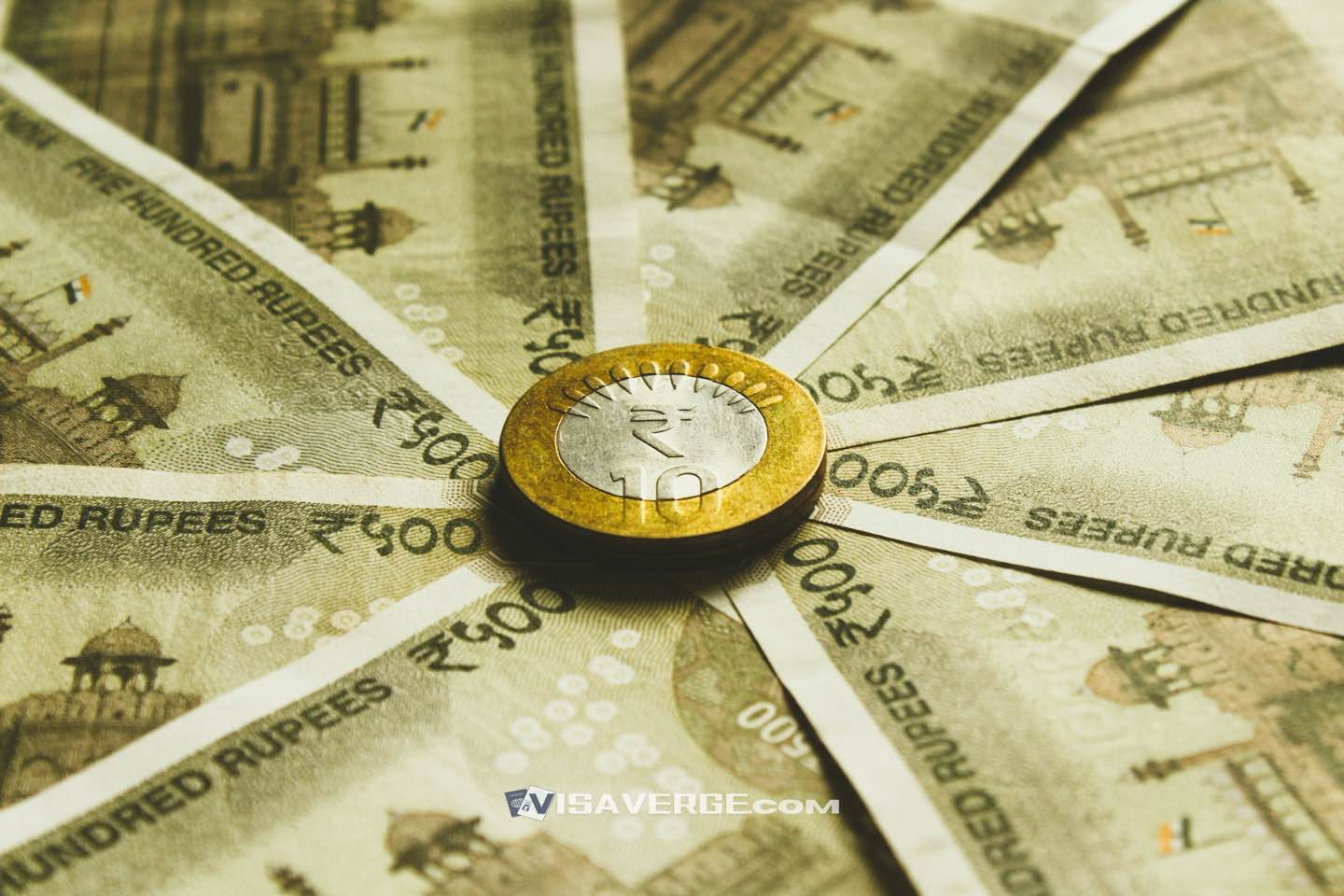
- Economist Arvind Panagariya suggests the RBI should not defend the rupee at the ₹100 mark.
- The central bank prioritizes managing market volatility over maintaining a fixed exchange rate target.
- A weaker rupee benefits exporters and remittances but increases costs for students and travelers.
(INDIA) — Arvind Panagariya, chairman of the Sixteenth Finance Commission, argued that the Reserve Bank of India should not defend the rupee at ₹100 per U.S. dollar at any cost, sharpening a debate over whether the central bank should spend reserves to protect a psychological level.
Panagariya’s point, as set out in the debate around the Rupee Near ₹100 per Dollar, is narrower than a blanket endorsement of a weaker currency. He drew a line between defending a round number and keeping foreign exchange markets orderly when pressure on the rupee reflects broader economic forces.
That distinction sits at the center of the discussion. Economists backing that view say the issue is not whether ₹100 is good or bad in itself, but whether the rupee is moving in a gradual, orderly way or dropping in a panic.
India does not run a fixed exchange rate regime. The rupee is broadly market-determined, and the RBI intervenes mainly to reduce excessive volatility and maintain orderly conditions in the foreign exchange market.
RBI material says the central bank does not aim at a fixed target or a pre-announced exchange-rate band. It steps in to smooth undue volatility or disorderly market behavior while allowing demand and supply to determine the exchange rate over time.
Sanjay Malhotra, governor of the Reserve Bank of India, said the central bank would do “whatever is required” to ensure orderly foreign exchange market conditions. That approach leaves room for intervention against abrupt moves without turning one number into a permanent policy line.
Economists who oppose defending ₹100 at all costs focus on the price of that defense. When a central bank supports its currency, it can sell dollars from foreign exchange reserves and buy rupees, easing immediate pressure but not changing the forces that created it.
If that pressure comes from oil prices, broad dollar strength, capital outflows, geopolitical uncertainty or trade imbalances, reserves can fall quickly while the underlying problem stays in place. In that setting, a controlled depreciation can look more realistic than a prolonged fight over a symbolic threshold.
Panagariya’s argument does not call for a free fall. A sharp drop can damage confidence, unsettle inflation expectations and deepen pressure on financial markets, which is why the RBI still faces a balancing act even if it refuses to treat ₹100 as sacred.
The costs and benefits of depreciation also fall unevenly across the economy. Exporters and families receiving money from abroad can gain, while importers, students, travelers and households exposed to higher prices can lose ground.
A weaker rupee can help exporters because dollar earnings translate into more rupees. IT services companies, pharmaceutical exporters, textile exporters and other export-oriented businesses stand to benefit, especially when most of their costs stay in rupees.
Non-resident Indians sending money home also gain on conversion. If one dollar converts to ₹83, a $1,000 remittance gives ₹83,000 before charges; if one dollar converts to ₹100, the same $1,000 gives ₹1,00,000 before charges.
That arithmetic can help parents dependent on overseas children, borrowers repaying Indian loans and families putting money into property or financial assets. A weak rupee lifts the local purchasing power of remittances.
The gain has limits. An NRI who owns Indian assets and later wants to repatriate money can find that rupee depreciation cuts the dollar value of those assets, even if the asset rose in rupee terms.
Students planning to study abroad face the reverse effect immediately. Tuition, rent, health insurance, living costs, visa charges, air tickets and application fees are often linked to foreign currency, so a weaker rupee raises the bill in rupee terms.
The difference can be large. A $50,000 annual education cost requires ₹41.5 lakh at ₹83 per dollar, but ₹50 lakh at ₹100 per dollar.
That gap can alter a family’s loan requirement, collateral burden and financial plan. Students already overseas can also need larger transfers from India if the rupee weakens after a budget has already been set.
Travel abroad follows the same pattern. Hotels, flights, forex cards, credit card spending, travel insurance, local transport and shopping all become more expensive in rupee terms when the exchange rate deteriorates.
Families traveling for visa interviews, admissions, immigration processing, conferences, destination weddings or medical treatment abroad feel that change quickly. Even when visa fees are fixed in dollars or another foreign currency, the rupee cost rises as the rupee falls.
Pressure on the rupee does not always reflect a domestic crisis. India imports a large share of its crude oil needs, so higher oil prices can push up dollar demand as importers buy more foreign currency to pay their bills.
Global shocks can intensify that pressure. Investors often move toward the U.S. dollar during periods of geopolitical risk, and foreign portfolio outflows from Indian equities or debt add another source of dollar demand as money leaves local markets.
A strong U.S. dollar can also weaken emerging-market currencies across the board, including the rupee. In those periods, external conditions alone can push the exchange rate lower.
Market sentiment has also swung with oil prices, geopolitical developments and signals from the RBI. The rupee hit a record low before recovering to a two-week high, showing how quickly expectations can change even without a shift in the broader policy framework.
Importers and consumers face some of the most direct domestic consequences of depreciation. India buys crude oil, gold, electronics, machinery, medical equipment and a range of industrial inputs from abroad, and all of those imports become costlier in rupee terms when the currency weakens.
Those higher costs can feed inflation through several channels. More expensive crude can lift fuel and transport costs, which can then reach logistics, food prices, aviation, chemicals, plastics and manufactured goods.
Imported electronics, laptops, mobile phones, medical devices and industrial machinery can also become more expensive. Businesses that depend on imported inputs must either absorb the higher cost or pass it on to customers.
That is why the debate over Rupee Near ₹100 per Dollar reaches far beyond currency traders and economists. Households that never travel overseas and never receive remittances can still feel the effect through rising prices at home.
Exporters, meanwhile, do not all benefit equally. A weaker rupee can improve competitiveness for firms paid in dollars, but that advantage shrinks if those same firms import raw materials, components or machinery.
Some companies also hedge their currency exposure, limiting the immediate benefit from depreciation. Exchange rate movement can help margins at the edge, but it does not replace productivity, infrastructure, manufacturing depth or policy stability.
That leaves the RBI with a narrow path. If it intervenes too aggressively, it risks spending reserves to defend a number that markets may still break; if it does too little, a disorderly slide can unsettle inflation expectations, investor confidence, corporate borrowing costs and financial stability.
The practical case for intervention rests less on prestige than on pace. A gradual, market-driven move can be absorbed more easily than a sudden, one-sided fall that turns into panic.
Families and firms exposed to foreign currency costs have already started adjusting their calculations. Students heading abroad are better served by building a 5% to 10% exchange-rate buffer into their budgets rather than assuming the current rate will hold.
NRIs sending money home can benefit from improved conversion, but large transfers still need proper banking records and source documentation. Investors living overseas also have to judge returns in both rupee terms and foreign currency terms if they expect to move funds back out later.
Travelers facing overseas expenses can compare forex card rates, bank rates and credit card markups before they spend. Import-dependent businesses have to review pricing, hedging and payment terms as exchange-rate shifts work through their cost base.
The argument around Arvind Panagariya’s remarks, then, is less about welcoming depreciation than about rejecting a mechanical defense of a round number. The Reserve Bank of India still has to act against disorderly moves, but economists in this camp say the central bank should manage volatility and market functioning, not treat ₹100 as a line that must never be crossed.