- The Certified – Expired label simply means the 180-day filing window has concluded.
- Timely I-140 filing ensures that an expired PERM status does not affect your approval.
- A 33-day extension was granted for deadlines during the 2025 shutdown period.
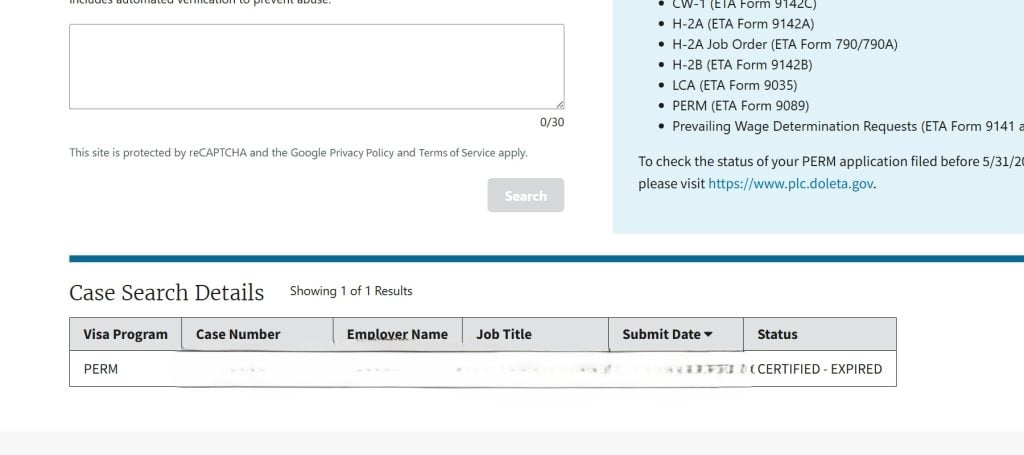
Seeing “Certified – Expired” next to your PERM in the DOL FLAG portal usually means only one thing: the labor certification’s 180-day filing window has run out. If your employer already filed and USCIS approved your I-140 on time, that portal label is normal and does not cancel your approval, your H-1B options, or your priority date.
That change can still feel alarming because it appears right when you’re building a long plan around work authorization, family moves, and green card timing. The key is to separate three different timelines: the Department of Labor’s PERM certification lifecycle, the USCIS filing rules for `Form I-140`, and the later benefits that flow from an approved petition.
This guide walks through the full path from PERM certification to an I-140 decision, shows where the 180-day clock fits, and explains how a shutdown-related deadline extension can apply.
Meaning of the DOL FLAG label “Certified – Expired”
In the DOL’s Foreign Labor Application Gateway (FLAG), “Certified” means OFLC approved the PERM labor certification for a specific job, employer, and location. “Certified – Expired” appears after the certification’s validity period ends.
It is a system status, not a judgment about the job offer or the worker. It also is not, by itself, an accusation of fraud.
A PERM is not a green card by itself. It is the employer’s proof to the government that no able, willing, qualified, and available U.S. workers were found for the offered role at the required wage.
After certification, the employer uses that PERM to file an immigrant petition with USCIS, most often `Form I-140` for EB-2 or EB-3 cases. The PERM stays valid for exactly 180 calendar days from the certification date. During that 180-day period, the employer must submit the certified PERM to USCIS as part of the I-140 filing.
Once the 180-day window closes, FLAG updates the record automatically from Certified to Certified – Expired. That update does not change what USCIS already received or decided. DOL manages the labor certification record. USCIS manages the immigrant petition record.
A PERM can expire in FLAG even while an I-140 is pending, approved, appealed, or later used for related filings.
The rule behind the 180-day window and shutdown deadline relief
USCIS puts the filing rule plainly in its Policy Manual. In Volume 6, Part E, Chapter 6, USCIS says the validity period for PERM certifications approved on or after July 16, 2007, is 180 days, and petitioners have 180 calendar days after approval to submit the certification with the immigrant petition.
The agency’s policy language and context are available in the USCIS Policy Manual.
DOL also issued emergency guidance after the federal shutdown that ran from October 1 to November 2, 2025. In a November 5, 2025 announcement, OFLC said it would treat mailed filings as filed on the postmark date and would automatically extend by 33 calendar days any response deadline that originally fell during the period when OFLC could not process applications.
The announcement remains posted on DOL’s OFLC News & Announcements page.
Read those two authorities as working on different parts of the same journey. USCIS focuses on whether the certified PERM reached the I-140 file within the required window. DOL focuses on what it will treat as timely when its own processing stops.
A deadline extension during a shutdown does not create a brand-new PERM or restart the full 180-day validity period in FLAG. Instead, it gives extra days for deadlines that fell inside the shutdown period, so late submissions tied to that window can still count as on time.
When “Certified – Expired” appears after an approved I-140
For many workers, the “Certified – Expired” label shows up months after USCIS approval. That timing is expected. Once the employer filed the I-140 with the certified PERM within the 180-day window, the labor certification has served its main purpose.
Think of it as being “used” for that petition. The FLAG portal then moves the PERM to a historical state when the 180 days pass, even if USCIS approved long before.
An expired PERM can still matter when a later filing relies on that same labor certification history. One example is a successor-in-interest case, where a new corporate entity takes over the job offer after a merger or acquisition and must show it stepped into the original employer’s shoes.
Another is a second I-140 tied to the same PERM after a denial that was not based on fraud, as long as the original I-140 was filed on time. In these fact patterns, USCIS looks closely at the paper trail, not at the FLAG label.
Priority date retention is another area where people worry once they see Certified – Expired. In general terms, your priority date is tied to the filing of the immigrant process, and it becomes most useful once USCIS approves the I-140.
Retention usually holds if the I-140 was approvable and approved, and it was not later revoked for fraud or willful misrepresentation. What jeopardizes retention is not the FLAG status change, but a problem with the petition itself or with the employer relationship that underpinned it.
Real-world timeline from PERM certification to long-term benefits
Processing delays make these deadlines feel tighter than they look on paper. In 2026, DOL posted PERM processing times that stretched beyond 500+ days for many cases filed in mid-to-late 2025, especially around the shutdown.
VisaVerge.com reports that these long queues pushed employers to plan filing calendars with little margin for error once certification finally arrived. The moment the PERM is certified, the clock that matters most is no longer measured in months. It is measured in days.
Here is the usual journey, with what you do and what the agencies do at each stage. Timeframes vary by case and workload, but the order stays mostly the same.
- PERM gets certified in FLAG. Your employer receives the certified labor certification and records the certification date, because the 180-day countdown starts immediately.
- Employer prepares the I-140 packet. This includes the PERM, proof the company can pay the wage, and evidence you meet the job requirements listed in PERM.
- USCIS receives `Form I-140` within the deadline. The petition is filed using Form I-140, Immigrant Petition for Alien Worker. Filing within the 180-day window is the core compliance point.
- USCIS adjudicates the I-140. If USCIS approves, the PERM is effectively tied to that approval, and the FLAG record later flipping to Certified – Expired does not undo it.
- You use the approved I-140 for later benefits. This can include keeping a priority date, supporting green card adjustment when a visa number is available, or supporting H-1B extensions past six years.
If your I-140 filing or a required response deadline landed during the October 1 to November 2, 2025 shutdown window, the DOL emergency guidance matters. The practical check is simple: match the original due date to that date range, then add the automatic 33-day extension that OFLC described.
Keep copies of delivery confirmations and postmarks, because OFLC treats mailed items as filed on the postmark date. Employers filing electronically should still keep submission receipts and timestamps.
Workers in H-1B status often see the Certified – Expired label right before an extension filing and fear it will break their case. It doesn’t. H-1B extensions beyond the six-year limit can rest on an approved I-140, even though the underlying PERM later expires in FLAG.
That’s because the legal benefit comes from USCIS’s approval and the facts behind it, not from keeping the PERM “active” forever in DOL’s portal. The expired label becomes a problem only when the I-140 was filed late and never met the 180-day rule.
Key facts to confirm in your own records
Most readers who see Certified – Expired are in the safest category: the I-140 was filed within the 180-day window and is already approved. In that scenario, the FLAG status change is mainly a reminder that the labor certification cannot be reused as if it were newly certified.
The filing window is still worth checking because it is a bright-line rule in USCIS adjudication. Where shutdown relief applies, it affects deadlines during a defined period. It does not rewrite the general PERM validity rule.
Before you assume something went wrong, pull the core documents and confirm four dates and facts:
- PERM certification date shown in FLAG and on the certified ETA 9089.
- I-140 filing date and proof USCIS received it within the 180-day window, counting any shutdown-related 33-day deadline relief when it applies.
- Current I-140 status, including the approval notice and any later revocation notice, because retention and H-1B benefits depend on the petition staying valid.
- Employer continuity, especially after mergers or acquisitions, because successor-in-interest filings rely on matching the original job offer and the employer’s legal assumption of it.
For context on current backlogs, DOL posts updates at DOL FLAG System Processing Times. Keep the PERM, I-140 receipt, and approval notice together. When those records show a timely filing, Certified – Expired is paperwork noise not an immigration setback.