- Federal agencies are intensifying immigration enforcement across metro Phoenix, shifting from jail-based pickups to street-level encounters.
- Phoenix is evolving into a regional logistics hub for administrative removal proceedings and federal criminal prosecutions.
- Increased use of 287(g) agreements allows local law enforcement to assist ICE with screenings and custody decisions.
(PHOENIX, ARIZONA) — Intensified federal immigration enforcement can move a person from a street encounter or jail booking to immigration detention and removal proceedings in days, and it can affect not only noncitizens, but also mixed-status families, employers, and local agencies across Arizona.
What is changing in metro Phoenix, based on public reporting and official statements, is not a new set of immigration laws. It is a shift in tempo and coordination.
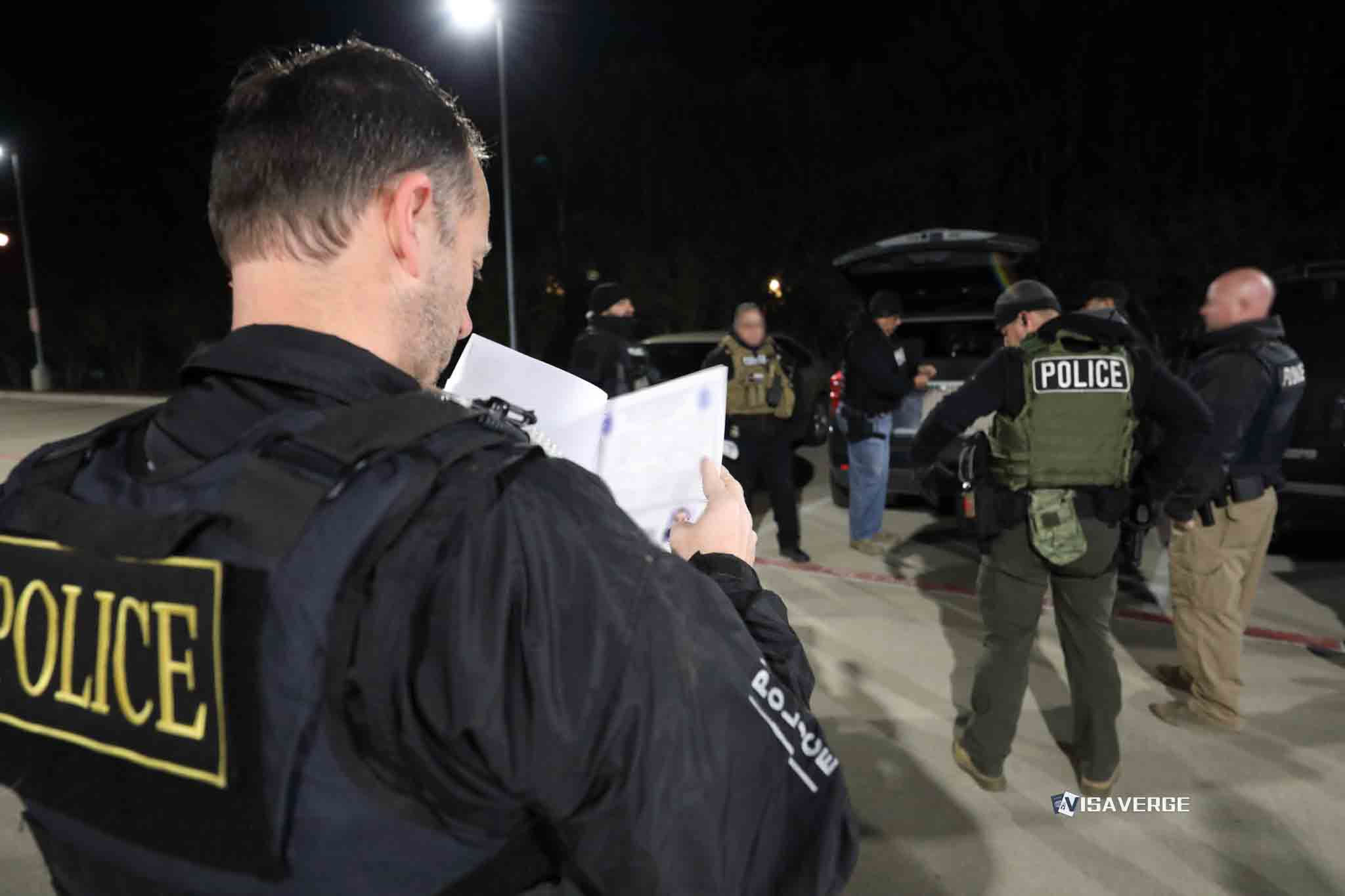
In practice, “intensified enforcement” can mean more arrests, more detentions, more rapid charging decisions, and more removals or transfers. It can also mean more “street-level” encounters, not only jail-based pickups.
Officials and advocates often frame this moment in “rule of law” and “zero-tolerance” terms. Operationally, “zero-tolerance” usually signals fewer discretionary releases and more cases placed into a formal pipeline.
That pipeline can be administrative (removal proceedings) or criminal (illegal entry or re-entry), with very different consequences.
1) What is confirmed vs. still evolving in Arizona
Several agency statements emphasize nationwide enforcement and limited disclosure of forward-looking operations. That matters because DHS and ICE typically avoid confirming planned tactics, locations, or dates in advance.
As a result, residents in Phoenix may hear fast-moving reports that are difficult to verify. Still, readers can focus on what is concrete: how arrest-to-detention-to-court processes work, what documents officers use, and what rights and deadlines apply once a person is in custody.
2) How to read official language about enforcement
Recent public messaging includes: (1) DHS stating it enforces the law daily while not discussing future operations, (2) detention oversight language tied to funding and facility access, and (3) ICE leadership encouraging state and local participation through 287(g) agreements.
Separately, HSI Arizona has publicly described continued enforcement operations after prior workplace and exploitation investigations. Taken together, this kind of language often correlates with greater operational capacity, more referrals between agencies, and more cases moving quickly through custody and charging decisions.
It does not, by itself, confirm the where and when of any particular operation.
3) The operational picture: the “removal hub” idea
When Phoenix is described as a “hub of removal,” the point is logistics. A hub concentrates several functions: arrests, processing, detention space, immigration court appearances, and transport for removal or transfer.
Public reporting has also highlighted an enforcement snapshot involving immigration-related criminal charging in Arizona. The key takeaway is not the exact count on a given week. It is the charging mix.
Criminal entry and re-entry prosecutions can increase the urgency of defense planning, because federal criminal court timelines differ from immigration court timelines.
4) What 287(g) is, and why it matters in Arizona
Section 287(g) of the Immigration and Nationality Act authorizes DHS to enter agreements with state or local law enforcement agencies so trained officers can perform certain immigration functions under ICE supervision. See INA § 287(g).
On the ground, 287(g) activity often shows up at a jail. It may involve screening, interviews, database queries, or assistance with paperwork that supports ICE custody decisions.
In some settings, it may increase the chances that a local arrest leads to ICE interest. A related tool is the immigration detainer, which is a request to a local agency. Detainers are governed in part by regulation. See 8 C.F.R. § 287.7.
Detainers can affect release timing, but they do not by themselves decide removability.
Warning: Do not assume a local police stop is automatically an “ICE stop.”
But do assume records created at booking can be shared and later reviewed.
5) Detention expansion and why “processing” differs from “beds”
Plans discussed publicly in Arizona include a processing facility concept and potential additions of detention bed capacity. Those are not the same thing.
A processing facility typically focuses on intake, fingerprinting, database checks, medical screening, property handling, and initial custody decisions. Long-term detention beds are about holding capacity while a case proceeds.
More capacity can change how quickly people are moved from arrest to detention, and how often ICE can run operations without running into space limits. Timelines and contracting can remain uncertain, and facilities can face approvals, staffing constraints, and litigation.
Local impacts are practical and immediate: transport distances, access to counsel, family visitation, and the ability to gather documents for court.
Deadline: If a person is placed in removal proceedings, missing an immigration court hearing can trigger an in-absentia removal order.
See INA § 240(b)(5).
6) Funding signals and what they can (and cannot) predict
Funding references matter because staffing, transportation, detention contracts, and overtime are expensive. If agencies hire rapidly, they may expand their operational reach.
At the same time, funding does not guarantee a specific schedule of Phoenix-area operations. DHS components can shift resources quickly based on priorities, court capacity, and detention space.
Readers who want verified updates should monitor agency announcements and press releases from DHS, ICE, USCIS, and the U.S. Attorney’s Office.
7) Why “street-level” enforcement changes community risk
“Street-level” encounters can increase fear because they are visible and can feel unpredictable. They also create more opportunities for misunderstandings about rights and obligations.
Risk varies sharply by personal history. Prior removal orders, prior criminal convictions, and prior immigration fraud findings can change outcomes. For example, reinstatement of a prior removal order is authorized by statute and can move fast. See INA § 241(a)(5).
Criminal re-entry exposure is a separate federal issue that may run parallel to removal.
8) The step-by-step process: from encounter to case outcome
Below is the typical process for Arizona residents who face an ICE encounter, jail transfer, or immigration court case. Not every step happens in every case.
1) Encounter, stop, or jail booking
What it accomplishes: Creates the initial record that may trigger ICE interest.
Documents you may see: Local booking paperwork; ICE may later generate Form I-213 (Record of Deportable/Inadmissible Alien).
Decision point: Street release, local prosecution, or continued custody.
Common mistake: Carrying false documents or making false claims to officers. That can create separate legal problems.
2) ICE interest, detainer, or transfer
What it accomplishes: Moves the person into federal immigration custody, or flags them for pickup.
Documents you may see: Detainer paperwork; administrative arrest documents such as Form I-200 (Warrant for Arrest of Alien), in some cases.
Timeline: This can happen quickly after booking, sometimes before local release.
Decision point: ICE may keep the person detained, or in some cases release with conditions.
Warning: Signing papers without reading can lock in a faster removal path.
Ask for an attorney, and request an interpreter if needed.
3) Charging pathway: immigration case vs. federal criminal case
What it accomplishes: Determines forum, deadlines, and available defenses.
Immigration path documents: Form I-862 (Notice to Appear) starts removal proceedings under INA § 240.
Criminal path: A federal complaint or indictment for illegal entry or re-entry may be filed, separate from immigration court.
Decision point: Some people face both tracks. Coordination between criminal defense and immigration counsel is often critical.
4) Custody review and bond (if available)
What it accomplishes: Determines whether the person can fight the case from outside detention.
Law and rules: Detention authority often arises under INA § 236 or INA § 241, depending on case posture. Bond rules differ by posture and category.
Forms: EOIR bond motions vary by court practice; representation is entered with Form EOIR-28 for immigration court, and Form G-28 for DHS matters.
Common mistake: Missing a bond hearing opportunity because family cannot quickly gather identity documents, proof of address, or support letters.
5) Relief screening and applications
What it accomplishes: Determines whether the person can stay in the United States legally.
Possible relief: Asylum under INA § 208, withholding under INA § 241(b)(3), CAT protection, cancellation under INA § 240A, and others.
Forms and documents:
- Form I-589 for asylum/withholding/CAT, with supporting declarations and country evidence.
- Identity documents, proof of residence, police/court records, and prior immigration records.
Timeline: Immigration court timelines vary widely. Detained dockets often move faster.
6) Court decision and next steps
What it accomplishes: Sets removability and relief outcomes.
If the person loses: Removal may be ordered under INA § 240, followed by enforcement under INA § 241.
If the person wins relief: Status or protection may be granted, depending on the application.
Decision point: Appeal deadlines are short. A BIA appeal generally must be filed within the required window after the immigration judge’s decision.
7) Removal logistics or release planning
What it accomplishes: Determines travel documents, transport, and custody conditions.
Documents you may see: Form I-205 (Warrant of Removal/Deportation), in some cases.
Common mistake: Not having a family plan for childcare, rent, medical needs, and access to key documents.
A short “how to verify” checklist for alerts in Phoenix
Rely on official sources first. Look for a corresponding press release or advisory from ICE, DHS, USCIS, EOIR, or DOJ.
Be cautious with posts that lack dates, locations, or agency identifiers.
When to get an attorney quickly
If a person has a prior removal order, a criminal history, or any pending criminal charge, attorney review is especially important. So is counsel for anyone considering signing a stipulated removal, voluntary departure, or any document they do not fully understand.
Official resources (government):
- ICE Newsroom (not listed):
- DHS News (not listed):
- USCIS Newsroom: [USCIS Newsroom](
- DOJ U.S. Attorney’s Office (District of Arizona): [DOJ U.S. Attorney’s Office (District of Arizona)](
- EOIR Immigration Court information: [EOIR Immigration Court information](
Community and attorney referrals:
- [AILA lawyer referral](
⚖️ Legal Disclaimer: This article provides general information about immigration law and is not legal advice. Immigration cases are highly fact-specific, and laws vary by jurisdiction. Consult a qualified immigration attorney for advice about your specific situation.
Arizona is seeing a significant shift in immigration enforcement, moving toward a ‘zero-tolerance’ model. This includes intensified street-level encounters, the expansion of detention facilities, and Phoenix’s emergence as a logistical hub for removals. Local police increasingly collaborate with ICE through 287(g) agreements, speeding up the transition from arrest to federal custody. Legal experts emphasize the importance of understanding rights and preparing for rapid administrative or criminal proceedings.