- New pilot programs in El Paso and San Diego mandate a 21-day filing deadline for asylum applications.
- Form I-589 must be completed without leaving any blank spaces to avoid immediate case dismissal.
- Applicants must connect their fear of harm to specific protected legal categories like religion or nationality.
(EL PASO) People filing asylum claims in El Paso and San Diego face a tighter clock in 2026, and Form I-589 is the document that starts the case. For many applicants, the biggest change is not the form itself but the deadline: in select pilot jurisdictions, filing must happen within 21 days of arrival or the case can be dismissed or pushed into removal proceedings.
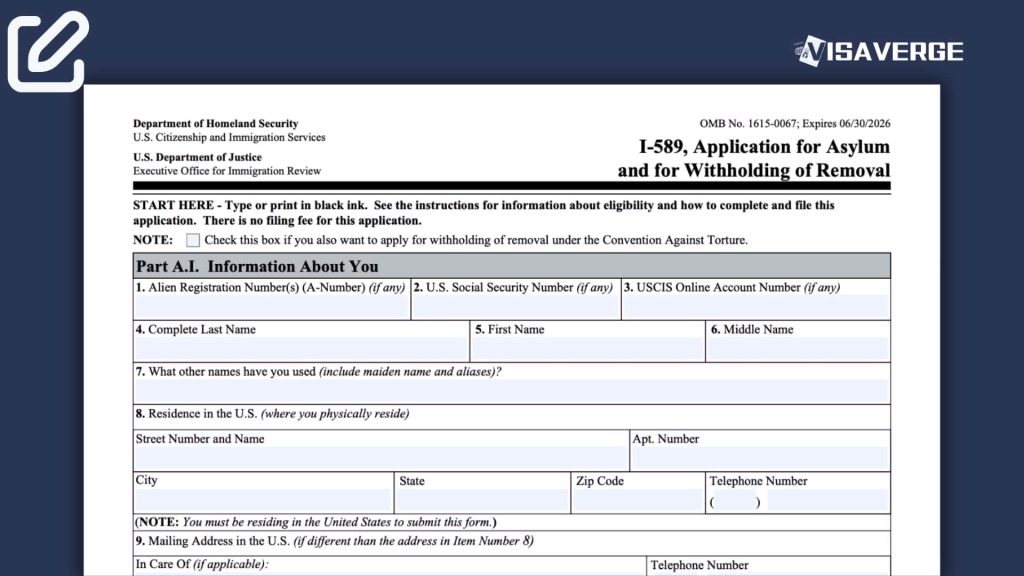
That makes early preparation urgent. The form still carries no filing fee, but USCIS expects complete, truthful answers, strong evidence, and clean paperwork. A late, thin, or inconsistent filing now carries more risk than it once did.
The filing window is now the first test
Form I-589, the Application for Asylum and for Withholding of Removal, is used by people physically present in the United States who seek asylum, withholding of removal, or protection under the Convention Against Torture. Most applicants still face the traditional one-year filing rule after their last arrival, with exceptions for changed country conditions, serious illness, legal disability, and other extraordinary circumstances.
In El Paso, San Diego, and Tucson, the 2026 pilot track shortens that window to 21 days. That deadline shapes the whole case. Applicants who miss it risk denial, referral to court, or removal exposure. VisaVerge.com reports that this stricter approach is already changing how attorneys and shelters organize intake, because delay now carries immediate consequences.
The first move is simple: get the latest edition of the form from USCIS and file the cleanest version possible. The official asylum page at USCIS asylum information explains the current filing rules, while the form itself is available at Form I-589.
Start with the parts that USCIS checks first
The form runs 10 pages, plus supplements. Fill it electronically when possible, then print and sign in black ink. Leave nothing blank. Use “N/A,” “None,” or “Unknown” where needed. Do not use correction fluid or make messy changes. If you make a serious mistake, start over.
Part A asks for personal details, immigration history, family information, and background. List your full name, address, birthplace, country of origin, A-Number if you have one, and Social Security number if you have one. Then disclose every U.S. entry, prior immigration contact, arrest by DHS, and any court appearance.
Part A also asks about a spouse and children. Include them if they will be covered by your case, or leave them out if they will apply later through Form I-730 after a grant. For more than four children, use Supplement A. If you are in court, related cases may be joined.
The claim section must tell one clear story
Part B is where the asylum claim lives. You must connect the harm you fear to race, religion, nationality, political opinion, or membership in a particular social group. That last category often covers LGBTQ+ claims and other identity-based cases.
Describe past harm in order. Include dates, places, names, threats, arrests, assaults, and the people who carried them out. If the harm came from private actors, explain why your government would not protect you. If you fear future harm, say exactly what would happen and why return is dangerous.
You must also explain criminal history, political or religious ties, and any fear of torture for Convention Against Torture protection. Answer every “yes” honestly and explain fully. USCIS treats dishonesty as a serious problem, and false statements can create permanent inadmissibility.
Extra answers belong in Part C
Part C asks about earlier asylum filings, travel through other countries, return trips home, late filing, and crimes or arrests in the United States. These questions matter because they can raise bars to approval.
If you passed through another country and did not seek protection there, explain why. If you filed late, explain the reason in detail and attach evidence. Medical records, school records, country reports, and affidavits all help. If you ever returned home after fleeing, explain the circumstances without minimizing the trip.
Keep the facts consistent with every other form, interview, and record. Even small contradictions can trigger deeper review.
Evidence turns a claim into a case
USCIS will accept the filing without every document, but strong applications usually arrive with the core proof already attached. Bring or mail two passport-style photos for each person, identity records, birth and marriage certificates, passports, and any Form I-94 record. Add translations for every non-English document.
The most important document is the personal declaration. It should be detailed, chronological, and written in the first person. Many strong declarations run 10 to 20 pages. They explain who harmed you, what happened, why it happened, and why you fear return.
Other useful evidence includes:
- police reports or complaint records
- medical and psychological records
- photos of injuries or damage
- witness affidavits
- journals or contemporaneous notes
- country-condition reports and news coverage
In the 2026 pilot jurisdictions, applicants are being pushed to submit key evidence with the first filing rather than waiting for later notices. That shift is especially important in fast-moving border cases.
Submission paths depend on where the case starts
Affirmative cases go to USCIS. Defensive cases go through immigration court. If you file affirmatively, mail the form to the correct USCIS address based on where you live, or file online through myUSCIS when the system allows it. After submission, a receipt notice usually arrives first, followed by biometrics scheduling.
If you are in removal proceedings, file with the immigration court and serve a copy on the government attorney. Keep proof of service and one full copy for your records. Missing the filing step in court can delay the case or create procedural problems.
What happens after USCIS receives the form
Biometrics are mandatory. Attend the appointment exactly as scheduled. Missing it can lead to abandonment. After that, USCIS usually schedules an asylum interview. The interview is non-adversarial, and an interpreter can be provided. Bring originals, organized copies, and any updated evidence.
If the case is pending long enough, the applicant can seek work authorization. Eligibility begins 150 days after filing, and the permit can be granted after 180 days if the case remains pending. Applicants use Form I-765 for that request.
The official filing page for work authorization is Form I-765. Asylees who win protection can later pursue lawful permanent residence after one year, which gives families a more stable path forward.
The practical pressure is growing
Backlogs remain heavy, and waiting times stretch widely across the system. USCIS cases can move in months, while court cases often take much longer. That delay affects work, housing, and family planning. For people in El Paso and San Diego, the 21-day pilot rule adds urgency before the first interview is even set.
The safest filing strategy is straightforward: use the current form, answer every question, explain every “yes,” and support the claim with evidence that fits the story. Keep copies of everything, including notices and translations. If family members are included, make sure names, dates, and relationships match across all pages.
For many applicants, Form I-589 is not just paperwork. It is the first official account of fear, escape, and survival. In a system that now moves faster at the border and remains slow everywhere else, the strength of that first filing matters more than ever.