Low-Cost VS Ultra-Low-Cost
The binary model of US aviation is dead. This report analyzes the structural, financial, and operational differences between LCCs and ULCCs—and the 2025 convergence reshaping how budget airlines survive.
LCC CHARACTERISTICS
- Evolved into “Value-Premium” carriers targeting business travelers
- Higher costs but command higher fares via bundled experience
- Free snacks, Wi-Fi, better legroom (31-33″ pitch)
- Southwest ending 50 years of open seating in 2026
ULCC CHARACTERISTICS
- “Cost-First” philosophy: lowest CASM is the primary goal
- Base fares often lower than taxes; revenue from fees
- High-density seating (28-29″) maximizes capacity
- Frontier leads globally at 62% ancillary revenue
For decades, the US airline industry was categorized into a simple binary: “Legacy” carriers and “Low-Cost” carriers. The last 15 years have fractured this low-cost segment into two distinct business models with fundamentally different economics.
As of 2025, the distinction is no longer just about price—it is about the fundamental architecture of how the airline makes money. LCCs like Southwest and JetBlue have evolved into “Value-Premium” carriers, while ULCCs like Frontier and Spirit operate on a “Cost-First” philosophy where the airplane is viewed not as a service vessel but as a real estate asset where every square inch must generate yield.
Free toolB1/B2 Tourist Visa Stay Calculator onlineDefining the Difference
The divergence begins with the philosophy of the seat. How each model views its core product—the aircraft seat—determines everything from pricing to operations.
LCC Model
Southwest, JetBluePhilosophy: “Inclusion.” The ticket price generally includes the seat, a carry-on bag, snacks, and entertainment.
Originally about simplicity (one plane type, no meals), US LCCs have drifted “upmarket” to capture business travelers and customers disillusioned by legacy carriers.
Fleet Strategy: Single fleet families (Boeing 737) with lower density configurations allowing 31-33″ pitch legroom.
ULCC Model
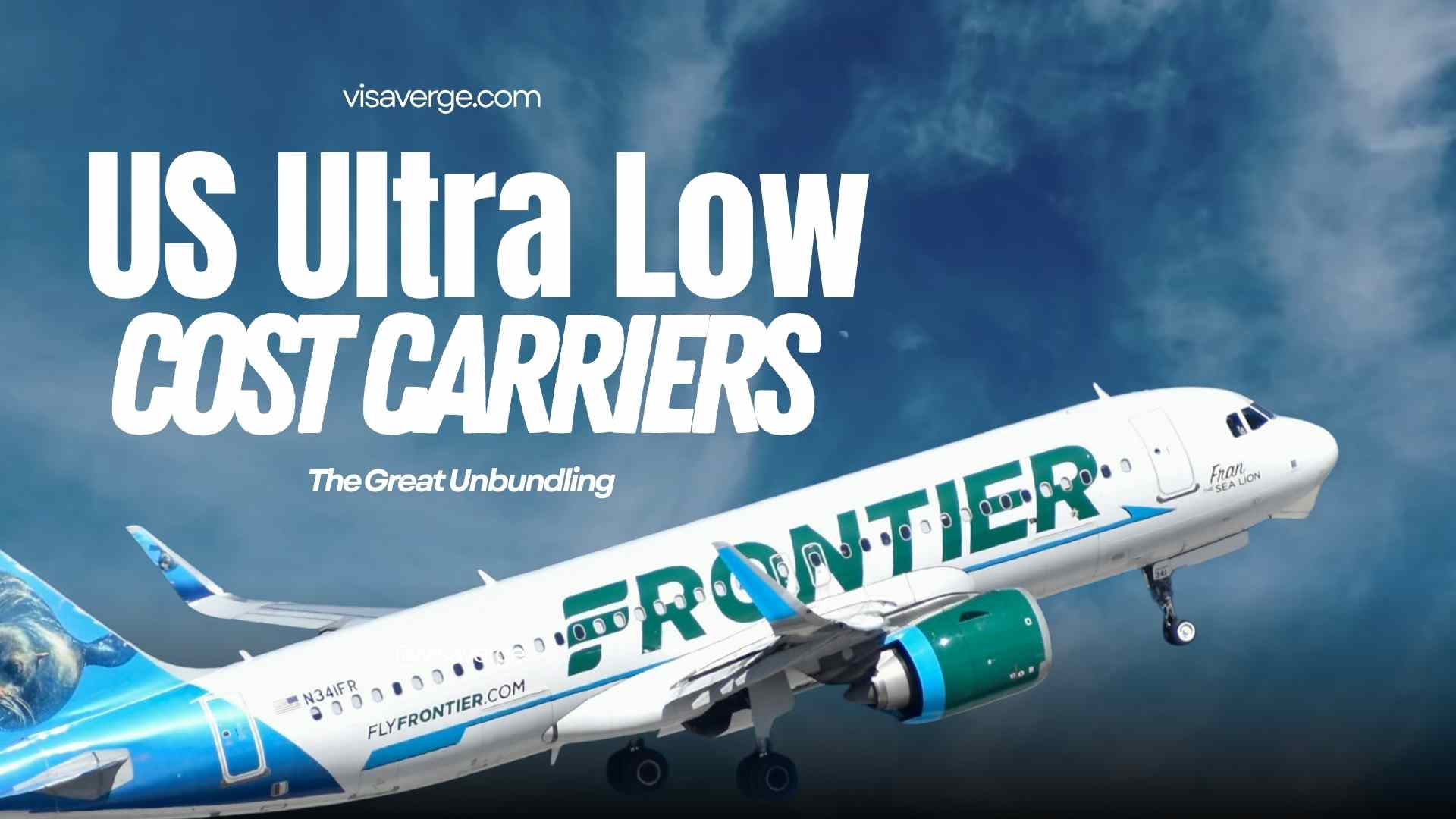
Frontier, Spirit, AllegiantPhilosophy: “Unbundling.” The ticket buys only transportation. Seat selection, bags, or water—you pay extra.
The ULCC model is a “financial derivative” of the airline industry, viewing the airplane as real estate where every square inch must generate yield.
Density: A Frontier A321neo fits ~230-240 passengers vs. ~190 on legacy carriers—mathematically lowering cost per passenger.
The Cost & Revenue Gap
The truest difference between an LCC and a ULCC is found in their Unit Cost (CASM) and Revenue Composition. Cost Per Available Seat Mile (CASM) excluding fuel measures how much it costs the airline to fly one seat for one mile—the definitive measure of efficiency.
The Efficiency Hierarchy (2024 Estimates)
| Category | Airline | CASM-ex | Analysis |
|---|---|---|---|
| ULCC | Frontier | ~6.24¢ | The efficiency king. Radical cost-cutting and high seating density. |
| ULCC | Spirit | ~7.97¢ | Rose significantly in 2024 due to lower utilization and engine issues. |
| LCC | JetBlue | ~11.82¢ | High costs due to NYC dominance and premium labor contracts. |
| LCC | Southwest | ~12.25¢ | Aging infrastructure and high labor costs eroded historic advantage. |
| Legacy | Delta/United | ~13.00¢+ | Highest costs due to complex hubs, lounges, and global networks. |
A ULCC like Frontier operates at nearly half the unit cost of an LCC like Southwest. This mathematical reality allows Frontier to be profitable at fare levels where Southwest would lose money.
The Ancillary Revenue Addiction
LCCs rely on ticket prices; ULCCs rely on “extras.” In 2024, Frontier generated 62% of its total revenue from ancillary fees (bags, seats)—the highest in the world. Spirit followed at 58.7%. Their business is effectively an e-commerce platform that happens to fly planes.
Southwest has historically had low ancillary revenue because of its “Bags Fly Free” policy. However, even this is changing with their move to monetize premium seating in 2025/2026.
The Great Convergence
The rigid wall between LCC and ULCC crumbled in 2024/2025 as both models faced existential threats. Stuck in the “middle” between cheap ULCCs and premium Legacies, LCCs are sprinting toward premium products—while ULCCs are “re-bundling” to look more like LCCs.
LCCs Moving Up
Ending 50 years of open seating. Introducing assigned seating and Extra Legroom sections (~34″ pitch) to capture business revenue.
Introducing domestic First Class (non-Mint) cabins on core routes in 2026 and opening airport lounges to compete directly with Delta.
ULCCs Re-Bundling
Eliminated change fees. Introduced “UpFront Plus”—European-style business class with blocked middle seat in first two rows.
Introduced bundled fares including carry-on, checked bag, and seat selection to combat legacy “Basic Economy” fares.
Feature Matrix: LCC vs. ULCC
| Feature | Low-Cost Carrier (LCC) | Ultra-Low-Cost (ULCC) |
|---|---|---|
| Primary Examples | Southwest, JetBlue | Frontier, Spirit, Breeze, Allegiant, Avelo |
| Base Fare | Moderate (includes essentials) | Rock Bottom (seat only) |
| Seat Pitch | 31–32 inches (Generous) | 28–29 inches (Tight/Pre-reclined) |
| Carry-on Bag | Usually Free | $$$ (Often more than the ticket) |
| Seat Selection | Moving to Paid/Assigned | $$$ (Dynamic pricing) |
| Network Model | Hybrid (Point-to-Point + Focus Cities) | Point-to-Point / Out-and-Back |
| Fleet Utilization | High, but constrained | Extreme (target 12+ hours/day) |
| Reliability (OTP) | Moderate to High | Volatile (cascading delay risk) |
| Customer Target | Families, Small Business, Value Seekers | Price-sensitive Leisure, Students |
A Spectrum, Not a Binary
The distinction between Low-Cost and Ultra-Low-Cost is no longer just about the price tag—it is about flexibility vs. discipline.
LCCs (Southwest/JetBlue) offer flexibility. They are designed for customers who want a “safe” travel experience with predictable costs. Their challenge in 2025 is that costs have risen so high (approaching legacy levels) that they must add premium products to justify fares.
ULCCs (Frontier/Spirit/Breeze) offer discipline. They are designed for the “expert” traveler who can navigate fee structures to travel for pennies, or the “splurge” traveler willing to pay for bundles still cheaper than legacy tickets. The failure of Spirit (bankruptcy) vs. the success of Frontier (profitability) in 2024 proves the ULCC model only works when operations are flawless and costs are ruthlessly controlled.
You fly an LCC to save hassle; you fly a ULCC to save money.