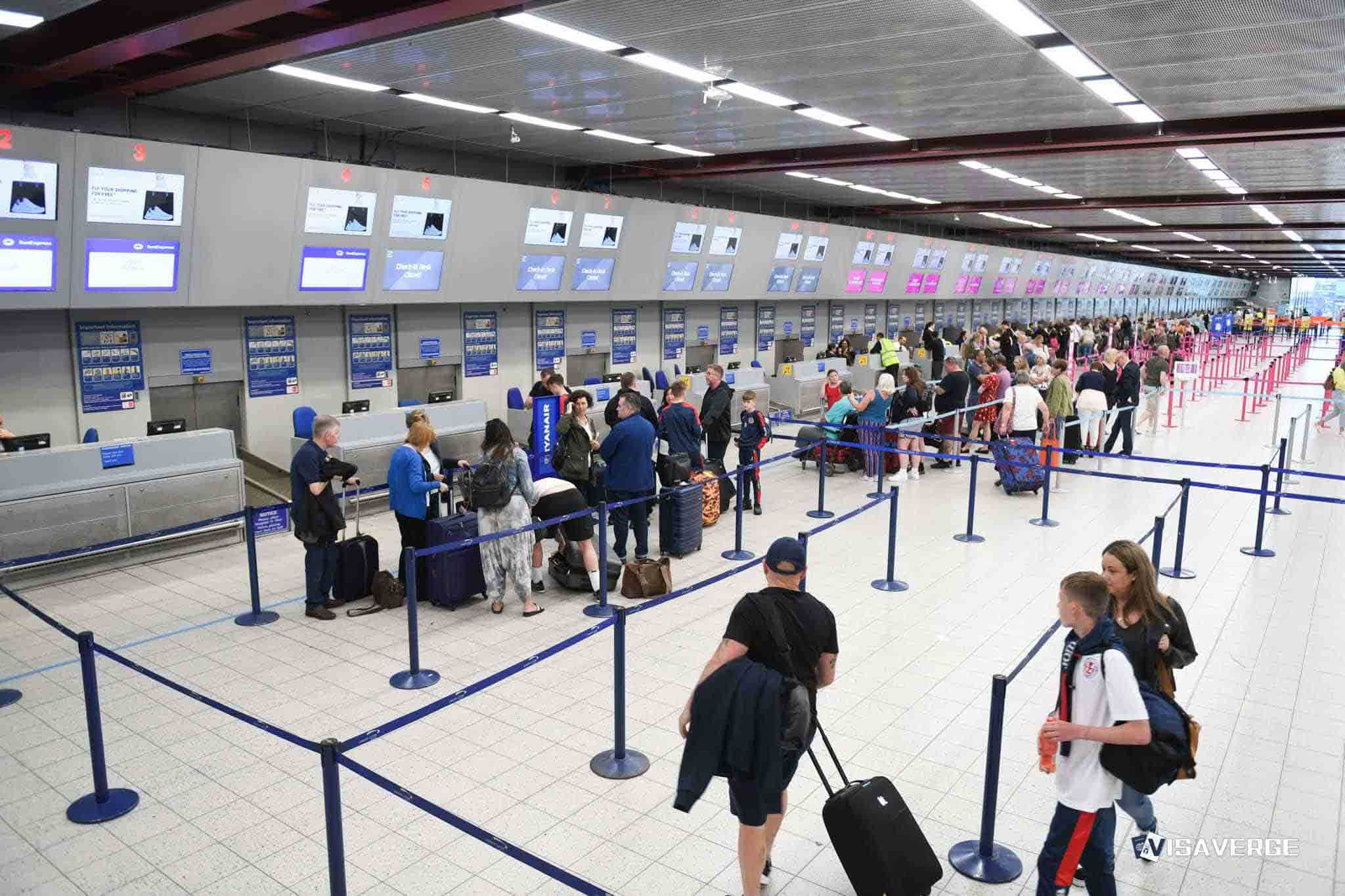
- Winter Storm Fern is causing thousands of flight cancellations across more than 40 states.
- Dallas-Fort Worth International Airport faces severe operational disruptions impacting nationwide flight rotations.
- Major airlines have issued travel waivers for rebooking without fees through January 25th.
(DALLAS, TEXAS) — A fast-moving winter storm is already triggering thousands of cancellations, and your best “airline choice” this weekend may be the one that can rebook you fastest. If you’re flying through Dallas-Fort Worth International Airport or any large hub, expect knock-on disruptions nationwide.
If your trip is optional, the smartest move is usually to rebook proactively under a waiver before seats vanish. Forecasters are calling the system Winter Storm Fern, and the footprint is huge.

Airlines and weather firms are projecting disruption across 40+ states. That scale matters because U.S. airline networks are tightly connected. When aircraft and crews can’t get into a hub on time, they can’t operate the next leg.
Even “clear-sky” airports can see delays or cancellations when the inbound plane is stuck elsewhere. AccuWeather has warned of as many as 6,000 cancellations “through Monday.” For travelers, “through Monday” includes Sunday night positioning flights and Monday-morning departures.
Those early flights are often the first to get pre-canceled. Airlines do that to keep crews legal and aircraft where they’re needed. And headlines can be misleading: “predicted cancellations” are an outlook, not a guarantee, while “confirmed cancellations” are what’s actually been pulled from the schedule so far.
The confirmed number usually rises in waves as airlines pre-cancel, then adjust again as runway conditions change.
The quick recommendation: pick the airline that matches your flexibility
If you’re choosing between carriers right now, focus on two things: how many alternative flights they can offer from your airport, and how cleanly their waiver rules let you change plans.
At Dallas-Fort Worth International Airport, American has the biggest operation. That can be a blessing because there are more same-day options, and it can also be a curse because a DFW meltdown hits American’s system hardest.
Southwest’s Love Field focus can be a nice escape hatch for some itineraries. JetBlue can work well in the Northeast, but it has less depth outside its core cities.
Ultra-low-cost carriers can be cheapest on paper, but they often give you fewer backup flights when the schedule collapses.
Side-by-side: storm disruption playbook by airline
Below is a concise summary of how major carriers typically behave in a storm, their waiver posture right now, and the main operational catches to watch for.
| Airline | Where it shines in a storm | Typical waiver structure right now | The main catch | Miles/points angle |
|---|---|---|---|---|
| American Airlines | Largest DFW inventory; lots of nonstop options | Waiver for ~34 airports; tickets bought before Jan. 19; travel Jan. 23–25; rebook by Jan. 25 | Eligibility depends on purchase date and city list | AAdvantage awards often redeposit more easily under disruptions; status flyers may get priority help |
| Delta Air Lines | Operational consistency; strong app rebooking | Waivers spanning parts of the East plus central/southeastern states | City list rules can be narrow | SkyMiles awards can be re-timed without cash; MQD/MQM earning depends on flown segments |
| United Airlines | Hub depth at EWR/IAD plus broad connectivity | Waivers for Mid-Atlantic/Northeast and parts of the South; examples include AUS, BNA, BHM, CHA, AMA for Jan. 23–25 | Routing changes may not be allowed | MileagePlus awards can be easier to adjust than cash during waivers |
| Southwest Airlines | Friendly change policy even without a waiver | Waivers issued; Love Field impact notable | Limited interline options; seats can disappear fast | Rapid Rewards points redeposit quickly; no change fees helps even outside waiver windows |
| JetBlue | Solid Northeast coverage; decent customer tools | Waiver for ~11 Northeast cities | Smaller network means fewer reroute options | TrueBlue awards can be flexible; Mint seats can be hard to reacquire once canceled |
| Spirit Airlines | Low upfront fares | Waives modification charges and fare differences for selected cities; travel Jan. 23–25 | Fewer backup frequencies | Award options are limited; cash rebooking can spike last-minute |
| Frontier Airlines | Sometimes the cheapest way out | Publishes delay thresholds for refunds on some itineraries | Very thin schedules in many markets | Miles are less useful during irregular ops; fewer partner outs |
These policies change quickly. The waiver headline is only step one. The real question is how many open seats your airline has on flights you’d actually take.
How big is the disruption right now, and why numbers don’t match
By mid-afternoon Friday, trackers showed hundreds of Friday cancellations and more than 2,000 already canceled for Saturday. Other early reports showed even higher totals, plus five-figure delays.
That mismatch is normal. Three things cause it:
- Time stamps matter. A 7 a.m. count will be lower than a 3 p.m. count. Airlines often pre-cancel later in the day.
- Cancellations vs. delays. A “delay” can still ruin your trip if it breaks your connection. A long taxi-out or a late inbound aircraft can cascade.
- Different definitions. Some trackers highlight “significant delay,” while others count any delay above a threshold.
Ripple effects are also real. You can see disruption at West Coast hubs when the storm is in Texas or the Southeast. Planes and crews need to arrive first; if they don’t, the outbound flight fails.
Use multiple sources for one purpose: confirming your specific flight number. Start with your airline’s app and text alerts. Then cross-check with an independent tracker and the airport’s departure board for gate-level changes.
The DFW factor: why one hub can wreck the national schedule
Dallas-Fort Worth International Airport is a connecting machine. When it slows down, it doesn’t just strand Dallas travelers.
It strands passengers connecting between coasts, aircraft that were supposed to overnight and fly out at dawn, and crews that time out and can’t legally continue.
For Saturday alone, DFW was showing 1,121 scheduled cancellations. That’s not just “Dallas flights.” It’s a national rotation problem. If your plane was supposed to start in DFW, your New York flight can cancel even in clear weather.
Waivers: what they usually cover, and what they usually don’t
A travel waiver is your permission slip to change plans without the usual penalties. In most cases, a waiver allows a fee-free date change within a window.
What a waiver often covers includes changing your travel date, rebooking to a different flight in the same city pair, and sometimes same-cabin moves without a change fee.
What it often does not cover includes changing your origin or destination freely, upgrading cabins without paying the fare difference, or protecting you from sold-out flights.
Eligibility usually depends on three things: when you bought the ticket, your original travel dates, and whether your airports are on the affected-city list.
This is where airlines differ in traveler experience. Southwest is naturally flexible even when a waiver is tight. Legacy carriers can be strong if you’re inside the waiver rules. Ultra-low-cost carriers can leave you with fewer backup flights.
⚠️ Heads Up: Don’t assume your airport qualifies just because it’s nearby. Waivers can exclude secondary airports, even in the same metro area.
Refunds, rebooking, and credits: the U.S. rules that matter in a storm
In the U.S., the Department of Transportation’s baseline principle is simple. If your flight is canceled or significantly delayed and you don’t accept the alternative, you’re entitled to a refund.
That’s true even when weather caused the disruption. Weather mainly changes what you should expect beyond the ticket price. You should not count on hotels, meals, or extra compensation for weather.
The choice you make matters: a refund returns money to the original payment method if you decline the alternative; rebooking accepts a new itinerary and can end your refund path; travel credit or voucher is often offered quickly, but it’s not the same as a refund.
Also watch waiver windows. If you rebook outside the waiver dates, the fare difference can return. If your airport isn’t on the list, the fee-free change may not apply.
Note: This section leads into traveler-facing tools that summarize city lists, refund options, and waiver windows. Use your airline’s published waiver page and DOT guidance to confirm specifics for your ticket.
Where the storm is hitting hardest, and how to think about alternate airports
Fern’s spread is wide, but three regions are getting the most operational stress.
Texas and nearby airports. DFW is the headline. Austin and Amarillo are also referenced in airline waiver lists. If DFW is your connection point, consider rerouting around it early.
South and Southeast corridor. Ice is the problem here. Crews may not be able to drive in safely. Ground operations slow down, and de-icing demand can overwhelm equipment.
Northeast and Mid-Atlantic. Dense schedules and slot constraints mean less slack. De-icing lines can stack up fast at Boston, New York, and Philadelphia.
Alternate airports can help, but there are tradeoffs: driving time and road safety, fewer flights per day at smaller airports, and fewer same-day rescue options if the new flight cancels.
Why ice is worse than snow for airports
Snow is disruptive, but airports and airlines plan for it. Ice is the schedule killer. Freezing rain and sleet can force longer de-icing cycles per aircraft and reduce braking action on runways.
Ice can also slow ramp work and baggage handling, and increase ground stops when conditions change fast. Non-aviation impacts matter too: power outages can thin staffing, and hazardous roads can wipe out rideshares.
Airlines reposition planes and crews before a storm, which can cause “sunny-day cancellations” elsewhere. The airline is protecting the next day’s operation.
What to do next: a practical sequence that saves time
Start with your flight status in the airline app. Then decide if you’re trying to travel or trying to protect your money.
- Confirm status and monitor changes. Look for simple status labels like “On time,” “Delayed,” or “Canceled,” and watch for updated departure times.
- Decide whether to fly. If you have a tight connection through a hub, a “delay” can be a functional cancellation.
- Rebook early if you must travel. Once the first big wave cancels, remaining seats get expensive and scarce.
- If you don’t need to go, aim for a refund. Don’t accept an alternate itinerary you won’t use.
- Document everything. Save screenshots of cancellation notices, rebooking offers, and fare differences.
- Pack for the airport, not the flight. Bring chargers, critical meds, and one meal’s worth of snacks.
💡 Pro Tip: If you’re chasing elite status, rebooking to a later nonstop can preserve miles and qualifying credit. A misconnected reroute can cut your earnings.
Miles and points: how storm rebooking affects your rewards
Storm days can quietly change your loyalty math. If you rebook onto a different airline, your mileage earning can change. This matters on partner tickets and codeshares.
If your fare class changes, your earning can drop on some programs. Keep your original receipt and compare after travel. Award tickets are often easier to move; many programs can shift the itinerary without repricing, but seats still have to exist.
Elite perks can matter more than usual. Priority phone lines, fee waivers, and same-day change flexibility are real advantages during mass disruption. If you’re within striking distance of status, don’t ignore the calendar.
A quick benchmark: how Fern compares to late-December’s storm
Late December 2025’s Storm Ezra produced more than 6,000 cancellations. That’s a reminder of how fast winter operations can unravel when hubs get iced in.
Fern is not related to Ezra. The point is operational fragility: ice versus snow, timing, and which hubs are hit determine how bad it gets.
Choose X if…, choose Y if… (real-world scenarios)
Choose American if you’re traveling through DFW or Charlotte and need the most same-day flight inventory. Book earlier flights when possible, and rebook by Jan. 25 if you qualify.
Choose Southwest if your plans are flexible and Love Field works for you. Southwest’s change-friendly structure can be a lifesaver when waivers are narrow.
Choose Delta if you want strong rebooking tools and you’re traveling in the Northeast or Southeast corridors under the waiver. It’s often smooth when you stay inside the rules.
Choose United if you can route around the worst airports using its hubs, especially in the Mid-Atlantic and Northeast. Check whether your specific city is listed.
Choose JetBlue if your trip is Northeast-centric and you value a straightforward experience. Just remember its network is thinner in irregular operations.
Choose Frontier or Spirit if you’re price-driven and have time flexibility. Thin schedules can mean the next available seat is days away.
This weekend, the “best airline” is the one with a waiver you actually qualify for and enough spare seats to get you moving. If your itinerary touches Dallas-Fort Worth International Airport, assume the disruption can echo into Monday morning.
Rebook before the first wave sells out, and if your flight is canceled and you won’t travel, push for a refund rather than a voucher.