U.S. Citizenship and Immigration Services said on Dec. 22, 2025 it has issued new, immediately effective guidance meant to “restore integrity” to victim-based immigration programs after what it called suspected fraud and a sharp rise in filings for VAWA, T nonimmigrant status, and U nonimmigrant status. The agency said the changes are now in the USCIS Policy Manual and apply to cases pending or filed on or after Dec. 22, 2025.
USCIS said filings rose far faster than expected in recent years. From fiscal years 2020 to 2024, the number of Form I-360 VAWA self-petitions increased by approximately 360%, while T nonimmigrant applications rose 1,044% and U nonimmigrant petitions rose 95%. USCIS framed the update as a way to protect these programs “as a resource for women and other alien victims of crimes,” while also “rooting out bad actors and fraudsters,” adding: “Immigration benefits are a privilege.”
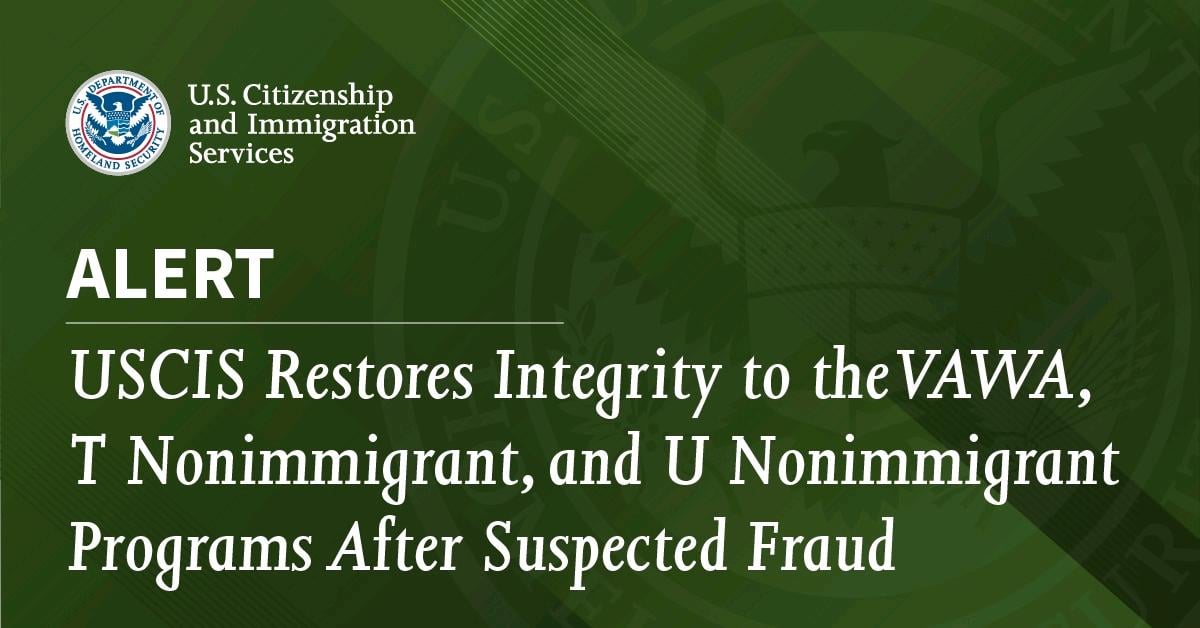
The policy alert, PA-2025-34, focuses on how USCIS applies the confidentiality and “prohibited source” rules in 8 U.S.C. 1367(a)(1) and (a)(2)—a legal shield meant to stop certain people (including an alleged or confirmed abuser, trafficker, or perpetrator of the qualifying crime) from using the immigration system to harm or control a victim. USCIS said earlier policy “limited the ability to use information from ‘prohibited sources’ in certain circumstances despite the statute expressly allowing use of the information,” and that the update will help officers do “thorough and efficient vetting” and investigate possible “fraud, national security, or public safety risks.”
Immediate effect, scope, and where the rules now live
USCIS said the updated guidance is effective immediately after publication and applies to benefit requests pending or filed on or after Dec. 22, 2025. The agency also said the Policy Manual guidance is “controlling and supersedes any related prior guidance.”
For readers who want the official text and the controlling chapter location, USCIS cited Volume 1: General Policies and Procedures, Part A, Public Services, Chapter 7, Privacy and Confidentiality (1 USCIS-PM A.7). The agency also invited public feedback through its Policy Manual channel.
One practical point for applicants and lawyers: when USCIS changes how it weighs evidence and what it can consider, it can shift what a case needs to succeed. That can be stressful for people filing VAWA, T nonimmigrant, or U nonimmigrant cases, because these filings often come during a safety crisis, a break from an abusive partner, or cooperation with law enforcement after a violent crime.
According to analysis by VisaVerge.com, policy shifts around confidentiality often create short-term confusion because many applicants fear that any added scrutiny means their private story will be exposed; the statute is designed to prevent that kind of exposure, but the new USCIS reading changes when and how certain protections apply.
“Prohibited source” information: what USCIS says officers may consider
A central change is USCIS’s explanation that the “prohibited source” provisions do not create a blanket ban on information. USCIS said the statute allows DHS to consider information from a prohibited source in certain circumstances, and the update is meant to clarify those circumstances so officers can review records “as Congress intended.”
In the policy alert’s highlights, USCIS explained a step-by-step approach tied to 8 U.S.C. 1367(a)(1):
- DHS considers whether an alien has been convicted of a crime or crimes listed under INA 237(a)(2) before establishing that prohibited source protections apply in the context described by the statute.
- USCIS said it had not previously implemented the statutory requirement to consider that conviction question first.
- USCIS also said it had not previously limited the ban on use of information “furnished solely” by prohibited sources to certain kinds of decisions, even though the statute describes that limit.
USCIS then drew a bright line about when prohibited source protections do not apply. The policy alert says that, in alignment with the statute:
- If DHS determines that an alien has been convicted of a crime or crimes under INA 237(a)(2), or
- If DHS is not making an adverse determination regarding admissibility or deportability,
then the prohibited source protections under 8 U.S.C. 1367(a)(1) do not apply.
USCIS gave examples of decisions that may fall into that “not making an adverse determination” category, including denial of a VAWA self-petition on Form I-360, denial of a battery or extreme cruelty joint-filing waiver request on Form I-751, or denial of an application for employment authorization for an abused nonimmigrant spouse on Form I-765V.
The alert adds another technical but important point: “Solely in the context of evaluating 8 U.S.C. 1367(a)(1) prohibited source provision applicability, DHS does not consider any available waivers of inadmissibility.” In plain terms, the agency is saying that when it decides whether the prohibited source rule applies, it looks at the conviction question and other statutory conditions first, without weighing possible waivers at that stage.
For survivors and their counsel, the high-stakes part is how USCIS weighs conflicting evidence, especially when an alleged abuser submits information that contradicts a victim’s account. USCIS acknowledged this tension directly in a section it labeled “Reliance Interest,” noting officers may need to consider credibility, weigh evidence case-by-case, and decide what weight to give different sources “particularly in the event of conflicting evidence provided by a victim and their alleged or confirmed abuser.”
Key takeaway: USCIS now instructs officers to ask whether the alien has relevant convictions under INA 237(a)(2) before deciding that prohibited source protections apply, and to treat the statutory limits on “information furnished solely” by prohibited sources as applicable only in certain categories of decisions.
Confidentiality protections: duration, adult-only waivers, and denaturalization
USCIS said it is changing how it reads the duration of confidentiality protections under 8 U.S.C. 1367, including a shift away from earlier guidance that treated those protections as ending at naturalization. The policy alert states USCIS recognizes this is “a substantive shift in both policy and practice,” but says it is necessary because prior policy was “inconsistent with the statute” and did not do enough to protect “the integrity of the immigration system.”
USCIS tied the update to Executive Order 14161, Protecting the United States From Foreign Terrorists and Other National Security and Public Safety Threats (January 20, 2025), saying the change supports adherence to multiple provisions of that order and helps USCIS implement an anti-fraud strategy in benefits protected by 8 U.S.C. 1367.
Two additional clarifications matter for people who worry about privacy after major status changes:
- USCIS said it “reinstates 8 U.S.C. 1367 protections upon initiation (not consideration, as previously stated) of denaturalization proceedings.” That means if denaturalization proceedings begin, USCIS says the confidentiality shield comes back at that point.
- USCIS confirmed that only adults can waive their confidentiality protections under 8 U.S.C. 1367(b)(4).
For families, including derivatives in VAWA, T nonimmigrant, and U nonimmigrant cases, these details can affect how attorneys plan communications and how safely a household can receive mail, attend interviews, or respond to requests for evidence without creating new risk at home.
Contact Center access, address rules, and the “safe mailing” corrections
Beyond evidence rules and confidentiality duration, USCIS said it made practical service changes that will affect daily case management for protected aliens and their lawyers.
- Expanded Contact Center access: USCIS is expanding access to the USCIS Contact Center so that protected aliens’ attorneys and representatives can submit case inquiries. For many survivors, calling on their own can be dangerous or simply not possible, especially if the abuser has monitored phones, mail, or shared logins. Allowing counsel to make inquiries can reduce that burden and may reduce mistakes caused by fear or rushed calls.
-
Address and registration requirements: USCIS emphasized that alien registration requirements and change of address requirements apply even to people covered by 8 U.S.C. 1367 confidentiality provisions. Confidentiality is not exemption from compliance duties. People who move to a safer place still have to follow address-change rules, even if they need USCIS to use a safe mailing method.
-
Safe mailing corrections: USCIS said it made “minor technical revisions” to safe address procedures to help protected aliens receive mail on time and control which address USCIS uses. These revisions also correct “minor technical errors” in previously published safe address procedures.
For readers trying to keep a case on track while staying safe, the details can matter as much as the legal standard. A missed notice can lead to a missed deadline, and a missed deadline can lead to a denial—so the safe mailing procedures are not a side issue for many VAWA, T nonimmigrant, or U nonimmigrant applicants.
Processing time, fairness, and fraud reporting
USCIS acknowledged that the policy shift “may either positively or adversely impact anticipated processing times,” depending on the case, because officers may need to review more evidence, weigh credibility, and address conflicting submissions.
USCIS also acknowledged a hard scenario: someone might be otherwise eligible for a waiver of inadmissibility because the victim proved a crime occurred in the context of victimization—USCIS gave the example of a person forced to commit a crime by an abuser or trafficker—yet the request could still be denied based on information provided solely by a prohibited source.
Even so, USCIS said it “has thoroughly considered all these potential outcomes” and decided they do not outweigh the need to follow “clear statutory language” in 8 U.S.C. 1367(a)(1). USCIS also said impacted aliens “will not suffer unfair surprise or harm” because they should be aware of the statutory requirements.
On procedural fairness, USCIS said that in individual cases it will:
- “Continue to provide notice of derogatory information of which the petitioner or applicant is unaware,” and
- Provide an opportunity to rebut the information and present information on their behalf before reaching a decision.
USCIS added that officers retain discretion to weigh evidence case-by-case.
Finally, USCIS encouraged the public to report suspected immigration benefit fraud or abuse using the official USCIS Tip Form. For survivors and advocates, that message can land in two ways at once: as a promise to protect programs from exploitation, and as a warning that filings in the VAWA, T nonimmigrant, and U nonimmigrant space may face closer review when facts don’t line up.
USCIS has introduced immediate policy changes for victim-based immigration programs to combat fraud and clarify legal standards. The update defines when officers may use information from prohibited sources, such as abusers, and outlines the duration of confidentiality protections. It also improves administrative procedures, including safe mailing protocols and expanded Contact Center access for legal representatives, while emphasizing that immigration benefits remain a privilege subject to rigorous vetting.