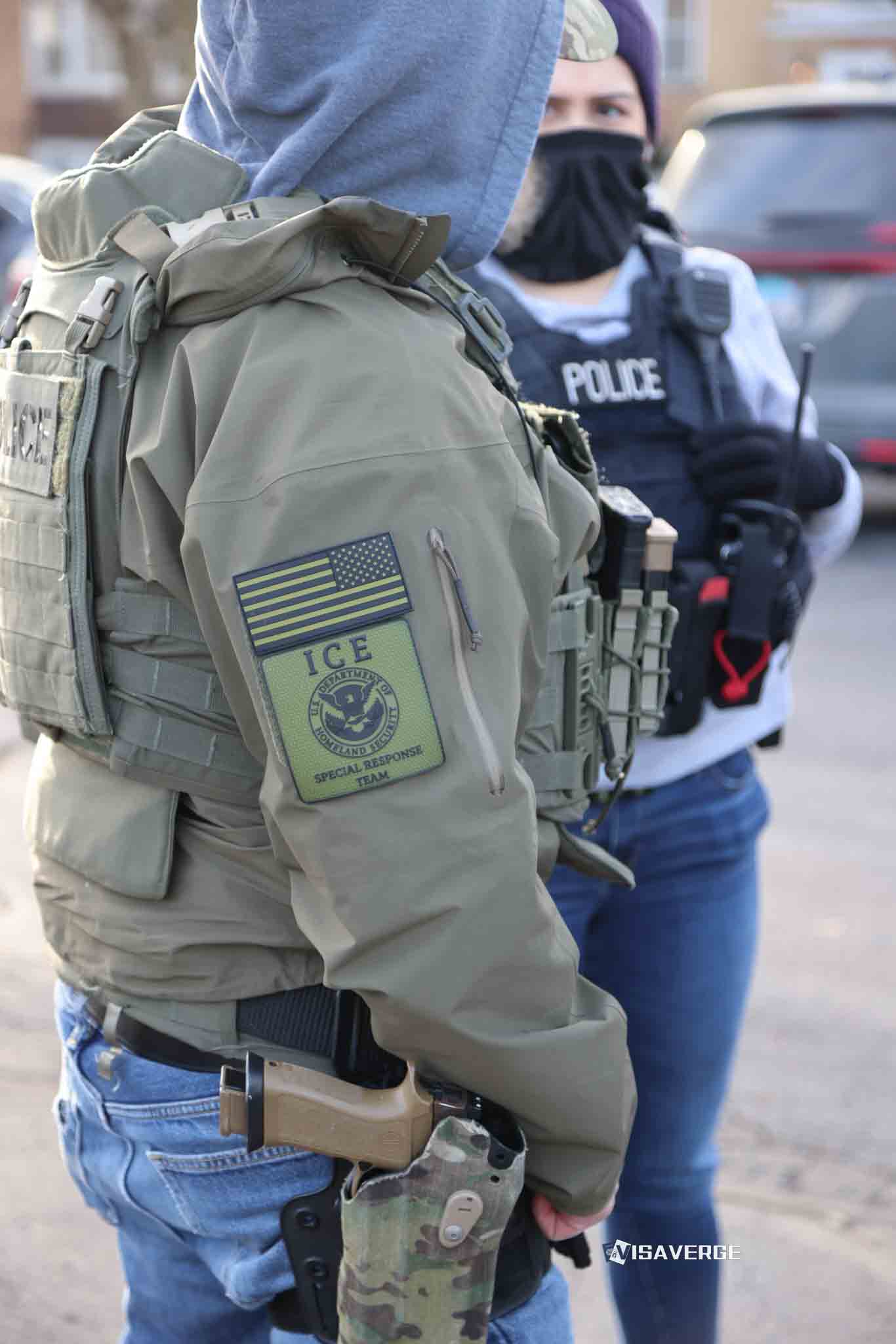
(MONTGOMERY COUNTY) — Montgomery County faith leaders joined local officials in urging support for the county’s proposed Trust Act, saying federal immigration enforcement changes have raised fears in congregations and across immigrant neighborhoods.
Religious leaders described what they called a “moral crisis” as they organized sanctuary networks and “Know Your Rights” training in response to a federal policy shift that allows ICE agents to enter “sensitive locations,” including houses of worship.

Federal officials’ framing vs. local concerns
Federal officials have framed the enforcement approach as a return to stricter screening and tighter coordination across agencies. In an end-of-year review dated December 22, 2025, U.S. Citizenship and Immigration Services (USCIS) said:
“As the end of 2025 approaches, U.S. Citizenship and Immigration Services would like to highlight key accomplishments for the year, including enhanced screening and vetting of aliens, increased coordination with our Department of Homeland Security immigration enforcement partners, and common-sense regulatory and policy changes that restore integrity to America’s immigration system.”
The White House also pushed back on local “Trust” Acts in a response dated December 4, 2025:
“ICE officers act heroically to enforce the law and protect American communities with the utmost professionalism. Pointing the finger at law enforcement officers instead of the criminals is simply doing the bidding of criminal illegal aliens,” a spokesperson said.
At the same time, Secretary of Homeland Security Kristi Noem warned jurisdictions considered sanctuaries in a statement dated June 3, 2025:
“Sanctuary politicians are on notice: comply with federal law. These sanctuary city politicians are endangering Americans and our law enforcement in order to protect violent criminal illegal aliens.”
What the Montgomery County Trust Act (Expedited Bill 35-25) would do
Expedited Bill 35-25, introduced by the Montgomery County Council on December 4, 2025, would:
- Prohibit county employees from investigating a person’s immigration status
- Bar the use of county resources — including staff, equipment, and facilities — for federal civil immigration actions without a judicial warrant
Supporters say the measure is meant to limit county participation in civil immigration enforcement unless a judicial warrant is presented. Opponents, including federal officials, argue that such local limits hinder public safety and law enforcement coordination.
Local impact: community response and organizing
Montgomery County’s immigrant demographics make this debate particularly acute. The county has the highest immigrant population in Maryland, with 45% of residents being foreign-born.
Faith leaders and community advocates report a broad “chilling effect” from the federal enforcement changes:
- Hesitancy to access emergency services, schools, or attend religious services
- Families carrying passports at all times
- Avoidance of public facilities and public-facing community services
Organizing has taken multiple forms:
- Congregations forming or joining coalitions such as “Faith Over Fear”
- Creation of rapid-response teams to support people facing potential deportation
- Expanded sanctuary networks and “Know Your Rights” training inside congregations
Courts and notable local cases
Local immigration battles have also moved into the courts. In December 2025, a federal judge barred ICE from re-detaining Kilmar Abrego García in Maryland after he had previously been deported in what the government admitted was an “administrative error.” Individual cases like this have become rallying points in the wider dispute over detention and enforcement.
Federal policy changes affecting daily life
Several fast-changing federal rules have intersected with the county debate and touch daily life beyond enforcement:
- Since January 20, 2025, prior restrictions on ICE agents entering “sensitive locations” — such as houses of worship, schools, and hospitals — were lifted.
- As of January 1, 2026, a revised Presidential Proclamation fully suspended immigrant and nonimmigrant visas for nationals of 19 countries, with partial restrictions affecting 20 others.
- Also effective January 1, 2026, USCIS implemented inflationary-adjusted fees for immigration benefits. The agency said applications postmarked on or after that date without the new fees will be rejected.
USCIS’s public messaging has tied enforcement actions to restoring “integrity” and enhancing interagency cooperation; its end-of-year review was titled “Making America Safe Again: U.S. Citizenship and Immigration Services End-of-Year Review Demonstrates Impact of Rigorous Immigration Crackdown.”
Polling and community exposure
A poll conducted by The Banner in late 2025 found:
- 1 in 4 Montgomery County residents know someone personally affected by recent federal enforcement actions
- 41% of Hispanic residents said they know someone personally affected
Faith leaders said these personal connections have intensified anxiety and contributed to the chilling effect described above.
Key takeaways and tensions
- Federal agencies emphasize screening, vetting, and coordination as part of an enforcement strategy intended to restore system integrity.
- Montgomery County’s proposed Trust Act (Bill 35-25) seeks to limit county involvement in civil immigration enforcement without judicial warrants, reflecting local concerns about community safety and access to services.
- Faith leaders have responded with both moral arguments and practical preparations, organizing sanctuary networks, legal know-how trainings, and rapid response teams.
- The debate highlights a sharp political divide between federal enforcement priorities and local efforts to shield residents from civil immigration actions in community spaces.
Where to find official sources
- USCIS Newsroom: https://www.uscis.gov/newsroom
- DHS press releases: https://www.dhs.gov/news
- Montgomery County Council materials on Bill 35-25: https://www.montgomerycountymd.gov/COUNCIL
- USCIS end-of-year review (December 22, 2025): https://www.uscis.gov/newsroom/news-releases/making-america-safe-again
As faith leaders continue building sanctuary networks and training sessions, the Trust Act debate remains a test of how Montgomery County will respond to enforcement policies that congregations say are reshaping daily life — including who feels safe enough to worship.
Montgomery County’s proposed Trust Act seeks to protect its large immigrant population by prohibiting county staff from investigating immigration status or assisting ICE without a judicial warrant. This move responds to federal policy changes that lifted restrictions on enforcement in sensitive areas like churches. While federal agencies frame these actions as necessary for security, local faith leaders describe a moral crisis, organizing sanctuary networks to support fearful residents.