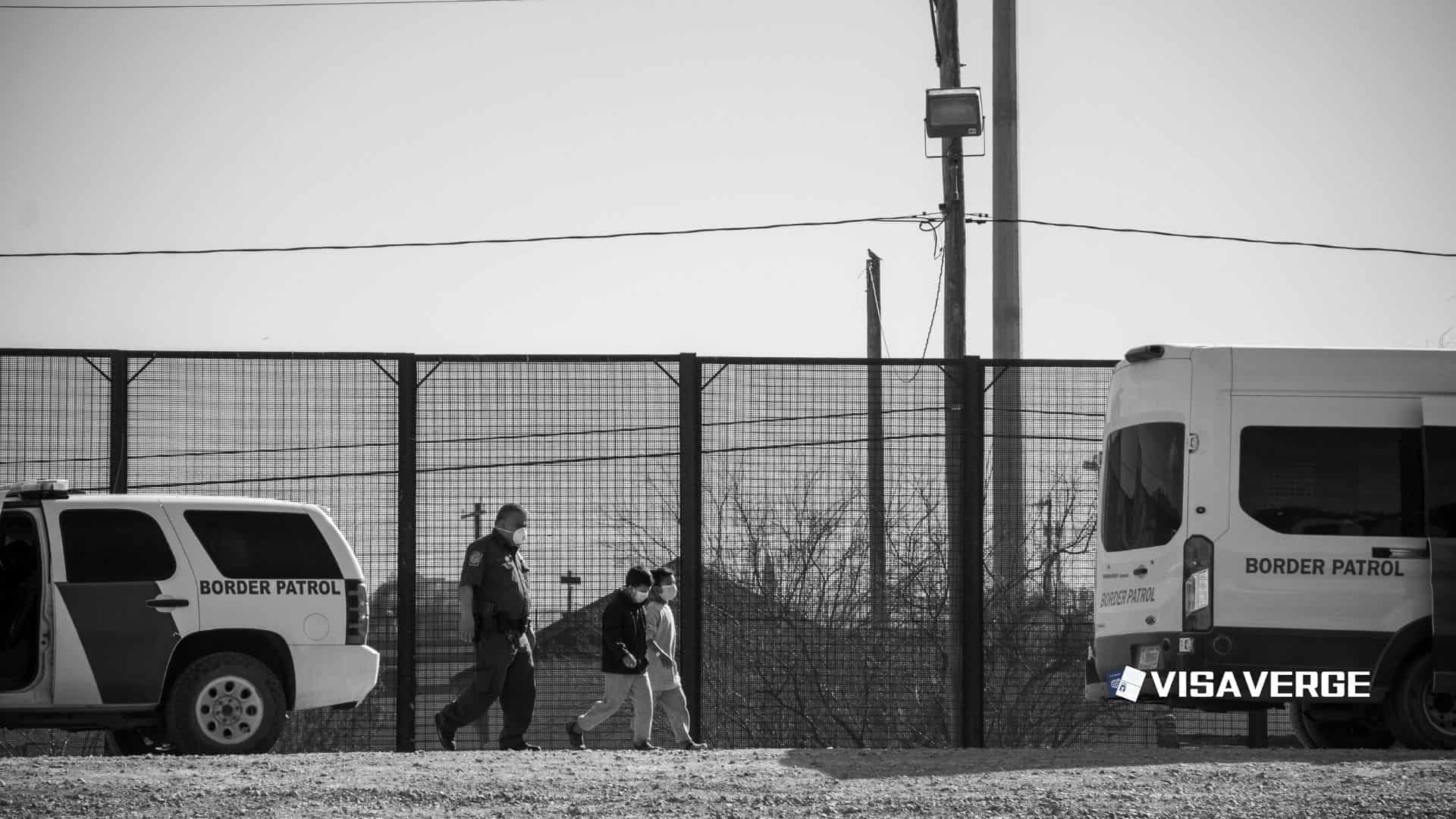
(UNITED STATES) Immigration enforcement has dominated President Trump’s return to the White House, with sweeping actions in his first week and continuing through August 18, 2025. The administration declared a national emergency at the southern border, ended “catch and release” in favor of mandatory detention, sharply restricted asylum, and moved to end birthright citizenship for children born to non‑permanent residents. These steps, paired with new laws and agency directives, have reshaped how the United States handles arrests, detention, and removal nationwide.
The centerpiece is the One Big Beautiful Bill Act signed on July 4, 2025, which pours about $32 billion into immigration enforcement and deportation operations through September 30, 2029, and more than $75 billion into border enforcement, including $47 billion for border wall construction. The law funds mass detention capacity and speeds removal operations, while executive orders signed on January 20, 2025 tightened entry and humanitarian programs. The White House blocked asylum seekers from entering and suspended nearly all refugee admissions.

A separate law, the Laken Riley Act, signed on January 29, 2025, requires detention of immigrants charged with or convicted of certain crimes. Meanwhile, expedited removal now applies nationwide: any undocumented person stopped anywhere in the country who cannot prove two years of residence can be deported quickly without a hearing before an immigration judge. ICE officers have been given daily arrest quotas of 1,200 to 1,500 people, and the administration has set a public goal of 1 million deportations a year, more than triple the prior record.
Free toolUSCIS Receipt Number DecoderVisaVerge.com reports that funding under the One Big Beautiful Bill Act is driving rapid expansion in detention beds and transportation resources, while internal policy changes limit bond eligibility for many detainees. According to analysis by VisaVerge.com, these combined moves are designed to keep people in custody from the moment of arrest until removal, curbing releases that were common in recent years.
Major Policy Changes and What They Mean
- Interior enforcement expansion
- Interior arrests now target all undocumented immigrants for possible criminal charges and deportation.
- The administration frames this as restoring the rule of law; advocates warn it sweeps in long‑time residents with U.S. citizen family members.
- Catch‑and‑detain replaces catch‑and‑release
- Bond options are sharply restricted, keeping many people in custody while their cases are processed.
- Policy changes limit who is eligible for bond and increase the likelihood of prolonged detention.
- Expanded 287(g) program
- State and local officers are being deputized to enforce federal immigration law through an expanded 287(g) program, which now includes a condensed 40‑hour online training.
- Details about 287(g) participation are posted by ICE here: ICE 287(g) Program.
- Enforcement at sensitive locations
- Operations may now occur at schools, hospitals, courthouses, and places of worship, reversing prior limits meant to protect vulnerable spaces.
- Border and asylum policies
- The United States has effectively closed access to most asylum seekers at the border.
- People who enter without inspection are barred from most benefits, including asylum, and many are being required to wait in Mexico while their cases proceed under a renewed “Remain in Mexico” approach.
- Pressure on non‑cooperating jurisdictions
- The Attorney General has been directed to identify jurisdictions that do not cooperate; they face threats of funding cuts and penalties, though some actions have been limited by courts.
Officials say these steps have driven unauthorized crossings to the lowest levels in decades. Critics highlight collateral arrests, mistaken detentions of U.S. citizens, and growing civil‑rights litigation.
On‑the‑Ground Effects
- Detention and family separation
- Detention is increasingly standard; parents and children can be separated when an adult is taken into custody.
- Rescission of prior reunification efforts means caseworkers may have limited ability to reunite families.
- Conditions for asylum seekers
- Asylum seekers forced to wait in Mexico report safety risks, limited medical care, and inadequate housing.
- Service groups warn of constrained humanitarian assistance in many cases.
- Community responses
- Sanctuary-area organizations are distributing “know your rights” materials.
- Some states are signing up for 287(g) agreements and constructing dedicated detention space.
The Step‑by‑Step Process Now (Simplified)
- Apprehension anywhere in the country by ICE, CBP, or deputized local officers.
- Transfer to detention, where bond is rarely available under current policy.
- Expedited removal if the person cannot show two years of residence in the United States.
- Access to humanitarian relief is tightly limited; most people who crossed without inspection cannot seek asylum without extensive documentation.
- Deportation follows quickly as ICE moves to meet daily arrest and annual removal targets.
Legal Battles and Court Rulings
- Court challenges were swift after the policy changes. Some asylum restrictions were temporarily blocked by federal courts in late January.
- The Supreme Court issued a ruling on June 27, 2025, in Trump v. CASA, addressing parts of the administration’s enforcement agenda and the scope of local agency cooperation.
- Despite litigation, most major policies remained in effect as of August 18, 2025, and agencies continue to implement new mandates.
Agencies, Roles, and Political Arguments
- Key agencies:
- Department of Homeland Security (DHS) — overall strategy and coordination.
- Immigration and Customs Enforcement (ICE) — arrests and removals.
- U.S. Citizenship and Immigration Services (USCIS) — adjusts guidance on benefits and humanitarian programs.
- State and local police — greater street‑level enforcement role via 287(g) agreements.
- Supporters’ view:
- Measures protect public safety and national security.
- Argue these steps enforce laws that were unevenly applied in prior years.
- Critics’ view:
- Legal and human‑rights groups (including the ACLU, Human Rights Watch, and the National Immigration Law Center) argue the approach:
- Violates due process and refugee law.
- Encourages racial profiling.
- Harms U.S. citizen children in mixed‑status families.
Funding, Capacity, and What’s Next
- The One Big Beautiful Bill Act provides tens of billions for enforcement:
- ~$32 billion for enforcement and deportation operations through September 30, 2029.
- >$75 billion for border enforcement, including $47 billion for border wall construction.
- Reported operational effects (VisaVerge.com):
- Rapid expansion of detention beds and transportation resources.
- Internal policies that limit bond eligibility and favor continuous custody from arrest to removal.
- Administration goals and requests:
- ICE daily arrest quotas set at 1,200–1,500 people.
- Public goal of 1 million deportations per year.
- White House and DHS are seeking additional congressional funding to further expand detention capacity and transport capabilities.
Ongoing lawsuits could still change parts of the program, but as of August 18, 2025, the direction is clear: more arrests, longer detention, and faster deportations, backed by billions in new funding and a renewed emphasis on physical border barriers.
This Article in a Nutshell
President Trump’s 2025 immigration overhaul prioritized enforcement: a $32 billion deportation fund, mandatory detention, nationwide expedited removal, and 1,200–1,500 daily ICE arrest quotas, reshaping asylum access, expanding 287(g) local enforcement, and pushing rapid deportations amid ongoing court challenges and humanitarian concerns through August 18, 2025.