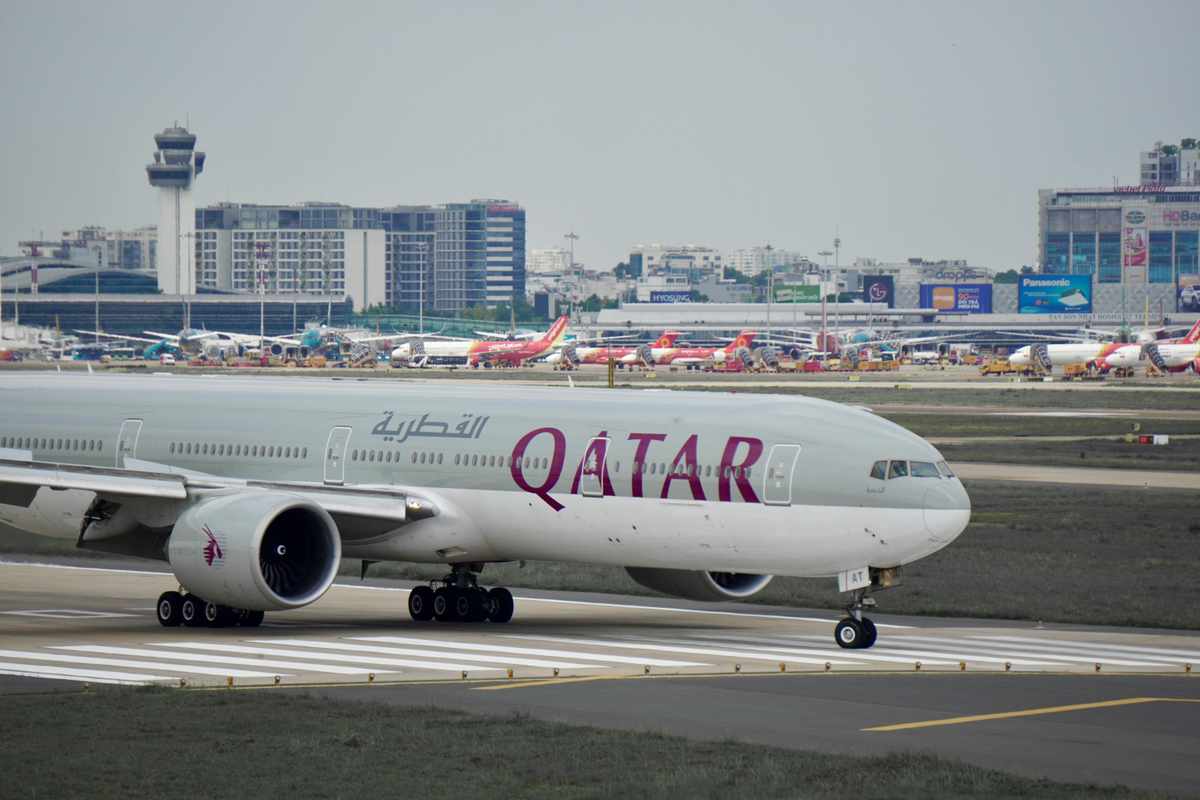
(DUBAI, UAE) — Israel, the United Arab Emirates, Qatar and Iran shut their airspace on Saturday after U.S. and Israeli strikes on Iran and retaliatory actions on February 28, 2026, triggering an airspace shutdown that halted commercial arrivals, departures and overflights across key Middle East corridors.
Airlines canceled flights, diverted aircraft already in the air, and began rerouting around restricted skies as the closures spread across multiple countries, disrupting passenger connections through some of the world’s busiest long-haul transit points.

The sudden restrictions hit routes that normally link Europe and Asia through Gulf hubs, forcing carriers to suspend services to major airports and adding time to flights that could still operate by taking longer paths.
In the United Arab Emirates, disruption centered on Dubai International Airport and Al Maktoum International Airport, where flights halted indefinitely as of Saturday and airlines tied to the Dubai hub suspended operations.
Emirates temporarily suspended all operations to and from Dubai International Airport, a move that affected about 500 daily flights, underscoring the immediate scale of stoppages at one of global aviation’s most important transfer points.
Flydubai also suspended Dubai operations and faced disruption from sudden shutdowns, as carriers that rely on dense short- and medium-haul schedules adjusted to the loss of normal departure and arrival flows.
Qatar’s Hamad International Airport also saw operations upended after Qatar Airways Group canceled all flights to and from Doha, following a temporary closure of airspace by Qatar’s civil aviation authority.
The rapid turn in Doha illustrated how quickly conditions changed for passengers who typically connect through Hamad International Airport between Europe, Asia and Africa, and for airlines that bank multiple departures and arrivals into tight windows.
In Israel, Ben Gurion Airport faced civilian airspace restrictions after Transport Minister Miri Regev announced the airspace closed to civilian flights, and multiple airlines suspended services through early March.
Iran announced nationwide airport closures, a step conveyed by Iran’s Civil Aviation Organisation spokesman via Tasnim news agency, adding to a ripple that affected operations beyond a single national hub and across surrounding flight paths.
Beyond the main hubs, partial or full closures also affected airports in Iraq, Kuwait, Bahrain, southern Syria and Jordan, narrowing options for alternates and shifting traffic toward routes that could remain open.
The broad set of closures followed U.S. and Israeli strikes on Iran and retaliatory actions on February 28, 2026, a sequence that swiftly translated into aviation restrictions that affected not just flights landing in the countries involved but also aircraft that would ordinarily cross their airspace en route elsewhere.
For commercial aviation, the shutdown meant airlines could not rely on routine overflight permissions and had to stop, delay or redirect flights when planned routes crossed restricted areas.
The immediate impact appeared in airline-by-airline operational moves that ranged from targeted suspensions to blanket pauses across multiple destinations, with aircraft sometimes turning back mid-journey.
United Airlines canceled U.S.-Tel Aviv flights through Monday and U.S.-Dubai flights through Sunday, and it diverted or returned flights that were already en route as airspace restrictions tightened.
British Airways canceled flights to Tel Aviv, canceled flights to Bahrain until next week, and canceled flights to Amman on Saturday; one Doha flight returned to London, highlighting how disruptions reached beyond the immediate closure points and into airline networks that rely on predictable routings.
Turkish Airlines suspended flights to Qatar, the United Arab Emirates, Oman, Kuwait and Bahrain, and also suspended flights to Lebanon, Syria, Iraq, Iran and Jordan until Monday, reflecting a broad pullback from multiple Middle East destinations as restrictions took hold.
Air India, IndiGo and Air India Express suspended Middle East services, while IndiGo canceled 72 flights and diverted a Delhi-Tel Aviv service, showing how the airspace shutdown affected carriers far beyond the Gulf and Israel, including operators with heavy exposure to Middle East routes.
A wider set of airlines also canceled or adjusted services. Lufthansa, Air France, Swiss, Virgin Atlantic, KLM, Wizz Air and others canceled flights to Dubai, Tel Aviv, Beirut and Oman, and airlines avoided Iraq and Iran airspace while adding time to some routes, including services to India, the Maldives and Riyadh.
Those operational decisions converged on a common pattern: airlines pulled aircraft away from affected airspace and airports, then recalculated schedules as they tried to rebuild networks under changing restrictions.
The cumulative effect for passengers was immediate uncertainty at check-in counters and on transit concourses, especially for travelers whose itineraries depended on same-day onward connections through hubs now paused or heavily constrained.
Diversions and returns also created knock-on problems for airline fleets. Aircraft that turned back or landed away from their intended destinations did not end up where carriers planned them to be, complicating efforts to restart service even where airports could eventually reopen.
Route changes added further strain. Flights from Europe to Asia began rerouting over Saudi Arabia, causing delays, as airlines sought paths that remained available while avoiding restricted skies.
Avoidance of Iraq and Iran airspace also lengthened some routings, adding time to flights that could still operate and shifting arrival patterns at destinations outside the immediate closure zone.
As carriers adjusted, rolling cancellations became more likely across the next several days because schedule integrity depended on both airspace availability and the ability to place aircraft and crews where they were needed after diversions and flight returns.
The timeline for suspensions varied by airline and destination, but the planning horizon stretched into early March for services into Israel, while some carriers set shorter windows measured in days for Dubai, Doha and other regional points.
For travelers, the most visible pressure points remained the large hubs that normally handle dense daily volumes. Dubai International Airport, in particular, functioned as a high-throughput connector for long-haul itineraries, and the halt to flights there affected passengers not only bound for the UAE but also those transiting through the airport on journeys between continents.
Doha faced similar dynamics, with Hamad International Airport typically handling connecting flows that knit together multiple regions on a single ticket, leaving passengers exposed to missed onward flights when the operating airline canceled the first leg or when incoming flights could not arrive.
In Israel, the closure to civilian flights at Ben Gurion Airport and airline suspensions through early March pointed to extended disruption for passengers who might otherwise rely on frequent service to reach Tel Aviv.
Iran’s nationwide airport closures added an additional layer of disruption for flights that would normally use Iranian airspace as part of efficient east-west routings, and for regional services tied to Iranian airports.
Airlines that kept some flights operating faced added time and variability from reroutes, which complicated tight connection schedules and increased the risk that passengers would misconnect even when individual flights still flew.
As the situation evolved, the pace of changes added to passenger confusion. Airlines issued cancellations and revisions as restrictions took effect, and flights that initially departed for a destination could still be redirected if airspace status shifted while they were airborne.
The operational load also moved to airline customer-service channels as passengers sought rebooking or refunds. Large, sudden cancellation batches—such as IndiGo’s 72 canceled flights—translated into immediate pressure on call centers and airport service desks, even as airlines tried to manage disruptions across multiple stations at once.
The magnitude of daily operations at Dubai’s airports raised the challenge further. Emirates’ suspension of all operations to and from Dubai International Airport, affecting about 500 daily flights, highlighted how quickly an airspace shutdown could spill into global schedules for passengers far from the Middle East.
Even where airports sat outside the closure zone, the changes in routings affected departure and arrival timings. Europe–Asia flights rerouting over Saudi Arabia meant delays could propagate through airline networks, affecting aircraft rotations and subsequent departures.
With airlines also avoiding Iraq and Iran airspace, additional time on routes to India, the Maldives and Riyadh created further schedule drift that could cascade into later legs, especially for aircraft intended to operate multiple flights in a single day.
For passengers booked to, from, or through the region in the coming days, airlines advised monitoring rapidly changing status information. Travelers could use airline apps or Flightradar24 for real-time status as conditions continued to shift.
Passengers seeking refunds or rebooking options typically needed to contact the operating carrier, especially when flights were canceled on short notice or when diversions disrupted a journey in progress.
Many travelers also faced choices about whether to postpone trips, rebook through different hubs, or accept later departures as airlines worked through constraints caused by the airspace shutdown and the resulting network disruption across Dubai International Airport, Hamad International Airport and other affected points.
Airspace Shutdown Halts Flights at Dubai International and Hamad International
Military actions on February 28, 2026, triggered a massive airspace shutdown across Israel, the UAE, Qatar, and Iran. This disruption has halted operations at global transit hubs like Dubai and Doha, forcing international airlines to cancel hundreds of flights and reroute others. The resulting logistical crisis affects travel between Europe, Asia, and Africa, creating long-term schedule instability and significant pressure on airline customer service channels.