The recent surge in criticism against H-1B visas appears to be driven more by political considerations than economic evidence. While politicians highlight isolated cases of program misuse to fuel anti-immigration sentiment, the potential elimination or severe restriction of H-1B visas could cause significant damage to the American economy as genuine high-skilled talent relocates to competitor nations, ultimately threatening America’s technological leadership.
The Political Theater Behind H-1B Restrictions
The H-1B debate has become a defining political battleground, exposing deep divisions even within the Trump administration. The September 2025 imposition of a $100,000 fee on new H-1B petitions represents one of the most dramatic restrictions on skilled immigration in U.S. history. This policy emerged from claims that H-1B visas have been “deliberately exploited to replace, rather than supplement, American workers with lower-paid, lower-skilled labor”.
The policy has created unprecedented rifts within Trump’s coalition. Tech magnate Elon Musk has publicly defended H-1B visas as vital for economic growth, while traditional supporters advocate for stricter restrictions. This internal conflict highlights the tension between anti-immigration rhetoric and the practical needs of American businesses, particularly in the technology sector.
The Reality of Program Misuse Versus Legitimate Contributions
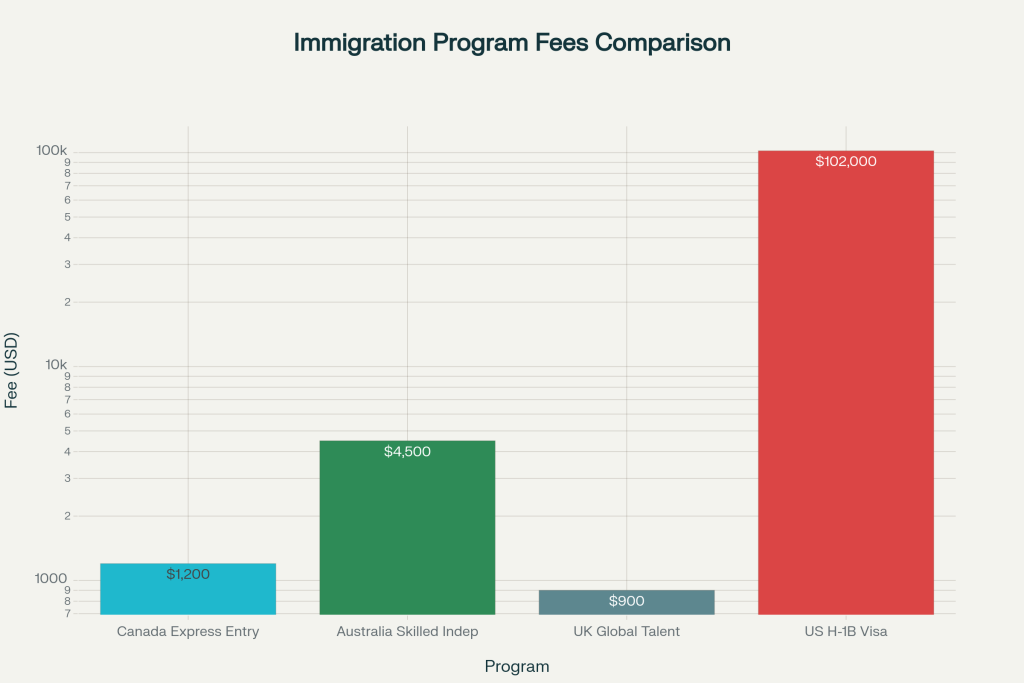
| Country | Program Name | Processing Time (months) | Annual Quota | Application Fee (USD) | Employer Sponsorship Required | Path to Permanent Residence |
|---|---|---|---|---|---|---|
| Canada | Express Entry | 6 | 132200 | 1200 | No | Yes |
| Australia | Skilled Independent Visa | 8 | 132200 | 4500 | No | Yes |
| United Kingdom | Global Talent Visa | 3 | Unlimited | 900 | No | Yes |
| United States (H-1B) | H-1B Visa | 12 | 85000 | 102000 | Yes | Limited |
While documented cases of H-1B fraud exist, they represent a small fraction of the program’s overall usage. Recent enforcement operations like “Operation Twin Shield” in Minnesota identified 270 suspected fraud cases out of thousands of applications. The Department of Justice has expanded its whistleblower program to target immigration violations, with notable cases including a $34 million settlement with an IT consulting firm that misused B-1 visas.
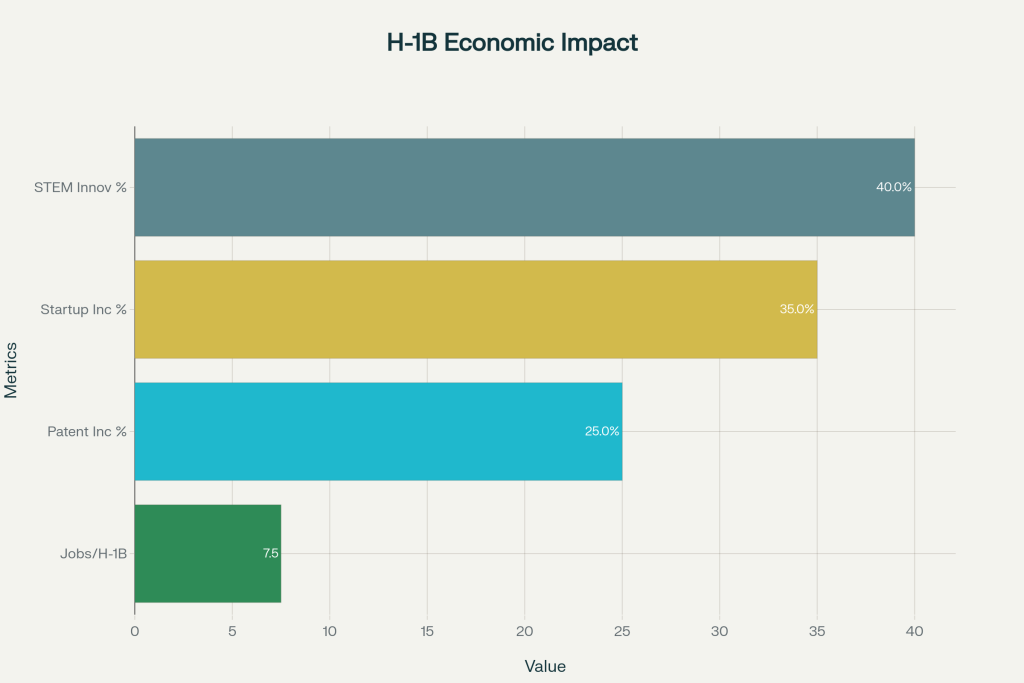
However, these isolated incidents pale in comparison to the program’s substantial economic contributions. Research consistently demonstrates that H-1B workers create rather than eliminate American jobs, with studies showing that each H-1B position generates an average of 7.5 additional jobs in the U.S. economy. The National Foundation for American Policy found that this job creation occurs through complementary effects, where skilled foreign workers fill specialized roles that enable companies to expand and hire more domestic workers.
The Economic Evidence: Innovation and Competitiveness at Stake
| Impact Category | Positive Impact | Study Source |
|---|---|---|
| Jobs Created per H-1B | 7.5 | NFAP Study |
| GDP Growth (billions) | 146.0 | REMI Economic Model (2045 projection) |
| Patent Filings Increase (%) | 25.0 | Harvard Business School |
| Wage Impact on US Workers (%) | -3.5 | NBER Study (wage depression) |
| Innovation in STEM Fields (%) | 40.0 | Multiple studies average |
| Startup Success Rate Increase (%) | 35.0 | Columbia Business School |
| Tax Revenue (billions) | 24.0 | Various economic studies |
The economic evidence overwhelmingly supports H-1B visa programs as drivers of American innovation and competitiveness. Studies by the National Bureau of Economic Research reveal that while H-1B workers may depress wages for U.S. computer scientists by 2.6% to 5.1%, they generate broader economic benefits including lower consumer prices, increased innovation, and higher productivity across multiple sectors.
Patent data provides compelling evidence of H-1B workers’ contributions to innovation. Harvard Business School research demonstrates that fluctuations in H-1B admissions significantly influence patent filing rates, with higher admission levels primarily increasing total invention through direct contributions of immigrant inventors. Companies that successfully hire H-1B workers through the lottery system are more likely to receive venture capital funding, achieve successful IPOs, and generate more patents than firms that lose the lottery.
The technology sector’s reliance on H-1B talent is particularly pronounced. In fiscal year 2024, 64% of approved H-1B petitions were computer-related. Major tech companies including Amazon, Google, Microsoft, and Meta employ thousands of H-1B workers in critical engineering and research roles. The careers of prominent leaders like Microsoft’s Satya Nadella, Google’s Sundar Pichai, and Zoom’s Eric Yuan all began with H-1B visas.
The Global Talent Competition: America’s Loss, Competitors’ Gain
The prediction that talented individuals will relocate to other countries is already materializing. Canada has explicitly announced plans to target tech talent affected by U.S. H-1B restrictions, with Prime Minister Mark Carney stating that Canada will “have a clear offering” for workers who would have previously obtained H-1B visas. Canadian immigration experts estimate that attracting just 20% of displaced H-1B workers could generate over $24 billion in annual income and contribute more than 1% to Canada’s GDP growth.
Other developed nations have responded to U.S. restrictions by creating more attractive pathways for skilled workers. Canada’s Express Entry system processes applications in six months with fees of only $1,200, while Australia’s skilled migration program offers permanent residency for $4,500. The UK’s Global Talent Visa costs just $900 and processes applications in three weeks for certain fields.
These programs explicitly target the same talent pool as H-1B visas but offer superior conditions: permanent residence pathways, no employer sponsorship requirements, and significantly lower costs. Australia’s 2025-26 migration program allocates 132,200 places to skilled workers, nearly matching the entire annual H-1B quota, while maintaining steady planning levels to provide certainty to applicants.
Corporate Response and Economic Consequences
The immediate business response to H-1B restrictions validates concerns about economic damage. Indian IT firms, which previously relied heavily on H-1B visas, have already begun reducing their dependence on the program by an average of 46% over the past five years. Companies are accelerating offshore service delivery and establishing operations in countries like India, Mexico, and the Philippines rather than paying the prohibitive fees.
Tech companies are advising employees on visas to avoid international travel due to re-entry concerns, while startups and mid-sized firms face the prospect of being priced out of the talent market entirely. The $100,000 fee particularly impacts smaller companies and universities, which lack the resources of tech giants to absorb such costs.
The Strategic Miscalculation
The evidence suggests that restrictive H-1B policies may achieve the opposite of their intended goals. Rather than protecting American workers, these measures risk accelerating the globalization of high-skilled work as companies establish operations in countries with more favorable immigration policies. Federal Reserve Bank of Richmond research indicates that firms respond to H-1B restrictions by offshoring operations to countries like Canada and India, ultimately moving both jobs and economic activity abroad.
The national security implications are particularly concerning. As the administration’s own proclamation acknowledges, “abuses of the H-1B program present a national security threat by discouraging Americans from pursuing careers in science and technology, risking American leadership in these fields”. However, the $100,000 fee may exacerbate this problem by making it even more difficult for American companies to compete for global talent.
The Path Forward: Reform, Not Restriction
While legitimate concerns about program abuse merit attention, the proposed solutions appear disproportionate to the problems they address. The $100,000 fee effectively creates a “de facto ban” on H-1B visas for all but the largest corporations, potentially driving innovation and economic activity to competitor nations.
The challenge lies in reforming the program to address genuine concerns about wage depression and fraud while preserving its essential function as a pathway for global talent. Evidence-based solutions might include raising prevailing wage requirements, implementing merit-based selection criteria, and strengthening fraud detection mechanisms – approaches that address specific problems without creating prohibitive barriers to legitimate usage.
Conclusion: The Price of Political Theater
The current trajectory risks a self-inflicted wound on American competitiveness. Genuine talent is already moving to competitor nations, weakening America’s technological leadership and ultimately harming the economic interests the policies purport to protect. As international competition for skilled workers intensifies, the United States may find that political theater has trumped economic strategy, with consequences that extend far beyond immigration policy to America’s long-term competitive position in the global economy.
The evidence is clear: the recent hatred toward H-1B visas stems primarily from political motivations rather than economic necessity. While politicians highlight a few bad actors to fuel anti-immigration sentiment, the broader economic reality demonstrates that restricting high-skilled immigration will likely accelerate America’s decline in global competitiveness, as genuine talent develops other nations that welcome their contributions with open arms.
Official Sources and Citations
Government Sources
United States Government
- White House. “Restriction on Entry of Certain Nonimmigrant Workers.” Presidential Actions, September 18, 2025. https://www.whitehouse.gov/presidential-actions/2025/09/restriction-on-entry-of-certain-nonimmigrant-workers/
- Federal Reserve Bank of Richmond. “Understanding the Potential Impact of H-1B Visa Program Changes.” Economic Brief, October 13, 2025. https://www.richmondfed.org/publications/research/economic_brief/2025/eb_25-39
- American Immigration Council. “The H-1B Visa Program and Its Impact on the U.S. Economy.” October 2024. https://www.americanimmigrationcouncil.org/wp-content/uploads/2025/01/he_h-1b_visa_program_and_its_impact_on_the_u.s._economy_102024.pdf
International Government Sources
- Government of Canada. “Express Entry: Federal Skilled Worker Program.” December 12, 2024. https://www.canada.ca/en/immigration-refugees-citizenship/services/immigrate-canada/express-entry/who-can-apply/federal-skilled-workers.html
- Australian Department of Home Affairs. “Skilled Migration Program.” October 16, 2025. https://immi.homeaffairs.gov.au/what-we-do/skilled-migration-program
- UK Government. “Apply for the Global Talent Visa: Overview.” October 30, 2024. https://www.gov.uk/global-talent
Academic and Research Institutions
National Bureau of Economic Research
- Kerr, William R. “Understanding the Economic Impact of the H-1B Program on the U.S.” NBER Working Paper. https://www.nber.org/system/files/working_papers/w23153/w23153.pdf
- Bound, John, et al. “Winners and Losers from the H-1B Visa Program.” NBER Digest, March 2017. https://www.nber.org/digest/apr17/winners-and-losers-h-1b-visa-program
Harvard Business School
- Hunt, Jennifer, and Marjolaine Gauthier-Loiselle. “H-1B Visa Reforms and US Ethnic Invention.” Harvard Business School Working Paper. https://www.hbs.edu/ris/Publication%20Files/09-005_005359f2-2ee8-4d73-b248-af492e44ecb4.pdf
Policy and Economic Research Organizations
Peterson Institute for International Economics
- “New US curb on high-skill immigrant workers ignores evidence of its likely harm.” September 21, 2025. https://www.piie.com/blogs/realtime-economics/2025/new-us-curb-high-skill-immigrant-workers-ignores-evidence-its-likely
Information Technology and Innovation Foundation
- “Trump’s De Facto H-1B Ban Will Boost the Trade Deficit, Reduce US Innovation.” September 22, 2025. https://itif.org/publications/2025/09/22/trumps-de-facto-h-1b-ban/
Economic Innovation Group
- “Exceptional by Design: How to Fix High-Skilled Immigration to Boost American Innovation.” January 2025. https://eig.org/wp-content/uploads/2025/01/Exceptional-by-Design.pdf
Congressional and Legislative Sources
- Congressional Research Service. “Measuring the Impacts of the H-1B Visa Program on U.S. Labor Markets.” February 27, 2025. https://www.congress.gov/crs-product/IF12933