- South Korea launched a trial program to ease visa rules for international students in technical majors.
- Students in designated programs can now work 35 hours weekly during the semester and avoid bank balance proofs.
- A new E-7-M visa provides a direct pathway to residency for graduates working in their field.
South Korea’s Ministry of Justice launched a trial program on February 9, 2026, easing visa rules and work limits for international students enrolled in government-designated technical majors and linking those students to a new post-graduation work route.
The policy, announced on February 5, 2026, raises the in-semester part-time work allowance for students in the designated programs and relaxes part of the D-2 student visa documentation burden for applicants who meet a Korean-language threshold. It also creates a new employment visa category for graduates that connects to a longer-term residence pathway.
Officials framed the changes as time-limited and subject to review, with the trial scheduled to run until the end of 2027. Students, schools and employers will need to watch how local immigration offices apply the program during the trial period, because participation depends on whether a student’s major and institution appear on the Ministry of Justice’s designated list.
Justice Minister Jung Sung-ho, announcing the changes on February 5, 2026, said: “We will actively work with local governments, vocational colleges, and relevant ministries to foster outstanding talent who have skills and Korean language proficiency, also addressing population decline and regional labor shortages.”
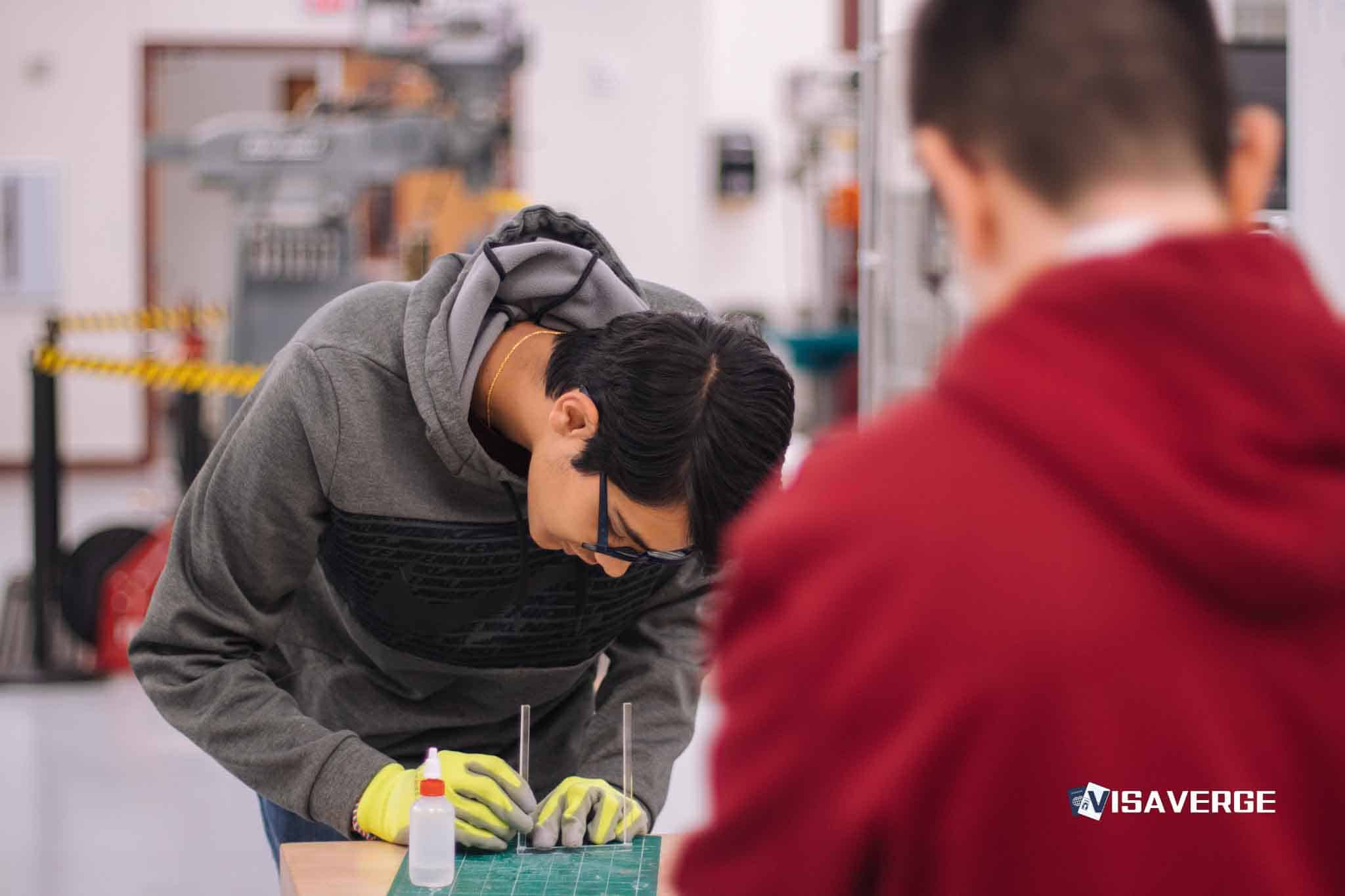
The changes focus on international students studying in a defined set of “workforce-focused technical programs,” rather than applying across all higher education. The Ministry of Justice designated 16 specific vocational programs at colleges around South Korea, tying eligibility to enrollment in those majors.
That “designated” label matters in practice. Students need their school and major to match what the government approved, because the eased visa rules and expanded work permission attach to the program designation, not simply to having a technical interest or attending a Korean institution.
The designated majors span manufacturing and engineering-related fields alongside applied programs that the government associated with regional workforce demand, including textiles and fashion, agri-food, and renewable energy. Examples named in the designation list include Automotive Engineering at Gyeonggi University of Science and Technology and Daelim University, Mechanical Engineering at several institutions including Dong-Eui Institute of Technology and Ulsan College, Textile Business & Fashion Design at Bucheon University, Smart Agri-food Resources at Kunjang University College, and Renewable Energy and Electricity at Mokpo Science University.
Because the programs sit across multiple provinces, students weighing admissions offers may treat geographic location as more than a lifestyle choice. The designation list links training to where employers operate and where local governments want graduates to remain, and later steps in the pathway include a faster option for work in a “population-decline” region.
Prospective applicants and current students typically confirm program designation through a school admissions office and by checking immigration guidance and ministry announcements. The official government sites that post policy and program information include the South Korea Ministry of Justice, the Korea Immigration Service (HiKorea), and the Study in Korea portal.
For students already in South Korea, the most immediate day-to-day change involves work hours during the academic term. International students enrolled in the designated programs may now work up to 35 hours per week during the semester, up from the previous 30-hour limit, while the Ministry of Justice said there remain no restrictions on work hours during weekends and vacations.
That split between “during the semester” and weekends or vacations can shape how students structure income and coursework. Students seeking to stay compliant still need to keep any required work permission or endorsement consistent with D-2 student status, and they will need to track hours carefully when combining multiple jobs or shifting schedules as exams and labs intensify.
The policy also alters what some students must show to obtain or extend D-2 status. Under the trial, students admitted to the 16 designated programs do not need to submit proof of a bank balance—typically 16–20 million won—if they have achieved TOPIK Level 3 or higher.
The Ministry of Justice tied the financial-proof relaxation to language proficiency, effectively treating a Korean-language score as a factor that reduces uncertainty in visa review. Applicants who do not meet the TOPIK threshold should expect the usual financial evidence expectations to apply, alongside core documentation that typically includes admission and identity records and other school or immigration requirements.
The post-graduation change sits at the center of the government’s effort to retain vocational and technical talent trained in South Korea. The Ministry of Justice created a new work visa, the E-7-M (K-CORE), specifically for graduates of the designated programs, turning what had been a student experience into a structured skilled-employment route.
Eligibility under the E-7-M model rests on several pillars spelled out in the program description. Graduates must secure a job in their field of study, meet an annual salary floor of at least 26 million won ($17,700 approx.), and satisfy a language or integration standard of KIIP Level 4 or TOPIK Level 5.
Job alignment sits at the center of that design. Graduates and employers will need to show that a role fits the field of study, which can affect choices about where to work and how to document duties, training relevance, and the connection between a curriculum and a job offer.
The longer-term residence link comes through the F-2 resident visa. Under the trial rules described by the Ministry of Justice, E-7-M visa holders can apply for an F-2 after working for five years, or three years if working in a “population-decline” region.
The government placed the trial within a wider recruitment strategy. South Korea’s “Study Korea 300K Project” aims to attract 300,000 international students by 2027, and the Ministry of Justice connected the visa and work changes to labor supply pressures and regional revitalization goals.
By expanding permitted work hours, reducing certain upfront documentation burdens for language-proficient applicants, and making a clearer post-study pathway for vocational graduates, the program sets out an alternative model for students who might otherwise look to other study destinations. The Ministry of Justice framed the plan around practical workforce needs, with an emphasis on technical majors that map onto industrial jobs outside the Seoul metropolitan core.
For students, the practical implications start with affordability and planning. The ability to work more hours during the semester can increase income while studying, and the removal of the standard bank-balance evidence for eligible TOPIK-proficient students can lower the initial barrier for those who can demonstrate language ability.
Employability considerations also shift earlier in a student’s stay. Because the post-graduation visa requires a job in-field, students may prioritize roles during study that build experience tied to their major, while also keeping a close eye on compliance—hours, permissions, and any school rules that govern employment while enrolled.
Outcomes will still hinge on execution. Schools may apply their own internal policies on student work, employers will differ in how they structure part-time roles, and local immigration offices may vary in documentation handling within the boundaries of the national program, making verification and recordkeeping central for students who want to preserve a later E-7-M option.
South Korea’s Ministry of Justice described the measures as a domestic program, and officials did not present it as connected to U.S. immigration policy. The Ministry of Justice announcement sits apart from U.S. developments referenced in broader student-visa discussions, including a USCIS fee increase for premium processing effective March 1, 2026, and a DHS proposal to implement fixed-term limits on F-1 student visas in the U.S.
Students comparing global options may follow both tracks, but the legal regimes are separate: South Korea’s trial affects D-2 student status and a Korea-specific work and residence path, while U.S. changes would apply to U.S. visa rules and processes. For official updates and evolving program lists during the trial period, South Korea’s government information typically appears on the Ministry of Justice and HiKorea websites, while study program guidance appears through Study in Korea and related government channels.