- Belarus reported that 15,910 visa-waiver travelers entered the country during early 2026.
- The United States has suspended immigrant visa issuances for Belarusian nationals as of January 2026.
- The U.S. State Department maintains a Level 4: Do Not Travel advisory for Belarus due to detention risks.
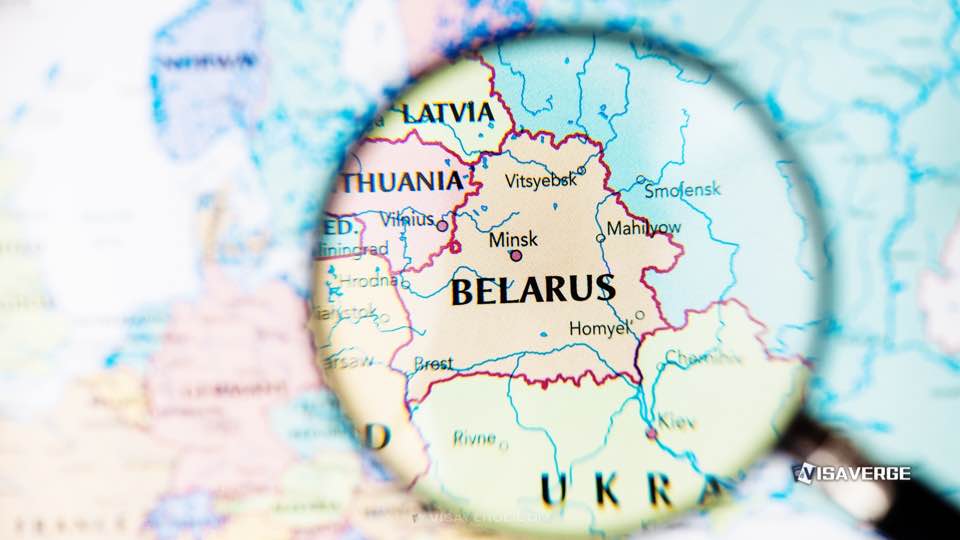
(BELARUS) — The State Border Committee of Belarus reported that 15,910 visa-waiver travelers from 38 European countries entered Belarus without a visa from January 1 to February 16, 2026, as Minsk promoted a program it says has drawn more than a million visitors since it began.
Belarus released the early-2026 snapshot through the state news agency BelTA, framing it as part of a broader visa-free entry system for eligible European residents.
The count reflects entries recorded by border authorities during that period, not necessarily unique individuals, and it does not describe travelers’ purpose of visit or length of stay.
Belarus launched the visa-waiver framework on April 15, 2022, and the State Border Committee put the cumulative total at 1,274,079 European residents who have visited under the program since then.
The border agency said the majority of visa-waiver travelers in early 2026 arrived from neighboring Lithuania, Latvia, and Poland, countries with close geographic proximity and frequent cross-border movement.
Minsk expanded the program on July 19, 2024, to include 35 additional countries, according to the State Border Committee. Since that expansion, 60,594 citizens from those countries have entered, it said.
The Belarusian figures come as the United States has rolled out early-2026 policy changes affecting Belarus-related travel and immigration pathways, involving both the U.S. Department of Homeland Security and the Department of State.
President Trump’s administration imposed a security-based restriction at the start of the year through Presidential Proclamation 10998, which took effect on Jan. 1, 2026, and included Belarus among affected countries.
“Pursuant to Presidential Proclamation 10998 on Restricting and Limiting the Entry of Foreign Nationals to Protect the Security of the United States. the United States is suspending or limiting entry and visa issuance to nationals of 39 countries [including Belarus],” a U.S. government statement said.
Separately, the State Department announced a pause that it said halted immigrant visa issuances to nationals of certain countries, including Belarus, effective Jan. 21, 2026.
“Effective January 21, 2026, the Department of State paused all immigrant visa issuances to nationals of countries, including Belarus, whose immigrants have a high rate of collecting public assistance at the expense of the U.S. taxpayer,” the State Department notice dated Feb. 2, 2026 said.
The pause centers on issuance, meaning applicants can still move through parts of the process even as final visa delivery stops, based on the U.S. government description that applicants can still attend interviews but visas are not being issued indefinitely while “screening and eligibility criteria” are reviewed.
DHS’s role in the broader shift appeared in referenced USCIS newsroom updates that cited DHS Secretary Kristi Noem on Feb. 13, 2026 in connection with stricter immigration enforcement and public charge reviews, including the termination of other statuses such as TPS for Yemen.
On the Belarus side, the visa-free entry rules described alongside the border statistics allow eligible European visitors to enter for up to 30 days, with a longer allowance of 90 days for Baltic and Polish citizens, and the program runs through December 31, 2026.
For European travelers considering Belarus, the practical effect is a simplified entry route that removes the need for a visa under the stated conditions, while leaving travelers to plan within the permitted stay window and the end date of the program.
Because the border data counts entries, repeated short trips can raise totals without indicating a corresponding number of distinct visitors, and nationality breakdowns can reflect proximity-driven travel patterns as much as tourism.
Belarus’s border agency identified Lithuania, Latvia, and Poland as the main sources of early-2026 visa-free entries, a detail that can fit cross-border shopping, family visits, or routine travel, though the Belarus report did not describe travelers’ reasons.
For Belarusians pursuing U.S. immigration, the State Department’s immigrant visa issuance pause creates uncertainty around timing, particularly for applicants who may proceed through interviews and administrative steps yet remain unable to receive an immigrant visa once a case is otherwise ready.
Applicants navigating the pause also face practical concerns tied to document validity and sequencing, including medical exam timing and the possibility of prolonged administrative processing, given the U.S. notice’s focus on ongoing review of “screening and eligibility criteria.”
U.S. citizens weighing travel to Belarus face a separate set of constraints shaped by U.S. consular posture and safety guidance.
The State Department’s travel advisory for Belarus remained at Level 4: Do Not Travel, updated Dec. 29, 2025, citing “arbitrary enforcement of laws” and “risk of detention,” language that signals a high-risk environment for U.S. travelers regardless of Belarus’s visa-free entry offer for Europeans.
The divergence between Belarus’s promotion of easier entry for European neighbors and Washington’s tightening measures on Belarus-related travel and immigration underlines how travelers and applicants can face sharply different rules depending on passport, destination, and visa category.
For visa-waiver travelers entering Belarus, the State Border Committee’s early-2026 tally offers a fresh measure of traffic through the program, while the longer-term total since April 15, 2022, provides a sense of cumulative use across shifting regional conditions.
For U.S.-bound applicants from Belarus, the combined effect of the Jan. 1, 2026 restrictions cited in Presidential Proclamation 10998 and the Jan. 21, 2026 immigrant visa issuance pause described by the State Department points to layered hurdles that can limit or delay outcomes.
Travelers and applicants seeking to verify the latest Belarus rules and counts typically turn to the State Border Committee of Belarus and BelTA, which publish entry figures, nationality breakdowns, and references to the visa-waiver framework.
On the U.S. side, the State Department posts travel advisories and visa-related updates at travel.state.gov, while USCIS publishes policy and guidance updates through its Newsroom.
The U.S. Embassy in Belarus provides local processing updates, including immigrant visa notes tied to the effective date of the pause, on its website at by.usembassy.gov.
A basic verification workflow starts with confirming the publication date of an announcement, then checking whether a change applies to nonimmigrant visas, immigrant visas, or both, and finally reading for “effective date” language that determines when applicants and travelers feel the impact.
BelTA reported the Belarus border statistics at belta.by, including the early-2026 figure of 15,910 and the longer-term total of 1,274,079, as Minsk continues to publicize visa-free access for eligible European visitors through the end of 2026 even as U.S. restrictions and visa issuance pauses reshape options for Belarusian nationals seeking entry to the United States.