Key Takeaways:
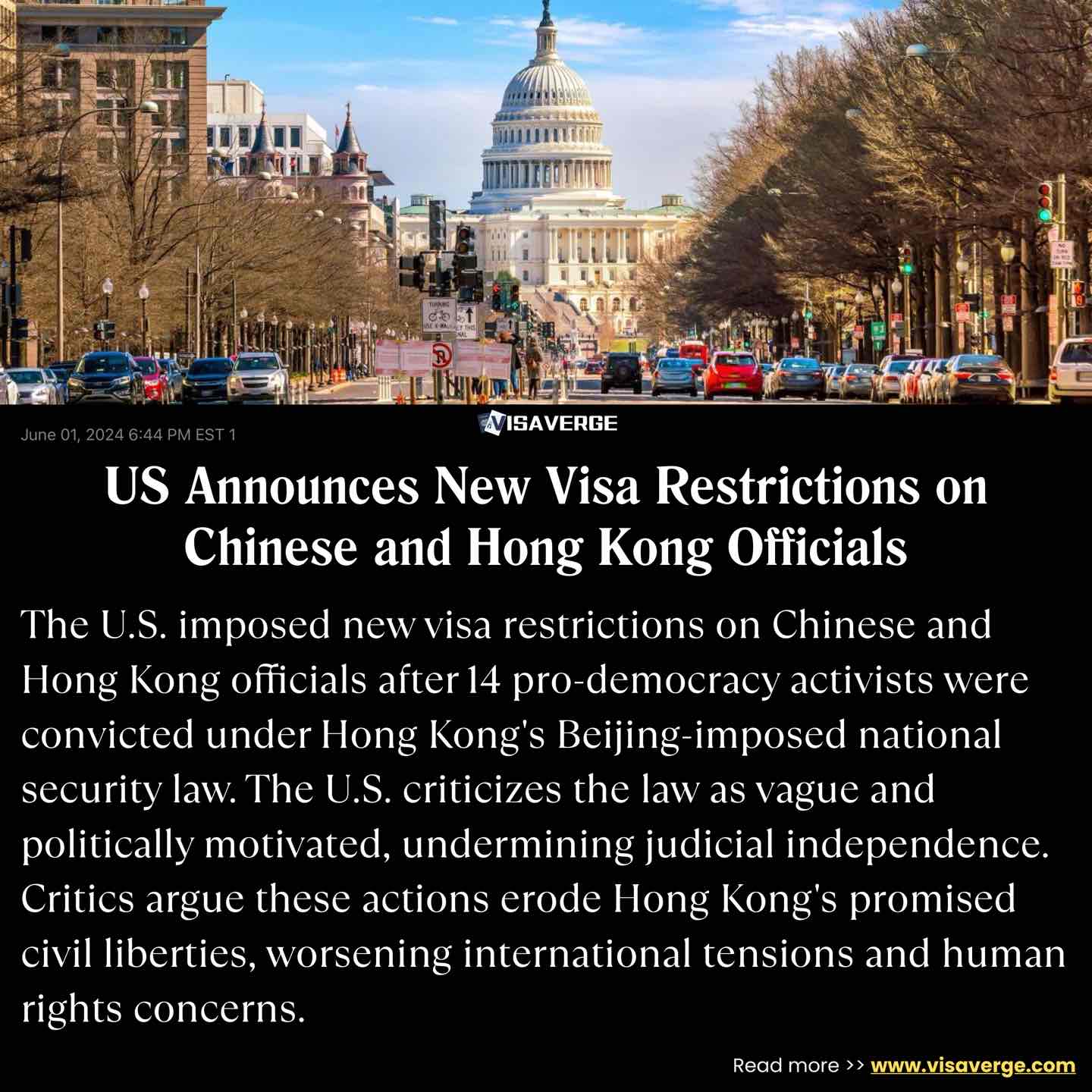
- The US imposed new visa restrictions on Chinese and Hong Kong officials responsible for prosecuting pro-democracy activists under Beijing’s national security law.
-
The restrictions respond to politically motivated prosecutions, aiming to hold accountable those undermining rights protected by Hong Kong’s Basic Law.
-
The prosecutions of 47 activists impact Hong Kong’s democracy, raising concerns over Beijing’s commitment to maintaining the city’s civil liberties.
What are the New US Visa Restrictions in Response to Hong Kong Security Verdict?
The United States has voiced its deep concerns regarding the recent convictions of 14 pro-democracy activists in Hong Kong. These convictions were made under a national security law imposed by Beijing. Following these landmark verdicts on October 13, 2023, the US has decided to take further actions by imposing new visa restrictions on officials from mainland China and Hong Kong who are responsible for enacting this sweeping legislation.
Why Are the Visa Restrictions Being Imposed?
According to US State Department spokesperson Matthew Miller, the defendants were subjected to politically motivated prosecutions. “The defendants were subjected to a politically motivated prosecution and jailed simply for peacefully participating in political activities protected under the Basic Law of Hong Kong,” stated Miller. The Basic Law serves as the city’s mini-constitution. The new visa restrictions are aimed at holding accountable those who prosecuted these activists for exercising rights supposedly protected by Hong Kong’s legal framework.
Who Are the Convicted Pro-Democracy Activists?
The 14 convicted individuals are among a group of 47 activists who have been charged in Hong Kong’s largest national security case to date. These activists were accused of trying to paralyze the government and topple the city leader by securing a legislative majority that could veto budgets indiscriminately. The convicted individuals were part of an unofficial primary election meant to push for democratic reforms, a move that prosecutors argued would undermine government authority.
Moreover, three judges appointed by the government to oversee the case believed that the activists’ efforts would create a constitutional crisis. However, two others who also pleaded not guilty were acquitted since the judges were unsure if their actions intended to subvert state power. The 14 convicted activists, along with 31 others who pleaded guilty earlier, are awaiting their sentences.
What Was the Outcome of the Verdict?
The mass prosecution of these 47 activists has significantly impacted Hong Kong’s pro-democracy movement, especially after large-scale anti-government protests in 2019. Critics argue that the trials demonstrate how Beijing’s promise to maintain Hong Kong’s Western-style civil liberties for 50 years, a commitment made when the former British colony returned to Chinese rule in 1997, is becoming increasingly tenuous.
What Does the U.S. State Department Say?
Miller called on Chinese and Hong Kong authorities to uphold Hong Kong’s judicial independence and to stop using vague national security laws to curb peaceful dissent. “The defendants were subjected to a politically motivated prosecution and jailed simply for peacefully participating in political activities protected under the Basic Law of Hong Kong,” he reiterated.
How Are International Bodies Responding?
Volker Türk, the U.N. High Commissioner for Human Rights, echoed concerns similar to those of the United States and the United Kingdom. Türk pointed out that the national security law does not comply with China’s obligations under international human rights law. “As the U.N. Human Rights Committee has stated, this legislation should be repealed and, in the meantime, not applied,” he said. This stance has been a point of contention, as both Beijing and Hong Kong governments assert that the law has helped restore stability to the city.
What Are the Criticisms from China and Hong Kong’s Governments?
Reacting to the international condemnation, the Hong Kong government strongly denounced the “untruthful” and “slandering” remarks from some Western countries and media outlets. They emphasized that all actions were conducted according to the law and were not influenced by the suspects’ political positions. They clarified that advocating for immunity for those who commit illegal acts is akin to endorsing lawlessness.
In response to the looming visa restrictions, the Hong Kong government described the U.S.’s actions as a despicable political maneuver aimed at intimidating those safeguarding security. They argued that the U.S. efforts represent blatant interference in Hong Kong’s affairs and violate international law. Chinese Foreign Ministry spokesperson Mao Ning reiterated Beijing’s support for Hong Kong’s law enforcement in punishing activities that threaten national security.
Where Can I Find More Information?
For more authoritative information on the subject, you can visit the U.S. Department of State website.
This continuing saga highlights growing international tensions and the struggle for democratic freedoms in Hong Kong. The future actions of the United States, particularly the implementation of these new visa restrictions, will be closely monitored by global observers. As this situation evolves, it will raise further questions about international relations and human rights practices.
By imposing these visa restrictions, the United States aims to make a strong statement against the treatment of pro-democracy activists in Hong Kong and against the implementation of the controversial national security law by Chinese and Hong Kong officials. This action reinforces the international community’s ongoing scrutiny and the demand for judicial independence and human rights adherence in Hong Kong.
Learn Today:
Glossary
- National Security Law: A law imposed by Beijing on Hong Kong meant to criminalize acts deemed as secession, subversion, terrorism, and collusion with foreign forces. Critics argue it curtails freedoms and is used to suppress dissent.
-
Visa Restrictions: Measures taken by a country to limit or deny entry to foreign nationals, often used as a political tool to sanction the actions of other government officials or entities.
-
Basic Law: Hong Kong’s mini-constitution which outlines the region’s governing principles and guarantees certain freedoms and rights for its residents under the “one country, two systems” framework.
-
Pro-Democracy Activists: Individuals who actively support and work towards establishing or maintaining democratic systems of governance, particularly in contexts where such systems are threatened or suppressed.
-
Judicial Independence: The principle that the judiciary should be independent from other branches of government, ensuring fair and impartial administration of justice without influence from political or other external pressures.
This Article In A Nutshell:
The U.S. imposes new visa restrictions on Chinese and Hong Kong officials following the October 13, 2023, convictions of 14 pro-democracy activists under Beijing’s national security law. This move aims to hold accountable those responsible for enacting legislation that undermines Hong Kong’s judicial independence and civil liberties.
— By VisaVerge.com
Disclaimer: If you use any information from this article, link back to the original article URL on VisaVerge.com. Thank you for respecting our content and giving proper credit.
Read more
- Decline in Hong Kong Students Applying to UK Universities Despite BNO Visa Impact
- Hong Kong Offers Extended Visas to Boost Tech Hub Ambitions
- India Travel Advisory: Pre-Arrival Registration for Hong Kong Visits
- New IRCC Temporary Policy for Hong Kong PR Applicants in Canada
- Hong Kong Universities Boost International Attraction Amid Rising Chinese Enrollment