- The University of North Texas faces a $45 million structural deficit due to falling international enrollment.
- Tightening federal policies and visa delays deter international master’s students from choosing U.S. institutions.
- Reduced international tuition revenue threatens academic programs, graduate research, and local economic stability.
(NORTH TEXAS) — The University of North Texas warned staff this week that it is projecting a $45 million structural deficit for the 2026 fiscal year after a sharp drop in international master’s student enrollment cut into a revenue stream that underpins many public-university budgets.
University leaders described the gap as structural, meaning it reflects an ongoing mismatch between recurring costs and recurring revenue rather than a one-time swing.
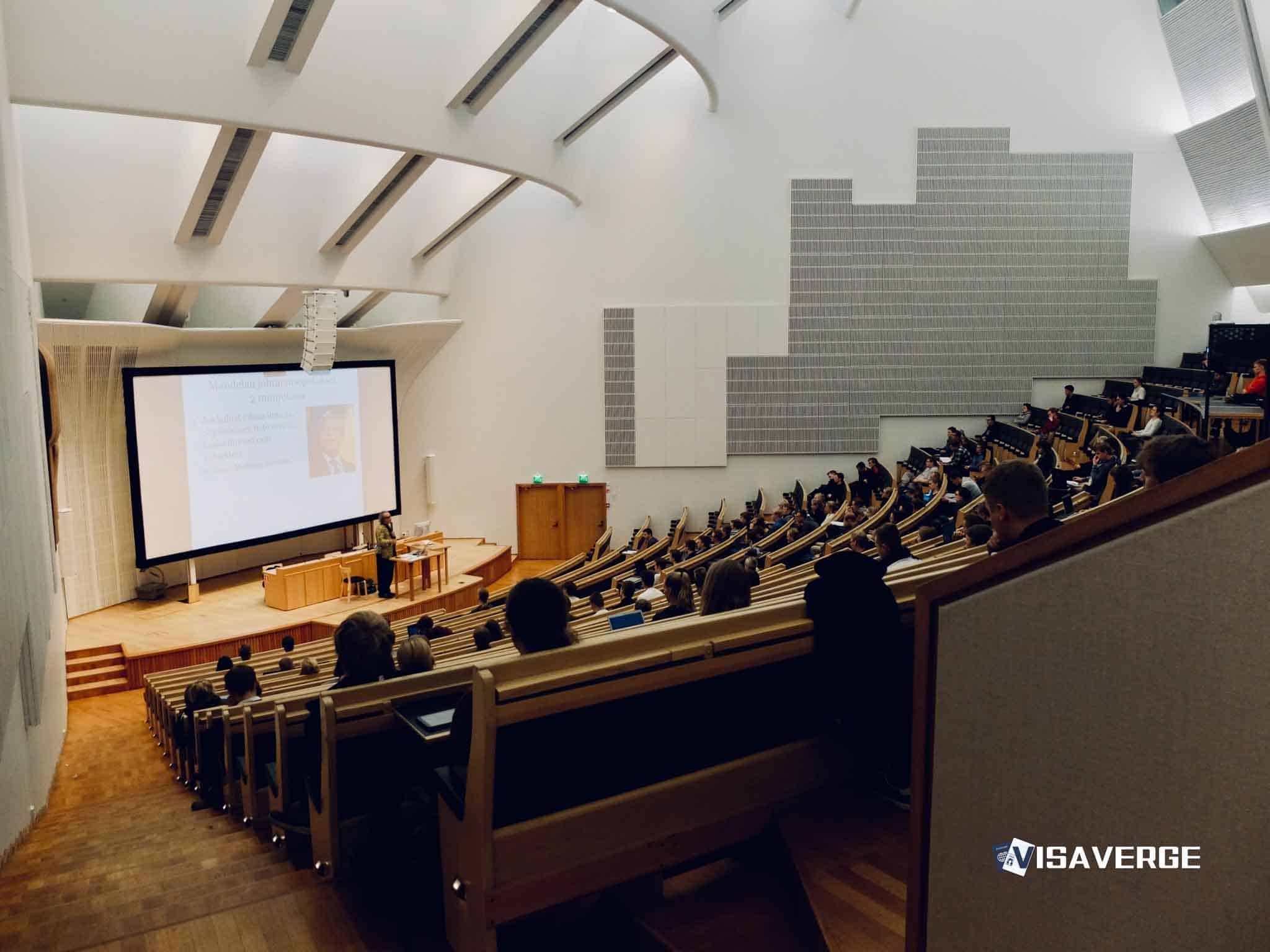
UNT’s latest forecast marks a steep deterioration from the $31.2 million gap projected in August 2025, and it comes as administrators point to tightening federal immigration policies and enforcement that have made international student enrollment less predictable.
The University of North Texas also cited a $32 million reduction in state funding as part of the budget pressure, alongside the enrollment-driven revenue loss.
International student enrollment has become a financial pillar for many public universities because international master’s students traditionally pay significantly higher tuition and fees than in-state residents, creating a premium that can subsidize other parts of an institution.
That premium has helped fund expansion in programs such as data science, computer science and engineering, while also supporting graduate research capacity that depends on steady cohorts of students and assistants.
When enrollment dips in those programs, the impact can be amplified because universities that built budgets around international master’s growth can face concentration risk, with fewer alternatives to replace the lost tuition revenue quickly.
UNT President Harrison Keller acknowledged that exposure in a letter to staff on February 17, 2026.
“Nobody could have envisioned what was going to be happening in international student enrollments. We’re overexposed compared to other institutions,” Keller wrote.
Across the United States, universities have reported that prospective students are weighing not only cost and academic offerings, but also the risk that visa processing delays or heightened scrutiny could derail plans for fall 2025 and fall 2026 starts.
University administrators and higher-education groups have also pointed to reports of visa revocations and increased review activity, which they say affects how safe and predictable the U.S. feels as a study destination.
In early 2026, the U.S. State Department announced it had revoked approximately 8,000 student visas as part of broader immigration enforcement priorities tied to national security rhetoric.
Officials said the move aimed to “Keep America safe” and targeted individuals deemed to pose security risks or who were linked to campus protests.
For applicants trying to lock in plans months in advance, uncertainty around whether a visa will be issued on time can push students toward deferring, switching schools, or choosing different countries altogether.
Universities have also cited processing delays and unpredictability around visa issuance as deterrents, particularly for students who must coordinate funding documentation, housing and travel with fixed academic calendars.
Competing destinations have benefited from that hesitation, with students increasingly choosing Canada, the UK, Australia and European institutions when U.S. entry feels less predictable.
Those shifts matter beyond a single admissions cycle because international students often represent the pipeline for graduate labs and research groups, then move through Optional Practical Training and into jobs that can rely on employer sponsorship.
Master’s and PhD candidates commonly weigh whether a program’s location will support that transition, and whether the immigration environment will remain stable through graduation and job searches.
For current students, uncertainty can also shape day-to-day planning, from renewing documents to timing internships and post-graduation work options, particularly in fields where hiring calendars and project timelines do not always align with immigration processing.
Schools say they also feel the effects in local economies that depend on student spending, because international students pay rent, use transportation, buy groceries, and support nearby services that employ local workers.
A decline in international enrollment can hit business activity and tax bases around campuses, especially in neighborhoods built around steady student demand.
Universities also frame the issue as a longer-term workforce challenge in sectors such as STEM and healthcare, where foreign graduate students have historically transitioned into U.S. employment and contributed to specialized labor pools.
Inside universities, fewer international graduate students can mean reduced enrollment in high-revenue programs and fewer research assistants and lab personnel, particularly in labs that rely on graduate labor for day-to-day operations.
Administrators have warned that budget gaps can force difficult tradeoffs, including potential cuts to academic offerings, faculty positions and campus services as financial pressure widens.
UNT has warned that budget cuts will be “felt across campus,” a signal that staffing and operations could face constraints even as leaders weigh what adjustments to make.
For planning purposes, some public institutions have also pointed to uncertainty around employment pathways after graduation, including sponsorship constraints that can affect recruitment for graduate assistants and researchers.
In late 2025, Texas Governor Greg Abbott froze H-1B visa petitions at state universities, adding another layer of labor market uncertainty for international scholars who might otherwise view campus jobs as a bridge after graduation.
Federal policy developments have also added to the backdrop that university leaders say students and institutions must now price into decisions, particularly for applicants from certain nationalities or fields.
On December 2, 2025, U.S. Citizenship and Immigration Services issued a Policy Memorandum titled “Hold and Review of all Pending Asylum Applications and all USCIS Benefit Applications Filed by Aliens from High-Risk Countries.”
The directive ordered a pause and re-review of benefit applications, including those for international students and scholars, from specific nationalities, adding time risk for applicants who must meet academic start dates.
The Department of Homeland Security on August 28, 2025, proposed a rule to end the decades-old “Duration of Status” policy for international students.
If finalized, students would no longer be admitted for the duration of their studies and would instead have fixed stay limits (typically 4 years), an approach DHS said would “improve program integrity” and “reduce the risk of visa overstays.”
A separate policy change took effect on December 15, 2025, requiring all F, M and J visa applicants to undergo expanded social media screening.
Applicants must now provide access to public social media profiles for vetting by federal authorities, a requirement universities say can increase perceived friction in the application process.
On January 1, 2026, the U.S. implemented a travel ban affecting citizens from 39 countries after a Presidential Proclamation on December 16, 2025, significantly restricting entry for new international students from those regions.
Together, those moves have contributed to the perception that U.S. study plans can hinge on policy shifts outside a university’s control, complicating recruitment strategies that once relied on steady international growth.
Nationally, new international student enrollment fell by 17% for the 2025-2026 academic year, the largest decline in a decade outside of the COVID-19 pandemic, a swing that many campuses say is difficult to offset with domestic enrollment alone.
At UNT, international graduate students previously accounted for 60% of UNT’s growth, a concentration that helps explain why a downturn in one segment can translate quickly into a large budget gap.
Higher-education groups have tried to quantify the spillover effects as well as the campus-level impact.
According to NAFSA: Association of International Educators, the national decline has led to an estimated $1.1 billion loss to the U.S. economy and the loss of nearly 23,000 jobs.
In Texas alone, the loss is estimated at $64.6 million, NAFSA said, underscoring how local economies around large campuses can feel the effects when international student numbers fall.
Even as universities point to lost tuition revenue and community spillovers, students face their own risk calculations around timelines, documentation and future work authorization.
Prospective F-1 applicants have been urged by universities to apply early, monitor changes in visa interview processes, and prepare for administrative delays that can complicate housing and travel plans.
Master’s and PhD candidates also weigh how OPT timing and the possibility of an H-1B transition affect program value, particularly in fields where internships and post-graduate employment are part of the expected career path.
Some students consider alternative destinations as contingencies, including Canada, the UK and Australia, as part of a broader comparison that now includes immigration predictability alongside academic reputation and cost.
The wider employment picture has also shifted for some job seekers who once saw U.S. graduate study as a relatively straightforward pipeline into specialized work.
As enrollment declines, universities and employers can see fewer candidates positioned to pursue H-1B, O-1, or employment-based Green Cards, with some students and workers looking to Canada Express Entry, UK Skilled Worker routes, or European Blue Card options to hedge against U.S. policy volatility.
Policy debate has also extended to potential fee changes, including a proposed $100,000 supplemental fee for some H-1B entrants, adding to concerns that cost and uncertainty can compound each other for students planning multi-year educational and career investments.
Public universities across the country are watching UNT’s warning because international master’s programs in technical fields have long served as revenue engines that help cover costs beyond the programs themselves.
As state appropriations stagnate or fall, campuses that relied heavily on international master’s growth can face sharper adjustments when global demand shifts or when immigration processing becomes less predictable.
Keller’s description of UNT as “overexposed compared to other institutions” has drawn attention because it frames the deficit as a vulnerability created by a particular funding model, not simply a short-term enrollment fluctuation.
For current students, the first signs of that pressure can show up in how universities prioritize programs and services when budgets tighten, even before any final decisions on staffing or course offerings become public.
Universities often respond by revising recruitment strategies, adjusting program portfolios, and seeking to diversify revenue sources, while trying to protect core academic functions.
At UNT, the deficit warning tied directly back to international student enrollment and the federal policy environment, an intersection that campus leaders say now shapes demand as much as academic offerings do.