- The Supreme Court struck down global tariffs imposed under the International Emergency Economic Powers Act on Friday.
- The 6–3 ruling establishes that presidents lack unilateral authority to set broad duties without clear congressional permission.
- A potential $170 billion in refunds may now be triggered for businesses affected by the invalidated trade policy.
(UNITED STATES) — The U.S. Supreme Court struck down former President Donald Trump’s sweeping global tariffs on Friday, ruling 6–3 that the International Emergency Economic Powers Act does not authorize presidents to impose broad duties on imports.
The decision, issued on February 20, 2026, invalidated a tariff program Trump imposed by declaring an economic emergency tied to trade imbalances, sharply curbing the White House’s ability to use emergency statutes as a shortcut to rewrite trade policy.
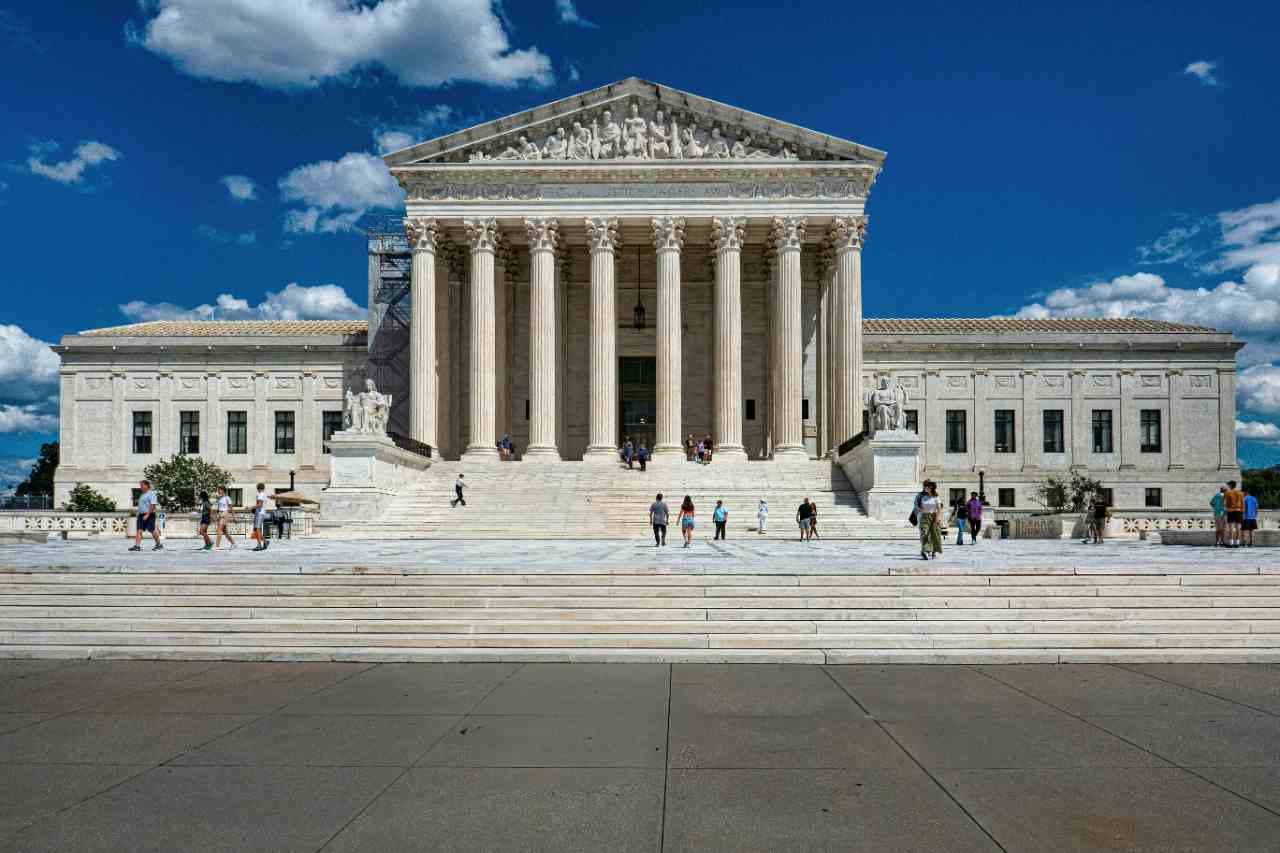
At the center of the dispute were consolidated challenges brought by import-reliant businesses in Learning Resources, Inc. v. Trump and V.O.S. Selections, Inc. v. Trump, which the justices used to draw a hard line between sanctions-style financial controls and tariff-making power.
Chief Justice John Roberts wrote the majority opinion, joined by Justices Amy Coney Barrett, Neil Gorsuch, and the three liberal justices, emphasizing that “the President asserts the extraordinary power to unilaterally impose tariffs of unlimited amount, duration, and scope” but IEEPA “falls short” of clear congressional authorization.
Roberts’ opinion framed tariffs as taxes and placed them squarely within Congress’ constitutional role, while also invoking the major questions doctrine to require clear statutory permission for actions with vast economic consequences.
The ruling landed as companies, investors and trading partners watched for signals on how far a president can go under emergency declarations to reorder commerce, especially after Trump tariffs became a central tool of U.S. economic pressure in the years after his presidency.
Friday’s decision also drew a bright boundary around the International Emergency Economic Powers Act, a 1977 law that generally authorizes economic measures tied to national emergencies and has long served as a foundation for sanctions and financial controls.
Trump used that framework to justify broad duties on imports from nearly all U.S. trading partners, arguing the measures were necessary for national economic security and to combat trade imbalances.
The consolidated cases began as challenges to Trump’s April 2025 “reciprocal” tariffs, which his administration declared under IEEPA to address trade deficits as a national emergency. The case record also notes prior duties that targeted Canada, China, and Mexico over drug trafficking.
Learning Resources, described in the case record as an educational-toy business, and V.O.S. Selections, described as a cycling-apparel company, argued the tariffs inflicted direct costs on importers and exceeded presidential authority. Challengers also included states like Oregon, the case record says.
Lower courts ruled against the tariffs before the Supreme Court took the case. The U.S. Court of International Trade and the Federal Circuit concluded IEEPA does not cover tariffs, and the justices granted certiorari on September 9, 2025, after oral arguments on November 5, 2025.
In siding with the challengers, the Court said IEEPA’s text and structure point to tools such as sanctions and financial controls, not open-ended authority to set tariffs across the global economy.
The justices also rejected the idea that long-standing trade deficits qualify as the kind of emergency IEEPA was designed to address, and they warned that reading tariff authority into the statute would expand presidential control over the economy.
The majority leaned on the major questions doctrine to reinforce that economically weighty steps require explicit authorization from Congress, rather than reliance on broad or ambiguous statutory language.
The Court’s reasoning also tied back to constitutional structure. Tariffs function like taxes, the majority said, and Article I places taxing and tariff-setting power primarily with Congress, limiting a president’s ability to claim unilateral authority in this arena.
Three justices dissented. Justices Clarence Thomas, Samuel Alito, and Brett Kavanaugh disagreed with the majority’s reading of IEEPA, and Kavanaugh wrote that the tariffs were “clearly lawful” under text, history, and precedent.
The ruling immediately voided IEEPA-based tariffs, forcing importers and supply chains to reassess pricing and contract assumptions that had been built around those duties.
A large question now turns to refunds. The case record says about $124–170 billion collected may trigger refund litigation in the U.S. Court of International Trade, a process described as potentially a “mess.”
The case record adds a procedural point that the U.S. Court of International Trade retains jurisdiction over IEEPA tariff challenges and refund claims via U.S. Customs and Border Protection, setting up what could become a long-running sequence of administrative claims and court fights over repayment.
Other tariff regimes remain in place because they rest on different laws. Duties under Section 301 of the Trade Act of 1974, aimed at unfair trade practices, and Section 232 of the Trade Expansion Act of 1962, tied to national security, remain valid under the Court’s decision, according to the case record.
That distinction matters for companies and governments trying to gauge what tariff risk looks like after Friday. IEEPA-based duties fell because the Court found the statute does not delegate tariff power, not because the Court eliminated tariffs as a policy tool.
The case record pointed to a market response shaped by reduced uncertainty around supply chains and planning. It described a positive investor response anticipated from lower uncertainty, after years in which companies had to price in the possibility of sudden, wide-ranging duties.
As a measure of the stakes, the case record cited the Congressional Budget Office’s estimate of a $3 trillion decade-long impact if the IEEPA tariffs had been upheld.
After the ruling, administrations that want new tariffs face slower and more procedural routes than a rapid emergency declaration. One option remains Section 232, which the case record describes as a national security tariff authority that requires a defined process rather than a blanket emergency claim.
Another path is Section 301, which the case record describes as an unfair trade practice mechanism that turns on investigations and findings, making it procedurally different from an IEEPA-based move.
The case record also says future tariff efforts may have to rely more heavily on Congress through legislation authorizing duties, shifting the center of gravity from the White House back to lawmakers for broad new tariff programs.
The decision’s effects extend beyond trade lawyers and importers because tariffs shape corporate investment and hiring decisions, including in sectors that intersect with cross-border mobility.
The case record describes indirect stabilization for employers in manufacturing, semiconductors, autos and logistics, industries that sponsor skilled workers through H-1B and L-1 visas and employment-based green cards. The case did not involve immigration agencies, and it explicitly notes no direct USCIS, EOIR, or BIA impacts.
Businesses that treat tariff levels as a core input to where they build, expand or staff operations may adjust recruiting and workforce planning as uncertainty recedes, including for roles tied to research and cross-border operations.
The case record also outlines possible downstream effects for international students and early-career workers in F-1/OPT/STEM tracks, describing how trade conflicts can affect research funding, cross-border collaborations, and hiring pipelines, even though the ruling itself addressed trade authority rather than visa rules.
Business travel could also respond to shifting investment patterns. The case record points to potential growth in cross-border investment and expansion of U.S. offices by global companies, which could translate into more B-1 business travel activity without any change in consular or USCIS standards.
Beyond commerce, Friday’s decision reinforced separation of powers and narrowed the zone for expansive executive economic action absent clear statutory permission, the case record says, adding that legal analysts view the judgment as one of the most significant separation-of-powers decisions in recent years.
For foreign governments and investors, the ruling also set clearer expectations about sudden tariff risk from emergency declarations. The case record describes a world in which global markets face less abrupt tariff swings and international investors regain policy predictability when tariff authority must trace back to clearer congressional hooks.
Even with the Court’s line-drawing, follow-on disputes now appear likely in the tariff arena, as companies pursue refunds and administrations test other authorities that survive Friday’s ruling.
By grounding its holding in the International Emergency Economic Powers Act of 1977 and the consolidated cases Learning Resources, Inc. v. Trump and V.O.S. Selections, Inc. v. Trump, the Court on February 20, 2026, rewrote the rules for how future presidents can try to revive Trump tariffs without Congress.