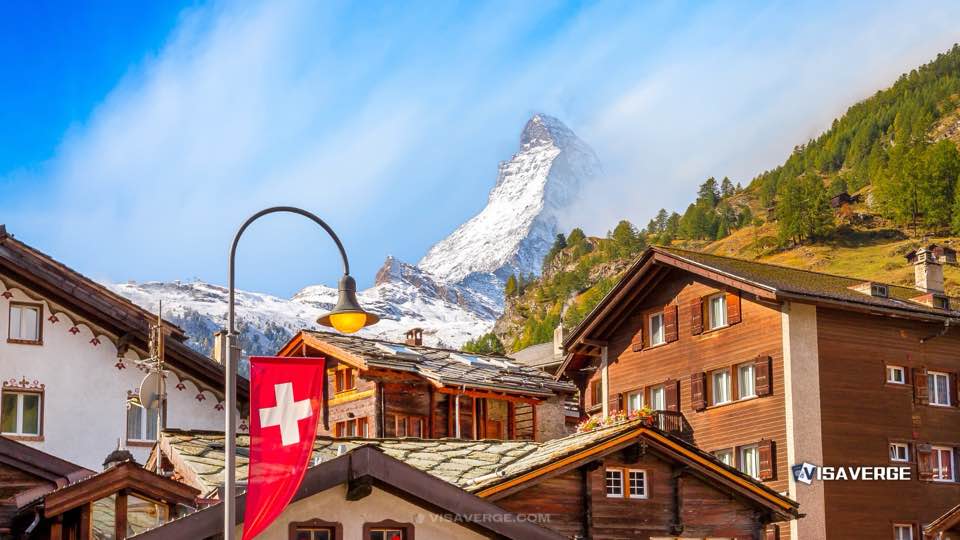
Switzerland will apply a tougher visa-suspension mechanism from December 17, 2025, bringing its rules in line with recent European Union reforms and tightening the way visa-free travel can be withdrawn for non-EU countries. The move lowers the bar for action against countries whose citizens overstay, see their entry refused, or lodge many weak asylum claims, and for the first time ties visa-free access directly to how foreign governments treat migrants and human rights. The change covers all Schengen states, so any suspension decided at EU level will also apply to Switzerland.
Lower threshold for action: 50% → 30%
Under the current Swiss and EU rules, visa-free travel can be questioned if there is at least a 50% increase in irregular stays or refusals of entry by nationals of a visa-exempt country. From December 17, 2025, that threshold will drop to 30%, making it far easier for the European Commission to move toward suspending visa-free access.
Swiss authorities are adjusting their own regulations to match this lower trigger, which will be written into the Ordinance on Entry and the Granting of Visas (EGVO).
Asylum patterns and recognition-rate trigger
Alongside overstay and entry-refusal figures, asylum patterns will now matter more.
- A sharp rise in asylum applications from a visa-free country can lead to suspension of visa-free travel if the recognition rate stays below 20%.
- This means that many asylum claims that are mostly rejected can be treated as abuse of visa-free entry.
Switzerland has chosen to apply the same standard, tying its border policy more tightly to EU migration and asylum assessments.
| India | China | ROW | |
|---|---|---|---|
| EB-1 | Apr 01, 2023 ▲31d | Apr 01, 2023 ▲31d | Current |
| EB-2 | Jul 15, 2014 ▲303d | Sep 01, 2021 | Current |
| EB-3 | Nov 15, 2013 | Jun 15, 2021 ▲45d | Jun 01, 2024 ▲244d |
| F-1 | May 01, 2017 ▲174d | May 01, 2017 ▲174d | May 01, 2017 ▲174d |
| F-2A | Feb 01, 2024 | Feb 01, 2024 | Feb 01, 2024 |
New public-order and human-rights grounds
The reform introduces broader public-order grounds beyond migration statistics:
- Instrumentalisation of migrants: where a foreign government is seen as using migrants as a political tool to pressure the EU or its neighbors.
- Serious human-rights violations: behavior deemed harmful to the EU’s external relations can support suspension of visa-free travel.
Switzerland will follow this approach as part of its Schengen cooperation.
Stronger powers for the European Commission
Under the revised mechanism, the European Commission gains stronger, faster powers:
- It can unilaterally reinstate visa requirements for up to 12 months for nationals of a visa-free country across all Schengen states including Switzerland.
- This uses a simplified and accelerated procedure, making the threat of suspension more immediate.
The source material notes that no country has yet been targeted under the new model, but the possibility is now clearer and closer.
What Switzerland must do administratively
In practice, Switzerland’s State Secretariat for Migration (SEM) must amend the EGVO to reflect the EU reform components:
- Lower the threshold from 50% to 30%.
- Include the asylum-trigger tied to the 20% recognition rate.
- Add new public-order categories such as instrumentalisation of migrants.
- Allow for longer suspension periods and potential extensions.
SEM will also need to coordinate risk assessments more closely with EU institutions so that its decisions fit with wider Schengen policy. Analysis by VisaVerge.com highlights that this deeper alignment shows how closely Switzerland’s border rules now track those of the EU, even though Switzerland is not an EU member.
Practical impact on travelers
For travelers from countries that could lose visa-free status, the effects would be immediate and concrete:
- They would have to apply for a Schengen visa at a Swiss consulate or external service provider.
- Typical requirements include biometric data (e.g., fingerprints), proof of purpose of stay, accommodation details, travel plans, and evidence of funds.
- Stated processing times: 15–30 days.
- The standard short-stay application form used across the Schengen area can be found via the European Commission’s visa pages, such as the common short-stay application form available through European Commission’s Schengen visa policy.
Impact on businesses and employers
Swiss officials expect tighter rules may raise compliance costs for employers, especially those who regularly move staff from visa-exempt partner countries for short business visits.
- Companies accustomed to fast, visa-free mobility could face new planning challenges.
- The framework is designed to make visa-free regimes reversible and conditional, creating extra uncertainty for businesses and frequent travelers.
Duration, extensions, and permanent revocation
The tougher mechanism changes possible suspension length and long-term outcomes:
- Initial suspensions can last up to 12 months.
- Further extensions are possible if underlying problems persist.
- In the most serious cases, reforms foresee permanent revocation of visa-free status when a third country fails to address the reasons for suspension (e.g., persistent irregular stays, low-quality asylum claims, or ongoing public-order and human-rights concerns).
Policy context and key takeaway
Although these changes are technical, they reflect a broader EU policy that treats visa-free access as something earned and maintained through cooperation on migration control, security, and fundamental rights. By adopting the same standards, Switzerland signals it will act in step with the EU when pressure is needed.
Important: No country has yet been targeted under this updated framework. The reforms do not by themselves remove visa-free access for any nationality; they create clearer tools and lower triggers that can be used if problems grow.
The next phase is mainly administrative: SEM will revise the EGVO, refine joint risk assessments with EU partners, and prepare to apply the simplified accelerated procedure if the European Commission proposes action. Official background on shared rules for short-stay visas and visa-free regimes is available at the European Commission’s Schengen borders and visa, which also applies in Switzerland through the Schengen association agreements.
Switzerland will implement tougher visa-suspension rules from December 17, 2025, aligning with EU reforms. The trigger for action drops from 50% to 30% for irregular stays and entry refusals. Asylum trends now matter: a recognition rate below 20% can support suspension. The European Commission gains faster powers to reinstate visas for up to 12 months across Schengen, including Switzerland. SEM must amend the EGVO and coordinate risk assessments. Travelers and employers should expect potential visa requirements, biometric checks, 15–30 day processing, and higher compliance costs.