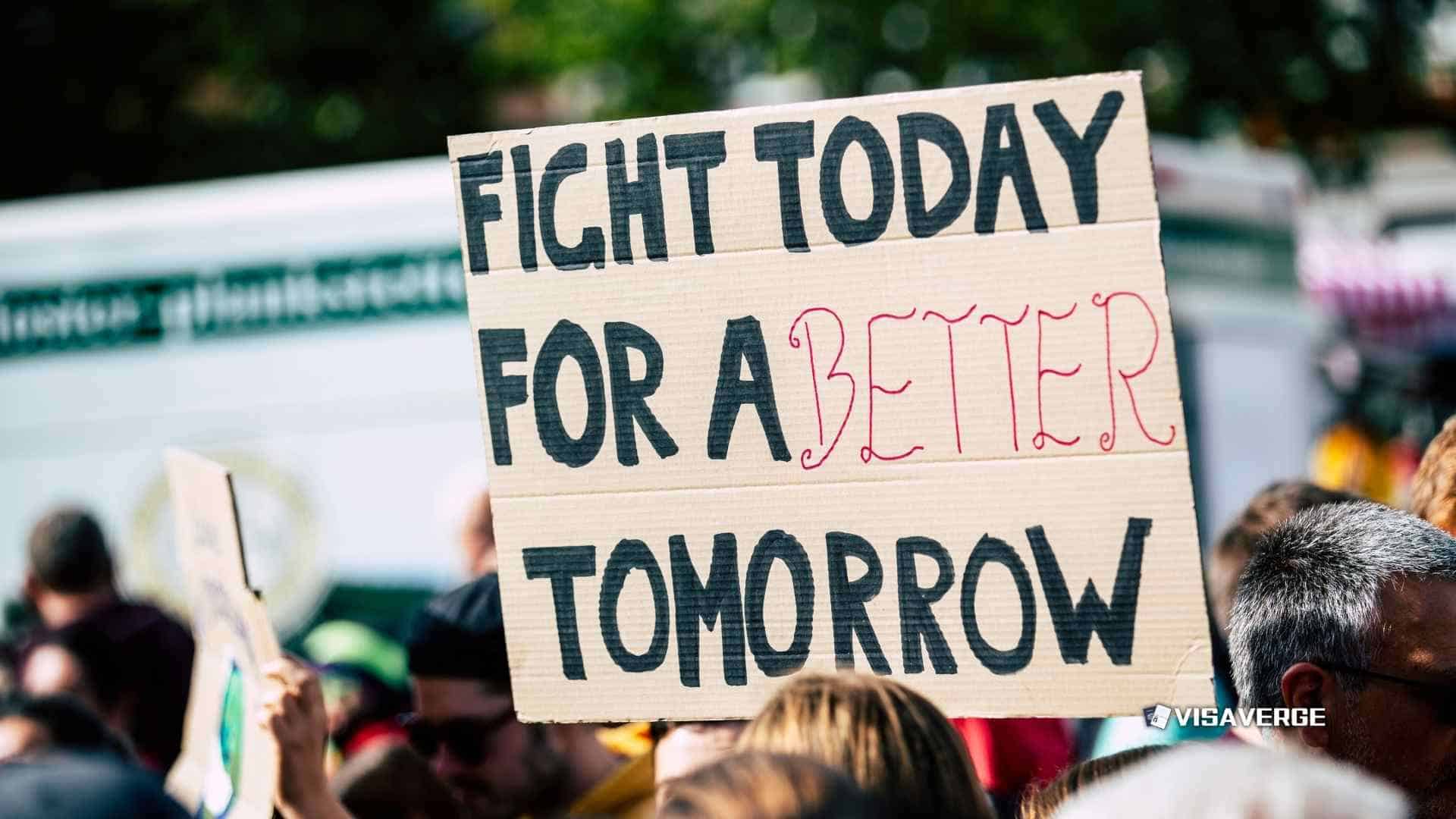
(COACHELLA, CALIFORNIA) — More than one hundred people gathered in downtown Coachella on Saturday to protest ice and immigration enforcement activity in the region, drawing drivers’ honks and passersby’s attention in a public show of opposition.
Participants met Saturday morning from 9:00 a.m. to 10:30 a.m. at the corner of Sixth Street and Cesar Chavez in Coachella, turning a downtown intersection into a rally point for signs, chants and conversations about federal enforcement.
The demonstration was promoted as part of an “ICE Out For Good” weekend of action tied to recent shootings involving federal agents, linking a local turnout to a broader burst of organizing across California.
Comité Latino, a local immigration rights and advocacy group, organized the gathering and described it as their first protest of the year, placing the event inside a calendar of continued activism rather than a one-off response.
Organizers framed the Coachella action around concerns about immigration enforcement in the coachella valley and opposition to ICE presence in the region, urging residents to treat enforcement activity as a community issue and not only a matter for those directly targeted.
In advance of the rally, it was described as a “local protest Saturday morning after two shootings this week involving federal agents,” a reference organizers used to connect public safety concerns with immigration enforcement.
Multiple events were planned across the weekend in the Coachella Valley area, with actions in Coachella and Palm Springs under the same “ICE Out For Good” banner.
Coordinated protests are often used by advocacy groups to broaden visibility and demonstrate solidarity across cities, and organizers in this case pointed to a statewide and regional mobilization rather than an isolated local gathering.
NBC Palm Springs reported that local organizers branded the broader set of actions as “ICE Out For Good” and a “weekend of action and demonstrations” focused on immigration enforcement and the death of Renee Nicole Good in Minneapolis.
Activists and attendees in Coachella framed their turnout as part of that shared message, with Comité Latino emphasizing opposition to ICE presence while keeping the focus on the Coachella Valley and the effects of enforcement in the area.
The weekend organizing extended beyond Saturday’s protest, with allied groups “Courageous Resistance” and “Indivisible of the Desert” planning a related demonstration in Palm Springs.
Organizers said the Palm Springs demonstration would “honor the lives lost at the hands of ICE, including the U.S. citizen, Renee Nicole Good, who was killed in Minneapolis this week by an agent.”
That reference to Good was used by organizers as a focal point for anger and grief, while also serving as a broader argument against immigration enforcement actions they say can produce deadly outcomes.
The reports describing the weekend actions did not provide details about the shootings involving federal agents beyond the mention that there were two this week, leaving the Coachella protest’s stated tie to those incidents at the level of organizers’ public messaging.
Similarly, the accounts of the Coachella gathering focused on the fact of the protest and its placement in a coordinated campaign, without offering specific information about whether any enforcement operation in the city prompted Saturday’s turnout.
Local coverage characterized the turnout as “over a hundred,” a size that can make an impact in a small-city downtown setting where a street corner can become a stage for civic debate.
In Coachella, organizers positioned the protest as both a warning and an invitation, seeking to persuade residents who may not attend rallies that immigration enforcement issues reverberate through workplaces, schools and neighborhoods.
Comité Latino’s role as organizer also anchored the event in existing local advocacy networks, providing structure for participants who wanted to show up for a clear, announced action rather than spontaneous protest.
The “ICE Out For Good” framing offered a unifying slogan across cities, allowing organizers to connect local concerns in the Coachella Valley to statewide mobilizations without requiring every participant to travel.
Palm Springs was the other Coachella Valley focal point named by organizers, with the planned protest set for January 11 at 10:00 a.m. in front of the Palm Springs courthouse, 3255 E. Tahquitz Way.
By organizing separate events in different cities over two days, advocacy groups sought to sustain attention across a weekend news cycle and keep pressure on officials and institutions they want to respond to their concerns.
The Coachella gathering, held in the open in a downtown area, also placed the message in view of residents going about their routines, rather than limiting the protest to private meetings or online outreach.
Organizers and participants described immigration enforcement as an immediate concern for the Coachella Valley, and Saturday’s protest served as a public marker that local opposition to ICE remains active into the new year.
For many attendees, the structure of a scheduled rally can be as important as the message, creating a defined space where people can find each other, share information and signal numbers to local leaders.
The statewide and regional mobilization described by NBC Palm Springs framed the weekend as bigger than any single intersection, but the Coachella turnout still functioned as its own statement in a city where public demonstrations are not everyday events.
The organizing also highlighted how local groups can work in parallel, with Comité Latino leading in Coachella while “Courageous Resistance” and “Indivisible of the Desert” prepared the Palm Springs action under the same banner.
Even without detailed information in the public descriptions about the shootings involving federal agents, organizers used that reference to stress urgency and argue that federal enforcement carries risks that ripple beyond the people directly involved.
The mention of Renee Nicole Good similarly served as a flashpoint for the weekend actions, with organizers presenting her death as central to the message they wanted the community and policymakers to hear.
Organizers’ statements about Good and about ICE were presented as part of the weekend’s framing, while the public accounts of the Coachella protest emphasized turnout, timing and the connection to coordinated actions.
With More than one hundred people gathering downtown, local participation offered a visible measure of engagement for organizers who want to show that opposition to immigration enforcement is not confined to large coastal cities.
“honor the lives lost at the hands of ICE, including the U.S. citizen, Renee Nicole Good, who was killed in Minneapolis this week by an agent.”
Attention now shifts to the remaining planned action in the Coachella Valley, where organizers have said they will “honor the lives lost at the hands of ICE, including the U.S. citizen, Renee Nicole Good, who was killed in Minneapolis this week by an agent.”
Protesters gathered in Coachella to oppose ICE presence and federal enforcement. The event, organized by Comité Latino, coincided with a statewide ‘ICE Out For Good’ campaign. It addressed local safety concerns and the death of Renee Nicole Good. The demonstration marks the start of a series of regional actions, including a planned protest at the Palm Springs courthouse, to advocate for immigrant rights and policy reform.