(TEXAS) More than 65,000 people spent the late-November holiday period locked up in immigration detention as the United States 🇺🇸 detention system hit a modern high point, with federal data showing ICE held 65,735 people on November 30, 2025, a record level that has intensified legal fights, strained local jails and private facilities, and pulled thousands of families into an enforcement dragnet even when there is no criminal conviction on their record.
The headcount, confirmed by TRAC Reports, sits close to widely cited “68,000” estimates and reflects a steep rise during President Trump’s second term. In January 2025, detention stood at about 39,000 people, according to Forum Together analysis cited in the source material. By November 2025, that analysis put the detained population at roughly 66,000, and it projected the system could reach 107,000 by January 2026 if the growth rate continues.

The figures matter because immigration detention is civil, not criminal, meaning many people are held while their immigration case moves forward rather than as punishment after a conviction.
Who in custody — convictions and classifications
A striking feature of the November 30, 2025 snapshot is how many detainees have not been convicted of a crime. TRAC Reports said 48,377 people — 73.6% of those in ICE custody — had no criminal convictions, with some detained after minor offenses such as traffic violations.
This detail has become central to the public debate because it cuts against the common idea that detention mainly targets people with serious criminal histories. It also means many detainees are fighting their cases from behind bars even though they have never been convicted of any offense in criminal court.
Policy changes inside ICE have helped drive the higher numbers, especially for people who have no criminal record. A memo dated July 8, 2025, signed by ICE Acting Director Todd Lyons, ordered detention for all “arriving aliens,” a legal term used in immigration law for certain people who seek entry or are treated as applicants for admission.
According to the material provided, the shift boosted non-criminal detainees to 16,251 in the average daily population in September 2025, exceeding the number held with convictions (15,719) or with pending criminal charges (14,332). Several federal judges ruled against the policy, the source material said, but enforcement continued amid mass deportation goals.
Geographic concentration and facility footprint
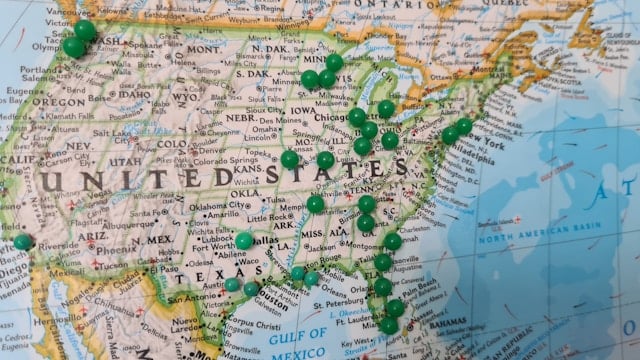
Texas, the nation’s biggest hub for immigration detention, held far more detainees than any other state. FY2026 data in the source material showed:
| State | Detainees (as of late Nov 2025) |
|---|---|
| Texas | 17,696 (as of November 28, 2025) |
| Louisiana | 7,096 |
| California | 5,711 |
| Florida | 4,217 |
| Georgia | 3,973 |
The geographic concentration is not just a spreadsheet detail. It shapes where families can visit, where lawyers can take cases, which local courts hear bond requests, and how quickly people can get medical care or mental health support in custody.
The build-up has also been tied to an expanding footprint of facilities. The Vera Institute’s public ICE reports found ICE used 605 facilities from January to early June 2025, up from 457 in the late Biden era. “Facilities” can mean dedicated immigration centers, county jails under contract, or other holding sites.
For detainees and their families, that broader web often translates into transfers—sometimes across state lines—that can separate people from their children, their job, and the attorney who was preparing their case.
Family detention and capacity expansion
Detention growth has shown up not only in adult facilities but also in the return of family detention in Texas. The Vera Institute data cited in the source material said family detention resumed at Karnes County, where 1,187 people were held on June 10, 2025, and at Dilley, where 575 were held.
The same material said two more centers were planned by year’s end, adding 5,500 more in capacity. Family detention has long drawn fierce criticism because it can lock up children and parents in an institutional setting during what can be weeks or months of legal proceedings.
Money, cost, and duration
Money is another force behind the expansion. The source material said detention spending surged to over $14 billion in FY2025, described as a 400%+ increase from FY2024. It also cited an $11.25 billion annual commitment through FY2029 via OBBBA. Those figures suggest a system being built for sustained high capacity, not a short-lived spike.
Key daily-life metrics reported:
| Measure | Figure |
|---|---|
| Average stay | 44 days (September 2025) |
| Cost per day | $152/day |
| October 2025 bookings | 41,624 people (36,635 after ICE arrests; 4,989 after CBP arrests) |
Forty-four days is long enough for a worker to lose a job, for rent to go unpaid, or for a child’s care plan to collapse if a parent is detained. It is also long enough for cases to become harder to win, because gathering documents and finding witnesses from inside detention can be slow and expensive.
How people enter the system
TRAC Reports said October 2025 bookings totaled 41,624 people, including 36,635 booked after ICE arrests and 4,989 booked after CBP arrests. That split matters because it shows both interior enforcement and border enforcement feeding detention.
In practical terms, a person can be pulled into immigration detention after:
- A workplace stop
- A traffic stop that leads to fingerprinting
- A handoff from border custody into ICE detention while an immigration case begins
Alternatives to Detention (ATD)
At the same time, the source material points out that detention is not the only tool the government uses. As of November 29, 2025, 182,009 people were monitored through ICE Alternatives to Detention (ATD) programs, with San Francisco at 20,853—the largest reported ATD population in the data provided.
ATD can include check-ins, electronic monitoring, or other reporting requirements, and it is often presented as a less restrictive option than jail-like custody. Readers looking for the government’s description of these programs can find it on ICE’s official page for Alternatives to Detention.
Legal friction and practical consequences
The legal back-and-forth has produced confusion for families and attorneys, especially when court rulings do not immediately change day-to-day practices in detention centers. Immigration judges, who work under the Justice Department rather than the federal courts, often face crowded dockets.
Meanwhile, detainees who might once have asked for release on bond can find themselves arguing over whether they are even eligible for a bond hearing, depending on how ICE classifies them and how courts interpret detention rules for people treated as “arriving.”
Advocates say the way ICE uses detention versus ATD can decide whether a family stays together during a case. Officials who support the detention surge argue that holding more people improves compliance with removal orders and speeds deportations.
TRAC’s finding that 48,377 detainees on November 30, 2025 had no criminal convictions has been cited by critics as evidence that the system is sweeping in people who pose little public safety risk.
Key takeaway: With ICE holding 65,735 people on November 30, 2025, and with projections in the source material pointing higher, the country’s immigration detention system has become one of the most visible pressure points in U.S. immigration policy — affecting courthouse challenges, family separation risks, and daily realities inside detention centers.
Human stakes and geographic effects
Because the source material does not name individual detainees, lawyers, or family members, their personal stories cannot be independently quoted here, but the human stakes are visible in the state-by-state and facility-by-facility build-out.
- When detention rises fastest in Texas and Louisiana, families in other parts of the country can suddenly find a loved one transferred hundreds of miles away.
- When family detention restarts in Karnes County and Dilley, the people affected include children whose days revolve around counts, meal times, and legal calls rather than school routines.
VisaVerge.com reports that the late-2025 spike, paired with expanded facility use and large new funding, is reshaping how immigration enforcement feels on the ground: more detention beds, more bookings, more transfers, and more people forced to fight complex immigration cases from inside custody.
With projections in the source material pointing higher, the detention expansion raises questions about the balance between enforcement goals and the practical, financial, and human costs of holding large numbers of people in civil custody.
The U.S. immigration detention system reached an unprecedented 65,735 detainees by November 30, 2025. This expansion is characterized by a high percentage of non-criminal detainees and a massive increase in federal spending. Texas and Louisiana lead in detention capacity, while the return of family detention and the use of over 600 facilities signal a sustained commitment to high-capacity enforcement despite ongoing legal challenges and human rights concerns.