- 01South Korea faces scrutiny after Jeju Air Flight 2216 struck a concrete wall during a runway overrun.
- 02Simulations suggest the 179 fatalities were linked to rigid airport infrastructure rather than the initial slide.
- 03Authorities plan to replace the structure with frangible, breakaway designs to meet international safety standards.
(MUAN, south korea) — If you’re booking flights in south korea this year, the headline lesson from jeju air flight 2216 is simple. Airport safety design can matter as much as the airline you choose.
For travelers, that changes how you weigh “low fare vs. full service,” and it adds a new question: how well do the airports you’ll use manage runway overruns?
This story has two “options” worth comparing. One is the traditional focus: airline choice (low-cost carrier vs. full-service).
The other is suddenly more relevant: infrastructure choice (rigid concrete obstacles vs. frangible, breakable installations). Both can shape outcomes when something goes wrong.
Below is a traveler-first comparison of what this incident says about (1) flying a low-cost carrier like Jeju Air versus a full-service airline on the same kinds of domestic and short-haul routes, and (2) the safety philosophy of “hard stop” structures versus breakaway designs at runway ends.
Quick recommendation
If price is your top priority, low-cost carriers can still be the right call on short hops. But after Jeju Air Flight 2216 at Muan International Airport, I’d pay more attention to the airport you’re flying into.
I’d also avoid ultra-tight connections at unfamiliar regional airports in poor weather. If you’re booking family travel, business trips, or anything time-sensitive, a full-service carrier often buys you more rebooking power, better disruption handling, and more predictable elite benefits.
Those things matter when an airport incident shuts down operations.
Side-by-side comparison: what matters for your next booking
| Category | Low-cost carrier (example: Jeju Air-style LCC) | Full-service carrier (Korean Air / Asiana-style) |
|---|---|---|
| Typical cash price | Usually lowest base fare, fees add up fast | Higher base fare, fewer “surprise” add-ons |
| Disruption handling | More limited rebooking partners, fewer later flights | More frequencies, alliances, and interline options |
| Loyalty earning | Often revenue-based and stingier on cheap fares | Better earning, elite bonuses, broader partner crediting |
| Redemption options | Limited or no strong “sweet spots” | More partner awards and premium cabin redemptions |
| Seat comfort | Tighter pitch more common, buy-up extras | More consistent seat pitch, better buy-up premium economy/business |
| Baggage | Carry-on and checked fees common | Status, premium fares, and co-brands can reduce fees |
| When airport issues hit | Lower-cost ticket may be less flexible | Higher fare often comes with better protections |
| What Flight 2216 adds | Airline choice matters, but airport design can dominate outcomes | Same: airport infrastructure can override airline differences |
Competitive context: This lines up with what you see globally. Legacy carriers usually win on irregular operations. Low-cost carriers usually win on price.
1) Incident overview: Jeju Air Flight 2216
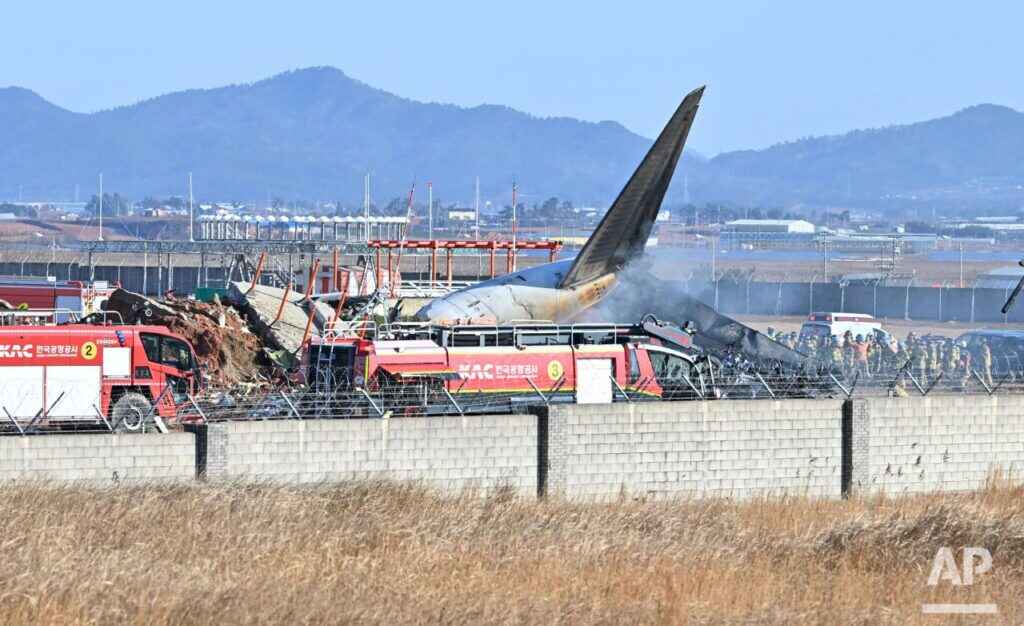
Jeju Air Flight 2216 crashed during landing at Muan International Airport. The aircraft overran the runway and then struck a rigid structure beyond the runway end.
The human toll was devastating. Authorities reported 179 deaths, including 175 passengers and 4 of the 6 crew.
This became a major safety story for one reason. Multiple reports described the initial overrun as survivable. The catastrophic outcome was linked to the collision with a concrete localizer berm / wall positioned beyond the runway.
What’s confirmed so far is the basic sequence. The aircraft landed, overran, and hit the structure. What remains under investigation is the full chain of causes.
That includes aircraft performance, crew decision-making, runway conditions, and airport design choices. Several key moments occurred in late December 2024, followed by official actions in late January 2025.
Those dates matter because they frame how quickly the response moved from analysis to mitigation.
2) Runway overrun and concrete wall details
A runway overrun is exactly what it sounds like. The aircraft doesn’t stop before the pavement ends.
That can happen after a long touchdown, reduced braking, hydroplaning, or a higher-than-expected landing speed. It can also follow a late go-around decision.
In an ideal world, the area beyond the runway end is clear and forgiving. Think grass, graded earth, or engineered materials that slow an aircraft.
The goal is to reduce forces on impact. At Muan International Airport, the key obstacle was a concrete localizer berm / wall. In plain terms, it supported equipment used to guide aircraft on approach.
Localizers are part of the instrument landing system. They help aircraft line up with the runway.
The reported placement is what raised alarms. The structure sat about 250 meters beyond the runway end. That distance matters because it can sit inside the area where an overrun is still survivable.
It can also be exactly where an aircraft finally decelerates into a lower-energy slide. When an aircraft hits a rigid, non-yielding barrier at speed, deceleration forces spike.
That is often the difference between serious injuries and mass fatalities. It’s also why modern airport standards put so much emphasis on what sits beyond the runway.
3) Survivability simulations and the barrier’s role
A survivability simulation is a structured attempt to answer a hard question. Given an aircraft’s estimated speed, angle, weight, and deceleration, what injuries would be expected?
Models can also test alternate scenarios. For example, “same overrun, but without a rigid obstacle.” Simulations are only as good as their assumptions.
Small changes in speed, braking effectiveness, or impact angle can change outcomes. Cabin break-up dynamics and post-crash fire modeling also matter.
Still, the reported takeaway here is stark. Multiple outlets described government-commissioned simulations suggesting that, without the concrete structure, all or nearly all occupants might have survived.
The key framing is “reported,” because the analysis discussed in media coverage was described as unpublished. One report said SBS obtained the analysis through a lawmaker, Kim Eun-hye.
Other coverage cited similar findings described in documents obtained by major outlets. These accounts broadly point in the same direction: the barrier likely turned a survivable event into a fatal one.
That doesn’t end the investigation. Final reports can confirm, refine, or contradict early modeling. But for travelers, the practical point is immediate: airport design is not abstract. It can determine whether an overrun stays survivable.
4) Safety standards and compliance context: ICAO and RESA
This is where the “airport vs. airline” comparison becomes real. The International Civil Aviation Organization (ICAO) sets global standards and recommended practices.
The intent at runway ends is straightforward. Keep them clear of hazardous obstacles. Reduce the chance that an overrun becomes a high-force impact.
The key concept is RESA, short for Runway End Safety Area. It’s a cleared, graded area beyond the runway designed to reduce damage if an aircraft runs off the end.
Here are the numbers most often cited in this discussion:
- Minimum RESA length: 90 meters
- Recommended RESA length: 240 meters
Those areas are meant to be free of dangerous obstacles. Some airports also use EMAS, an engineered material arresting system.
EMAS is common in the U.S. at space-constrained airports. It’s less common elsewhere. Compliance is not always a clean yes-or-no for the public.
Local regulations, terrain, and legacy airport layouts can complicate the picture. Airports can also have “equivalent level of safety” arguments. But the underlying principle is consistent: hard, unyielding objects near runway ends are a known hazard.
5) Media corroboration and expert perspectives
What pushed this story beyond a routine accident update was corroboration. Multiple outlets reported similar conclusions about survivability without the structure.
Some referenced documents obtained through official channels. Others cited reporting based on the unpublished government-commissioned analysis.
Aviation safety expert David Learmount’s critique, as reported, focused on the aircraft remaining “still intact” until the barrier impact. He also condemned the idea of a hard structure in that location.
His point matches modern runway safety thinking. You don’t want a rigid object where an overrun aircraft may still be moving fast.
For travelers, the best way to read this coverage is to separate three things:
- Reporting on what simulations and documents allegedly say
- Expert opinion about best practice and risk
- Official investigative conclusions, which carry the most weight
Early reports can be directionally correct and still miss details. That’s why final accident reports matter. They can change the narrative around speed, braking, or decision points.
4) Aftermath and response: removal and replacement plan
Authorities later announced the concrete structure would be removed. They also said it would be replaced with an easily breakable installation.
That word matters: frangible. In airport design, frangible structures are meant to break away on impact. They still serve their purpose for navigation or lighting, but are designed to reduce forces on an aircraft.
The timing also matters for public confidence. The incident occurred in late December 2024. The removal and replacement plan was announced in late January 2025.
Those are the anchor points travelers will see in the timeline. What happens next is where frequent flyers should keep watch: whether the structure is actually removed on schedule and whether the replacement meets frangibility expectations.
Also watch for whether broader runway-end audits happen across the country and whether interim measures are put in place during the transition. For airline ops, there’s another practical impact.
When a runway end area is under construction or review, airports can face temporary restrictions. That can mean payload limits, reduced runway availability, or schedule padding.
You’ll see it first in on-time performance and last-minute cancellations.
⚠️ Heads Up: If you’re flying into smaller regional airports in winter weather, leave more buffer time. Airport disruptions don’t just delay flights. They can strand you when frequencies are limited.
Miles and points implications: what changes after a safety-driven disruption
This is not a “book on points and you’re safe” story. But safety incidents and airport closures do affect your miles strategy.
Here’s how:
- Award tickets can be easier to change. Many programs now allow free changes on awards. Cash tickets can still carry fare differences.
- Elite status helps during rebooking. Priority lines and protected connections matter when seats are scarce.
- Credit where you fly matters. If you’re flying an LCC, your earning may be limited. Full-service carriers usually offer better partner crediting.
If you’re status-chasing, disruptions can cut both ways. A cancellation can cost you segments. A reroute on a partner can sometimes earn differently.
Always check the accrual chart before accepting a rebooked itinerary.
Use case scenarios: which “option” should you choose?
Choose a low-cost carrier if…
- Your trip is short and flexible.
- You can tolerate a same-day delay or even an overnight.
- You’re traveling light and know the baggage rules.
- You’re flying in good weather seasons, with backup flights available.
Choose a full-service carrier if…
- You must arrive on time for work or a connection.
- You want better same-day rebooking options.
- You value lounge access and priority support during disruptions.
- You’re earning toward elite status or want partner mileage credit.
Choose your airport carefully if…
- You’re booking into a regional field with limited alternates.
- Weather and runway conditions are often marginal.
- The airport has a history of operational constraints.
- You’re traveling with family or anyone for whom disruption is harder.
In other words, after Jeju Air Flight 2216, “airline vs. airline” is only half the comparison. “Airport vs. airport” deserves equal weight.
The smartest move for 2026 bookings is simple. If you can choose between nearby airports, pick the one with more runway margin and more daily frequencies.
And if you have a trip that can’t slip, pay for the schedule that gives you the most later-flight backups the same day.