- Over 200 Grand Prairie High School students protested federal immigration enforcement during a Friday walkout.
- The march toward city hall occurred despite warnings of state sanctions from the Texas Education Agency.
- Organizers cited community fear and injustice as the primary motivations for their public demonstration.
(GRAND PRAIRIE, TEXAS) — More than 200 students walked out of Grand Prairie High School on Friday, February 13, 2026, just after 11 a.m. to protest federal immigration enforcement by U.S. Immigration and Customs Enforcement.
Students marched from the school toward city hall, turning the midday walkout into a public show of solidarity and a visible statement of concern about ICE activity.
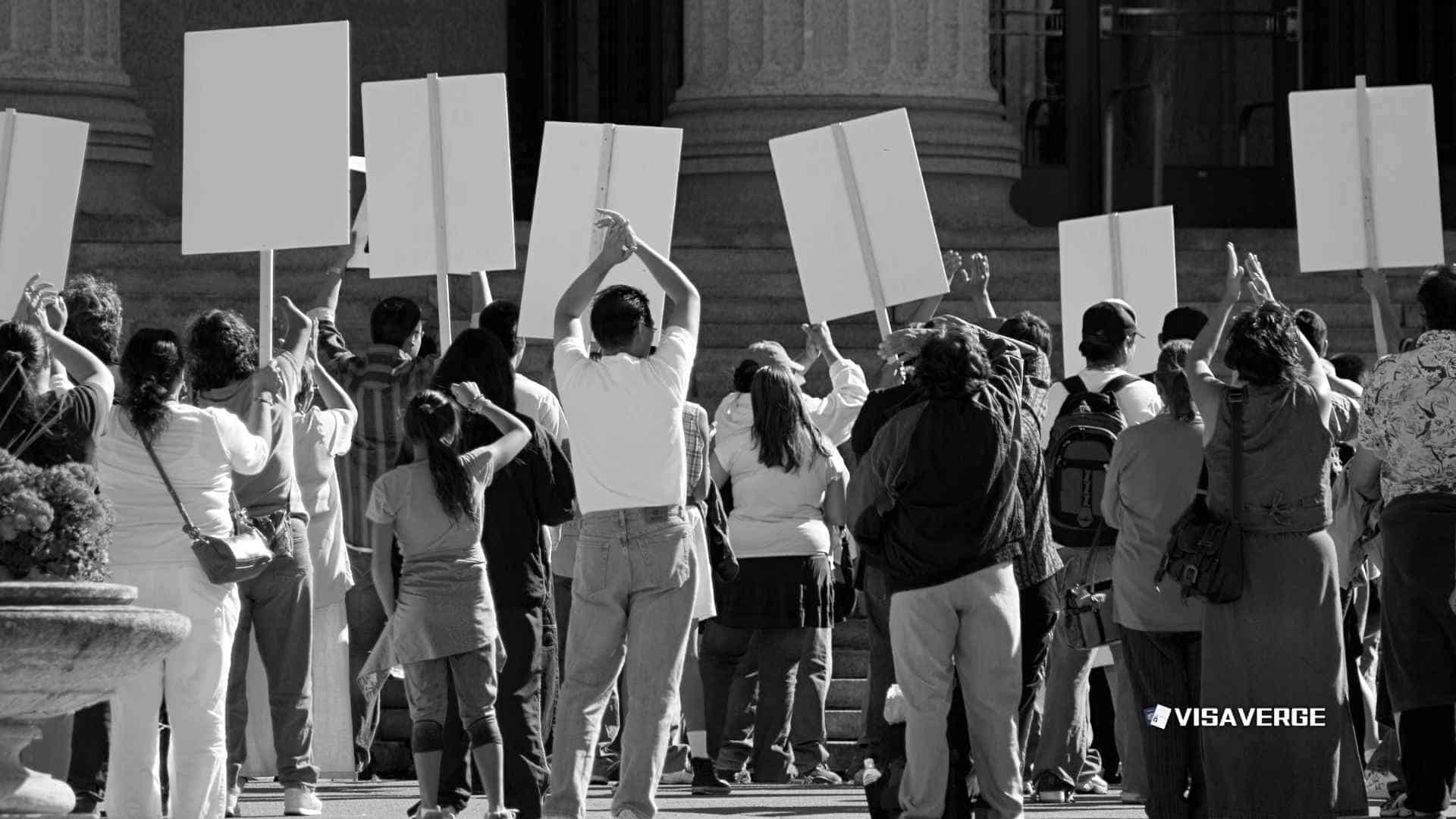
Handmade signs rose above the crowd as they moved through the city, including messages that read “We are skipping our lessons to teach you one” and “ICE Out.”
Chants echoed along the route, with students calling, “No justice! No peace! No ICE on the streets!” as passing cars and trucks honked in support.
A student played guitar during the march, adding to an atmosphere that students framed as organized and purposeful as they headed toward city hall.
The group walked approximately one mile and stopped at the intersection of Main and 4th Street before continuing, according to the account of the event.
Grand Prairie High School has approximately 3,000 students, most of whom are Latino, a demographic reality that students and families in the area often link to broader community worries about immigration enforcement.
Students said they walked out to protest ICE activity and what they described as the impact on people around them, emphasizing community fear rather than any school-sponsored programming.
Some students said they had heard rumors about potential consequences for participating, but still joined the walkout.
For them, the protest’s message centered on what they saw as harm to people they know, rather than a debate confined to the classroom or a school event on campus.
A student organizer described the motivation in personal and sweeping terms in comments to KERA, tying the action to relationships and shared experiences across the city.
“Everyone here knows or has some connection to someone affected [by] the discrimination, the injustice, the pain and the torture from the government of ICE that are trying to stop us, trying to rob our people, and we just won’t stand for it,” the student organizer told KERA.
That statement, delivered as students marched, captured how organizers framed the walkout as grounded in family and neighborhood ties, rather than a narrowly political message.
At the state level, Texas education officials had already warned districts about walkouts, raising the stakes for students and school employees even as teenagers across the campus decided to leave class.
The Texas Education Agency released guidance earlier in February warning school districts of serious consequences if they facilitate walkouts, including possible state takeover.
Under the guidance, students who participate in walkouts must be marked absent, and teachers who allow walkouts could face sanctions.
State leaders tied the guidance to Gov. Greg Abbott’s call for the state Education Commissioner to investigate “political indoctrination” in schools, placing campus activism within a larger political fight over what happens in Texas classrooms.
The warning from state officials landed as students in Grand Prairie took their protest into the streets, a move that made the walkout highly visible beyond campus and, for a time, the focus of city attention.
Grand Prairie Police monitored the protest from across the street, as officers urged students to remain on sidewalks and grass and not enter the street.
A helicopter was heard overhead during the event, adding to the sense of security presence as students moved through the area in a large group.
Students’ signs and chants made their message clear, with “ICE Out” appearing alongside classroom-themed slogans and the call-and-response cadence of “No justice! No peace!” as part of their broader chant.
The rallying cry “No justice! No peace!” appeared not only as a chant but as a framing device for students who said they felt pushed to act despite hearing talk of attendance or disciplinary consequences.
By leaving class together and heading toward city hall, participants made their protest legible to residents who encountered the march through honking vehicles, street-corner pauses, and a steady flow of teenagers holding posters.
The walkout also unfolded under a state policy backdrop that explicitly instructs how districts must treat student participation, a factor that can shape how administrators respond after a protest ends.
With TEA guidance warning districts about facilitating walkouts and directing that students must be marked absent, the state’s approach puts attendance rules at the center of how schools record a political action taken during the school day.
The possibility of sanctions for teachers who allow walkouts, outlined in the guidance, adds another layer for educators who might be asked by students for support or flexibility when protests arise.
Abbott’s call for an investigation into “political indoctrination” in schools has helped drive scrutiny of campus speech and activity, even when students describe their participation as rooted in community experiences and fears.
In Grand Prairie, students’ decision to march off campus and toward city hall underscored the public nature of the action and the intent to be seen beyond the walls of Grand Prairie High School.
Even with an energized crowd and loud chants, police instructions focused on keeping students out of the street, directing them to remain on sidewalks and grass as they moved.
The sound of a helicopter overhead, heard during the event, became part of the march’s backdrop as students walked in a tight group with signs raised high.
For many participants, the protest’s urgency appeared linked to what they described as ICE-related fear in their community, reflected in both the “ICE Out” sign and the repeated chant line, “No ICE on the streets!”
Students’ remarks about rumors of consequences suggested that worries about attendance marks or punishment circulated even as classmates kept walking and kept chanting.
The demonstration’s scenes—guitar music, honking support, and handmade signs—showed how a school-day walkout can quickly become a wider civic moment, particularly when students move off campus and into city spaces.
At the same time, the TEA guidance made clear that the state views walkouts through the lens of compliance and consequences, warning districts not to facilitate them and spelling out how participation must be recorded.
The intersecting pressures—teen-led activism on one side and state scrutiny tied to claims of “political indoctrination” on the other—have put school districts in a position where student protests can carry administrative and political risk.
In Grand Prairie, the walkout brought those tensions into the open: students chanting “No justice! No peace!” in the streets while state guidance threatens serious consequences for districts judged to have facilitated such actions.
As students reached city hall after their roughly one-mile march, their message remained focused on ICE and the community impact they described, with “ICE Out” serving as a blunt demand and a unifying slogan for the crowd.