(CANADA) — Canada reported a 33% drop in asylum claims between January and October 2025 compared with the same period in 2024, as coordinated “stronger border measures” in 2024 and 2025 drove down irregular crossings and tightened screening for would-be claimants.
Official reports from both the Canadian and United States governments, confirmed as of January 5, 2026, pointed to fewer asylum claims and fewer irregular border crossings across North America as enforcement and eligibility rules narrowed routes used by migrants.

Key statistics and observed changes
- 33% decline in asylum claims in Canada (Jan–Oct 2025 vs Jan–Oct 2024).
- Daily irregular crossings into Canada dropped from an average of 165 to 13 people after the Additional Protocol to the Safe Third Country Agreement (STCA).
- U.S. Customs and Border Protection (CBP) reported a 90% drop in apprehensions at the U.S.-Canada border in June and July 2025 year-over-year.
- 97% reduction in airport claims from Mexican nationals after partial visa requirements introduced in early 2024.
- 65% drop in claims from Temporary Resident Visa (TRV) holders by mid-2025 due to tighter TRV screening.
| Metric | Before | After | Reported change |
|---|---|---|---|
| Canadian daily irregular crossings | 165 | 13 | Large decline after STCA Additional Protocol |
| Asylum claims (Jan–Oct) | 2024 baseline | 2025 | -33% |
| U.S.-Canada border apprehensions (June–July) | 2024 | 2025 | -90% |
| Airport claims (Mexican nationals) | pre-visa changes | post-visa changes | -97% |
| TRV-holder claims | pre-screening change | mid-2025 | -65% |
Policy changes driving the shift
A number of coordinated policy measures and enforcement actions were credited with producing the declines:
- Expansion of the STCA: Now applied across the entire 8,891 km border, intended to close previous “loopholes” that allowed claims between official ports of entry.
- Additional Protocol to the STCA: Implemented in 2024–25 and associated with the sharp drop in daily irregular crossings.
- Partial visa requirements for Mexican nationals (early 2024): Linked to immediate reductions in airport-based claims.
- Tighter TRV screening: Contributed to a large decline in claims from TRV holders by mid-2025.
- U.S. Biometric Entry-Exit System rules (dated December 26, 2025): Require all non-U.S. citizens, including Canadians, to be photographed upon entering or leaving the U.S., expanding biometric collection for departures and arrivals.
- U.S. USCIS policy memorandum (PM-602-0192, dated December 2, 2025): Directed a “Hold and Review of all Pending Asylum Applications,” intentionally delaying processing in the interest of perceived national security priorities. The memorandum is posted on the U.S. Citizenship and Immigration Services website: U.S. USCIS policy memorandum (PM-602-0192, dated December 2, 2025).
Government framing and diplomatic context
Canadian officials described the changes as a return to “restored control” after years of rising asylum volumes, aligning closely with U.S. enforcement priorities.
Diplomatic pressure also played a role, with U.S. officials reportedly threatening a 25% import tariff on Canadian goods if border security was not tightened.
Canadian Minister Marc Miller framed the policy shift as protecting process integrity:
“the asylum system can’t be used as a shortcut to immigration,” Miller said.
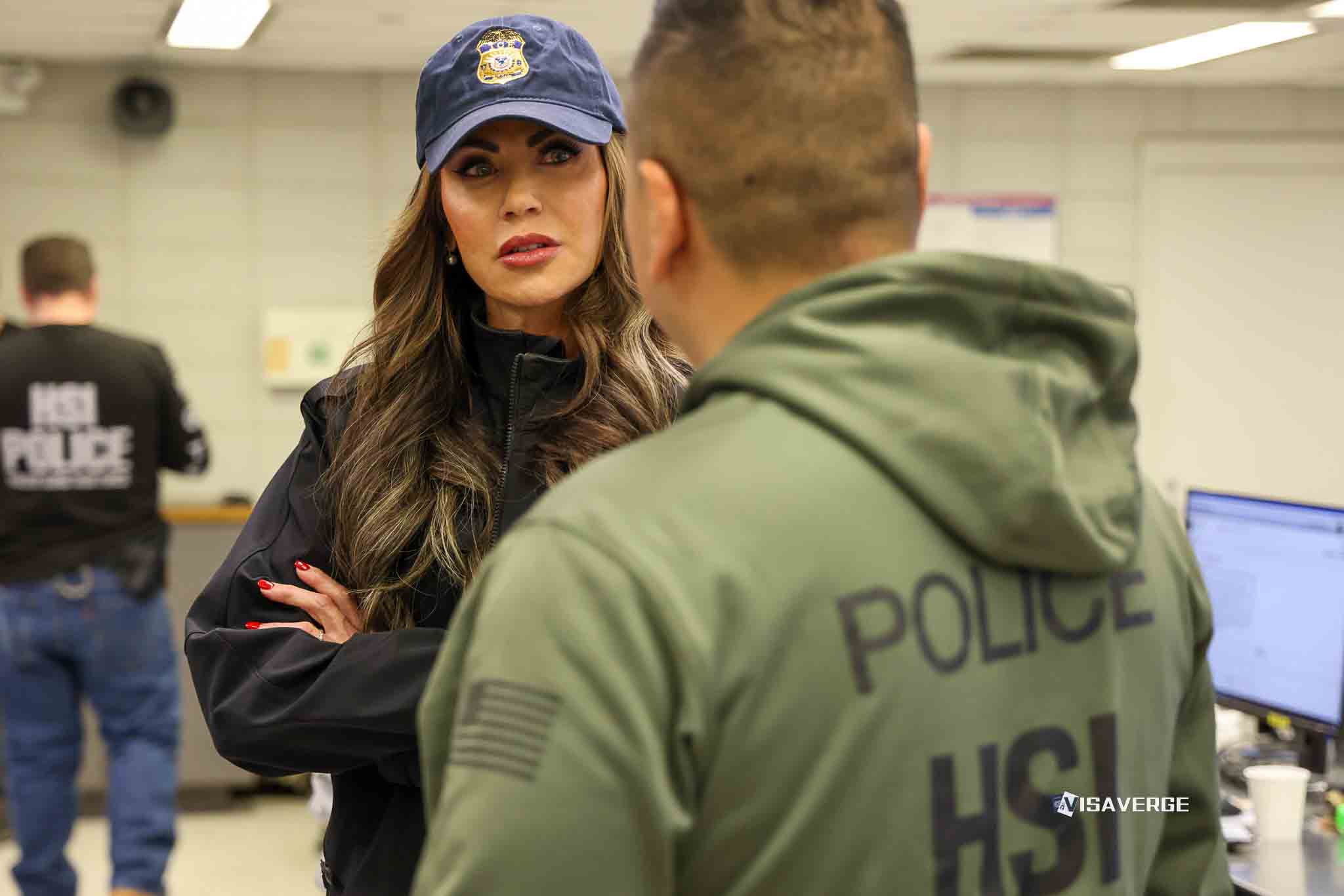
On the U.S. side, senior officials publicly praised enforcement outcomes tied to the stepped-up controls. DHS Secretary Kristi Noem and CBP Commissioner Rodney Scott issued statements posted on the U.S. Department of Homeland Security website:
“History made: the lowest border crossings in October history and the sixth straight month of ZERO releases. This is the most secure border ever. Thank you, President Trump and our brave DHS law enforcement. You make America proud!” — DHS Secretary Kristi Noem (statement posted on https://www.dhs.gov, November 5, 2025)
“Our mission is simple: secure the border and safeguard this nation. And that’s exactly what we are doing. No excuses. No politics. Just results delivered by the most dedicated law-enforcement professionals in the country,” — CBP Commissioner Rodney Scott (statement posted on https://www.dhs.gov, November 5, 2025)
Procedural impacts and consequences
The reports highlighted both intended enforcement outcomes and unintended or secondary effects:
- Increased screening thresholds and faster filtering of what officials described as “non-genuine” claims.
- Reduced pathways for migrants who previously relied on:
- Irregular entry points,
- Visa-free airport arrivals,
- Temporary resident channels (TRVs).
- The USCIS hold on pending asylum applications increased wait times for legitimate asylum seekers already in the system, with the agency describing delays as a necessary tradeoff for national security concerns.
- Expansion of biometric data collection at U.S. ports of entry to enhance identity checks and border integrity.
Legislative and programmatic changes in Canada
Canada’s policy agenda included proposed legislation and program adjustments intended to further tighten asylum and immigration processes:
- Bills C-2 and C-12: Described as proposals to modernize immigration response, including provisions to:
- Limit the right to seek asylum for those in Canada for more than a year.
- Grant the government powers to cancel documents without due process (as described in the reports).
- Remote Area Border Crossing Program: Scheduled to be terminated by September 2026, to be replaced by a telephone reporting system intended to enhance border integrity.
The reports did not provide precise legislative timelines for Bills C-2 and C-12, but presented them as part of a broader push to tighten access and strengthen what officials called system integrity.
Overall assessment presented in the reports
Taken together, the measures amounted to a broad narrowing of opportunities for migrants to initiate asylum claims in Canada through:
- Irregular routes,
- Airport arrivals after visa-free travel,
- Temporary resident channels that came under greater scrutiny.
The STCA expansion was presented as a structural change that removed the ability to make claims at points that previously fell outside the agreement’s reach. Supporters argued these steps protect asylum systems from being used as alternative immigration pathways.
At the same time, the reports acknowledged consequential impacts on claimants, such as longer waits from the USCIS hold and reduced options for initiating claims.
The reporting emphasized differing emphases in official messaging:
- U.S. statements focused on enforcement outcomes and border security metrics.
- Canadian framing emphasized system integrity and the expectation that those seeking to immigrate should follow established legal rules.
Marc Miller’s remark reiterated that framing:
“the asylum system can’t be used as a shortcut to immigration,” he said.
Canada and the U.S. have implemented rigorous border controls throughout 2024 and 2025, leading to a 33% drop in Canadian asylum claims. Key measures include the full-border expansion of the Safe Third Country Agreement, new biometric entry-exit requirements, and stricter visa screenings. While these policies have achieved record-low irregular crossings, they have also introduced significant processing delays and restricted access for potential claimants.