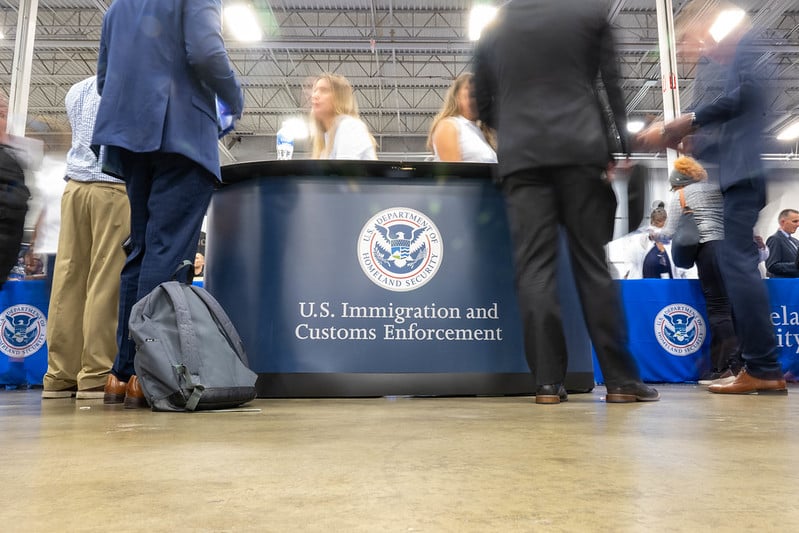
- Port Richey PD received federal reimbursement funds for participating in the 287(g) Task Force Model.
- Funding incentives may increase routine immigration screenings during local police encounters like traffic stops.
- Under Matter of Barcenas, defendants must prove unlawful evidence collection before the government justifies its use.
(PORT RICHEY, FLORIDA) — Port Richey’s announcement that it received a reimbursement award tied to immigration enforcement cooperation matters less as “new law” and more as a practical signal: more local police agencies may expand 287(g) Task Force Model activity, increasing the chances that routine policing contacts trigger immigration screening, referral to ICE, or removal proceedings.
A key legal backdrop for what happens next is the Board of Immigration Appeals’ evidentiary rule on challenging how the government obtained immigration evidence after an arrest or stop. In Matter of Barcenas, 19 I&N Dec. 609 (BIA 1988), the BIA held that a respondent seeking to suppress evidence in removal proceedings generally must first make a prima facie showing that the evidence was unlawfully obtained. Only then does the burden shift to the government to justify the evidence’s admissibility.

In practice, that rule shapes how immigrants and their counsel contest immigration cases that begin with local police encounters—an issue likely to arise more often as funding incentives expand local participation in immigration enforcement.
1) Port Richey PD reimbursement announcement: what it is—and what it is not
Port Richey PD reported it was awarded a reimbursement payment administered by Florida’s Chief Financial Officer. The money is described as tied to the department’s cooperation with ICE through the 287(g) program, specifically the Task Force Model.
“Reimbursement” has a specific operational meaning. It is not a new deportation power created by a local press release. It is payment meant to offset costs a local agency says it incurred while assisting a federal immigration initiative. These costs can include personnel expenses tied to trained officers performing immigration-related functions under an agreement.
Under the 287(g) Task Force Model, certain trained local officers may be authorized to perform limited immigration functions under ICE oversight, after training and under a signed agreement. The legal authority comes from federal statute, not state or city law. The funding is a separate mechanism that may encourage participation.
Port Richey’s announcement fits a broader pattern described in coverage of the salary reimbursements tied to 287(g) participation. Readers should interpret it as an incentive structure connected to enforcement cooperation, not as a change to who is removable under the Immigration and Nationality Act (INA).
A 287(g)-linked reimbursement announcement does not itself expand arrest powers. But it may change how frequently immigration screening is initiated after routine police encounters.
2) National context: what 287(g) authorizes versus what funding changes
The statutory foundation for 287(g) is INA § 287(g) (8 U.S.C. § 1357(g)). It allows DHS to enter written agreements with state or local agencies so designated officers, once trained and supervised, may perform certain functions of an immigration officer.
That legal authority is distinct from the recent reimbursement approach. Appropriations and DHS program design can increase enforcement capacity without changing substantive immigration law. Put simply, Congress can fund more cooperation, while the INA’s removability grounds remain the same.
DHS and ICE have framed reimbursements as a way to reduce the financial burden on local agencies that participate. Reimbursable categories are often personnel-driven. They may include salary and benefit costs for trained officers, plus overtime concepts within set limits.
When reimbursements are tied to personnel costs, the policy effect can be significant. It may make participation budget-neutral or budget-positive for local departments. That may shift staffing decisions, training priorities, and how aggressively agencies pursue tasks that generate reimbursable activity.
This distinction matters legally. A person’s defense in immigration court still turns on the INA and evidence rules, not on a grant award. Yet, more funding may mean more initial encounters that lead to ICE involvement.
3) Florida coordination and program mechanics: why growth and “performance” framing matter
Florida’s distribution structure is described as coordinated through the Florida State Board of Immigration Enforcement, created under state law. The state entity applies for and channels reimbursements to participating local agencies. That model can scale quickly because local departments interact with a state-level coordinator rather than building separate financial systems.
Nationwide growth in 287(g) agreements suggests a larger enforcement footprint. Even where the legal authority is “limited” and “supervised,” the practical reach grows when many agencies participate. The Task Force Model, by design, is closer to street-level policing than a jail-only screening model.
The policy also appears to include “performance” framing. In plain terms, performance language often means agencies are measured against ICE-identified priorities or target lists. That can affect operational choices. It may influence whether officers call ICE for guidance during stops, how quickly detainers are pursued, and how strongly supervisors encourage immigration-related referrals.
Florida’s experience has drawn attention because it pairs the 287(g) buildout with state-level policy messaging.
If your case begins with a local arrest or traffic stop, the earliest reports and body-camera footage can become central evidence. Preserve documents and request records quickly.
4) Significance and impact: how reimbursements can reshape day-to-day outcomes
The discussion below explains likely practical effects and points toward where interactive tools will provide visual detail on significance and impact.
A. Local policing incentives and immigration referral pathways
Reimbursements can change local enforcement priorities because they reduce the financial downside of dedicating officers to immigration-related tasks. In some agencies, it may also support more training slots, more specialized shifts, or more supervision focused on immigration referrals.
For residents, that may mean routine encounters are more likely to produce immigration screening steps. Examples include traffic stops, calls for assistance, or investigations where identity questions arise. While 287(g) officers are not “ICE,” their authorized functions can serve as a pathway into ICE custody.
B. Community trust, reporting, and healthcare spillover
Communities often experience tradeoffs when local police are closely linked to immigration enforcement. People may hesitate to report crimes or serve as witnesses. That hesitation can affect public safety outcomes that are difficult to measure in real time.
Healthcare systems can see collateral effects. Mixed-status families may delay seeking care, including preventive services, due to fear that any government contact will surface immigration issues. While medical providers are generally not immigration enforcement agents, fear can still reduce access. Providers should also remember that privacy rules like HIPAA do not eliminate all law-enforcement disclosures. They regulate them.
C. Oversight questions residents can ask—without assuming wrongdoing
- What training do participating officers receive, and how often is it refreshed?
- What supervision does ICE provide, and what audit process exists?
- What complaint process is available for alleged profiling or improper questioning?
- What data is published about referrals, detainers, or ICE transfers?
These questions matter because the legality of a stop, the scope of questioning, and the chain of custody for evidence can later become issues in immigration court.
D. How Matter of Barcenas may shape litigation when cases start locally
Removal proceedings are civil, and suppression is harder than in criminal court. Under Matter of Barcenas, 19 I&N Dec. 609 (BIA 1988), respondents generally must first present enough evidence to establish a prima facie case that evidence was unlawfully obtained. That can include affidavits, police reports, video, or witness declarations.
If that threshold is met, the government may have to respond and justify admissibility. In 287(g)-adjacent encounters, the contested evidence may include identity documents, statements, or forms created after the stop. Where the initial encounter is challenged as unlawful, Barcenas becomes a practical roadmap for how the motion must be built.
E. Circuit splits and conflicting approaches on suppression
While the BIA sets a baseline, federal circuit courts vary on suppression standards in removal proceedings, especially for Fourth Amendment violations and what counts as “egregious.” The Ninth Circuit has recognized suppression more readily in certain unlawful stop contexts than some other circuits.
Other circuits apply different tests or emphasize different factors. Florida is in the Eleventh Circuit, so local precedent there can be decisive. This is one reason attorney guidance is critical in stop-based removal cases.
If ICE arrests a person, families often have limited time to locate the detainee, request bond, and secure records. Early legal screening can affect bond and relief strategy.
5) Official sources and how to verify participation and funding
If you want to confirm the basics using primary sources:
- EOIR immigration court information (hearings, locations, updates): DOJ EOIR
When reviewing claims online, rely on archived press releases, official program pages, and signed agreement listings. Keep screenshots and dates. Policies can change quickly through funding guidance rather than statutory amendments.
Practical takeaways for families, advocates, and practitioners
- A reimbursement award is a funding signal, not a change in removability law. But it may increase local-to-federal referrals.
- 287(g) authority comes from INA § 287(g), implemented through written agreements and training. Scope depends on the agreement’s terms.
- If a case begins with a stop or arrest, suppression fights are technical. Matter of Barcenas underscores the need for evidence early.
- Healthcare access fears are a real community effect. Patients should ask providers about privacy practices and avoid assumptions.
- Consult counsel early. The best strategy often depends on the jurisdiction, the arrest facts, and available relief options like asylum (INA § 208), withholding (INA § 241(b)(3)), CAT protection, or cancellation (INA § 240A).
⚖️ Legal Disclaimer: This article provides general information about immigration law and is not legal advice. Consult a qualified immigration attorney for advice about your specific situation.
Resources: