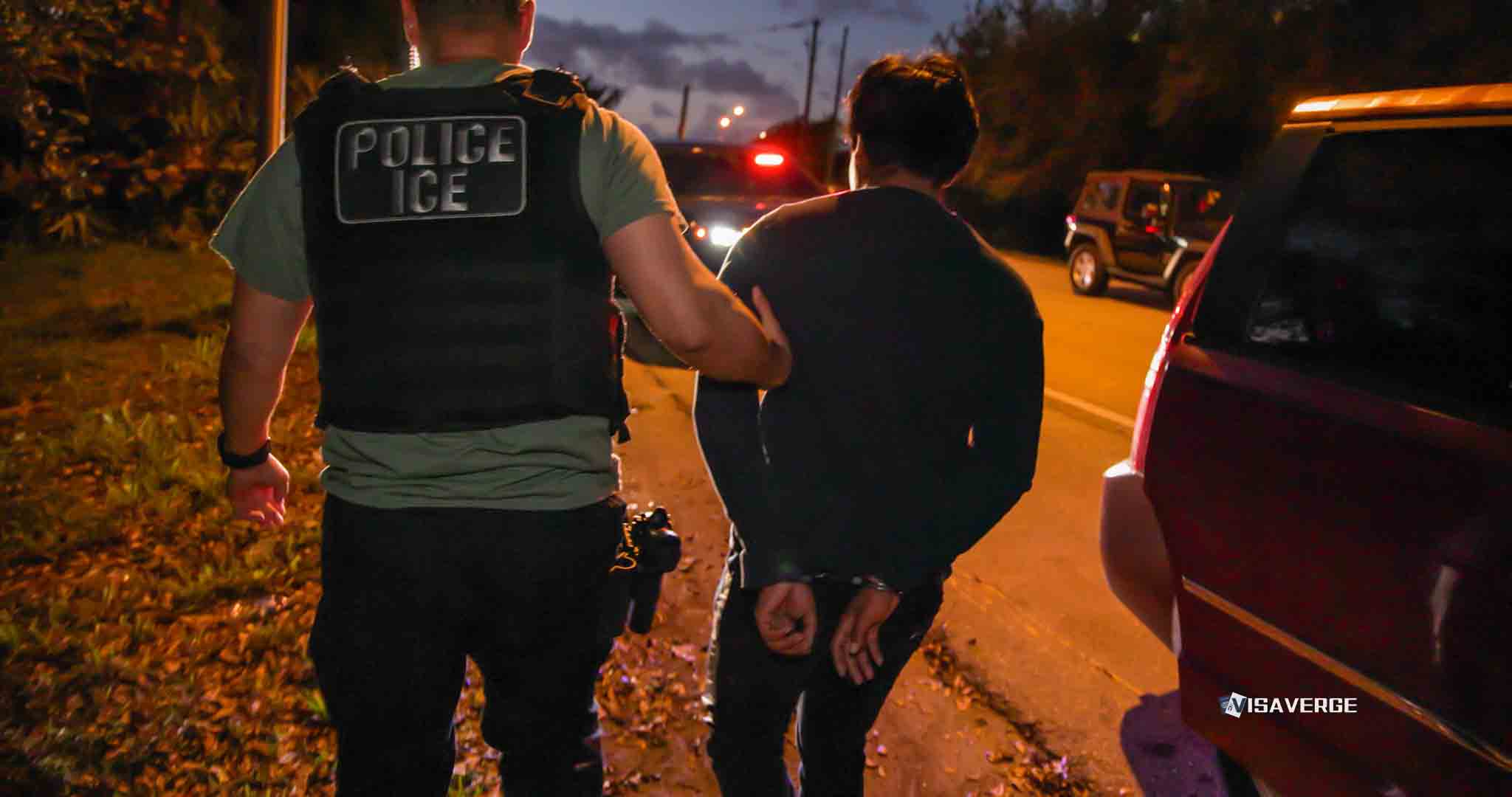
ICE Know Your Rights: Interactive Guide for Every Encounter

Key Takeaways Everyone in the U.S. has constitutional rights during an ICE encounter, regardless of immigration status, including the right to remain silent. ICE agents cannot enter your home without a judicial warrant signed by a judge; an administrative warrant (Form I-205) does not grant entry. Knowing your rights in advance and having an emergency […]

ICE Know Your Rights Interactive Guide for Every Encounter
Key Takeaways
  • Everyone in the U.S. has constitutional rights during an ICE encounter, regardless of immigration status, including the right to remain silent.
  • ICE agents cannot enter your home without a judicial warrant signed by a judge; an administrative warrant (Form I-205) does not grant entry.
  • Knowing your rights in advance and having an emergency plan prepared can protect you and your family during enforcement actions.

Immigration enforcement actions by U.S. Immigration and Customs Enforcement (ICE) have increased sharply in 2025 and 2026, with the Department of Homeland Security projecting over 150,000 people affected nationwide. Whether you are a U.S. citizen, a green card holder, a visa holder, or undocumented, understanding your legal rights during these encounters is essential to protecting yourself and your family.

This guide breaks down your rights in every scenario you might face: at your front door, on the street, at work, or if detained. It covers the critical difference between judicial and administrative warrants, explains what ICE agents can and cannot legally do, and provides a step-by-step emergency preparation checklist you can act on today.

The information here draws on guidance from the ACLU, the National Immigrant Justice Center, and federal court rulings. While this guide provides general legal information, it is not a substitute for advice from a qualified immigration attorney who can evaluate your specific situation.
ICE Know Your Rights Interactive Guide for Every Encounter
ICE Know Your Rights Interactive Guide

The U.S. Constitution protects every person on American soil. The Fourth Amendment guards against unreasonable searches and seizures. The Fifth Amendment guarantees due process and the right against self-incrimination. These protections apply to citizens and non-citizens alike, and they form the legal foundation for your rights during any ICE encounter.

In recent months, the federal government has rescinded the longstanding “sensitive locations” policy that previously restricted ICE from conducting enforcement at schools, hospitals, churches, and courthouses. Several states, including Massachusetts, New York, and Oregon, have responded with their own legislation to protect these spaces. Staying informed about both federal policy and your state’s protections is more important than ever.

Below, you will find a structured walkthrough of your rights organized by the type of encounter you may face, followed by preparation tools you can use right now.

Your Core Constitutional Rights

Before diving into specific scenarios, every person in the United States should know these five fundamental rights that apply during any interaction with ICE.

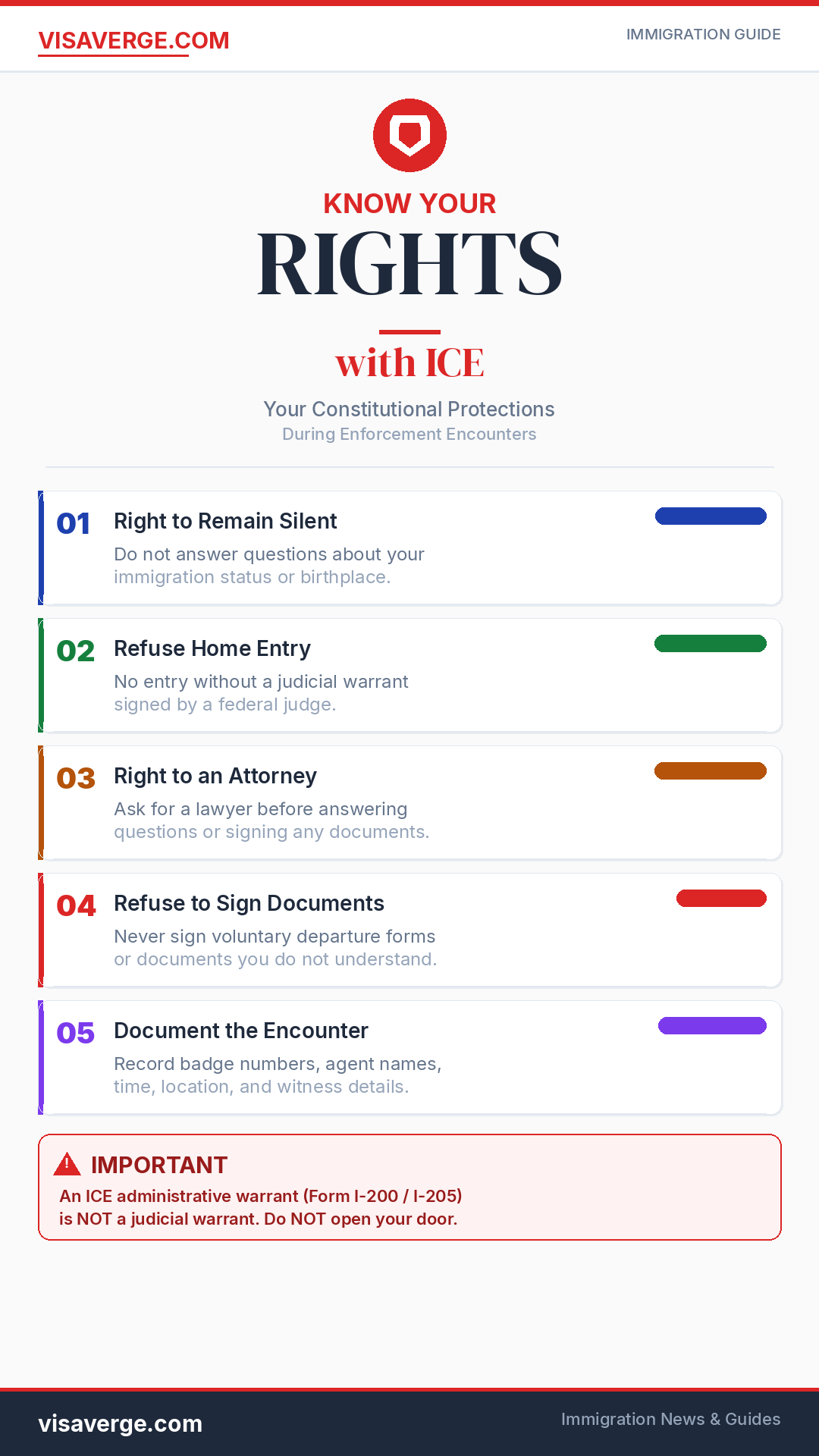
5 Rights Every Person Has During an ICE Encounter
1

Right to Remain Silent

You do not have to answer questions about where you were born, your immigration status, or how you entered the country. Say clearly: “I am exercising my right to remain silent.”

5th Amendment
2

Right to Refuse Entry to Your Home

Do not open your door unless agents present a judicial warrant signed by a judge. An ICE administrative warrant (Form I-205) does not authorize entry into your home.

4th Amendment
3

Right to an Attorney

You have the right to speak with a lawyer before answering any questions or signing any documents. Ask for one immediately. Note: the government does not provide a free attorney in immigration cases.

6th Amendment
4

Right to Refuse to Sign Documents

Never sign anything you do not understand. Signing a voluntary departure agreement or other forms can waive your right to see a judge and fight your case.

5th Amendment / Due Process
5

Right to Document the Encounter

If you are not under arrest, you may record or photograph ICE activity in public spaces, as long as you do not physically interfere with their operations.

1st Amendment

Scenario Guide: What to Do During an ICE Encounter

Your rights and recommended actions differ depending on where the encounter happens. The following scenario-by-scenario guide covers the four most common situations and what to do in each one.

Scenario 1: ICE Comes to Your Door
DO
  • Keep your door closed and locked. Speak through the door or a window.
  • Ask: “Do you have a warrant signed by a judge?” Ask them to slide it under the door.
  • Check the warrant carefully: a valid judicial warrant has a judge’s signature, a court seal, and your correct name and address.
  • Say: “I am exercising my right to remain silent. I do not consent to you entering my home.”
  • Write down badge numbers, agent names, and the number of agents present.
DO NOT
  • Do not open the door. Once you open it, agents may claim you gave consent to enter.
  • Do not answer questions about your name, birthplace, or immigration status.
  • Do not show identification documents or papers through the door.
  • Do not run, resist, or physically obstruct the agents.
Key distinction: An ICE Form I-200 or I-205 (administrative warrant) is signed by an ICE officer, not a judge. It does NOT authorize entry into your home. Only a judicial warrant signed by a federal judge allows agents to enter without your consent.
Scenario 2: Stopped on the Street or in Public
DO
  • Ask calmly: “Am I free to leave?” If they say yes, walk away slowly and calmly.
  • If they say no, state: “I am exercising my right to remain silent. I want to speak to a lawyer.”
  • Keep your hands visible at all times. Stay calm and do not argue.
  • Ask agents to identify themselves and show their badges.
  • If possible, have a bystander record the encounter from a safe distance.
DO NOT
  • Do not run, even if you are afraid. Running can be used as probable cause.
  • Do not provide false documents or make false statements. This is a federal crime.
  • Do not physically resist, even if you believe the stop is unlawful.
  • Do not consent to a search of your person or belongings.
Remember: You have the right to verify ICE agents’ identity. Legitimate agents carry official credentials and will identify themselves when asked.
Scenario 3: ICE at Your Workplace
DO
  • Remain calm and avoid drawing attention to yourself.
  • Exercise your right to remain silent. You do not have to answer questions about your status.
  • If agents enter non-public areas without a warrant, your employer can ask them to leave.
  • Call your emergency contact or attorney immediately if you can do so safely.
DO NOT
  • Do not flee the building or act in a way that could be construed as evasion.
  • Do not show agents your ID or immigration documents without legal advice.
  • Do not sign any documents presented at the workplace.
For employers: ICE agents need either a judicial warrant or employer consent to enter non-public areas of a workplace. Employers may ask to see the warrant and can decline entry to private areas if none is presented.
Scenario 4: Stopped While Driving
DO
  • Pull over safely. Keep your hands on the steering wheel where they are visible.
  • You must provide your driver’s license and vehicle registration if asked by law enforcement.
  • State: “I do not consent to a search of my vehicle.”
  • Beyond providing license and registration, exercise your right to remain silent.
DO NOT
  • Do not answer questions about your immigration status, country of origin, or travel history.
  • Do not consent to a search of the vehicle. If agents search anyway, say clearly: “I do not consent.”
  • Do not reach for items without telling the officer what you are doing first.
At a checkpoint: At interior immigration checkpoints (within 100 miles of the border), you must stop. However, you still have the right to remain silent beyond stating your citizenship. You do not have to answer additional questions or consent to a vehicle search.

Judicial Warrant vs. Administrative Warrant: How to Tell the Difference

One of the most critical things to understand during an ICE encounter at your home is the type of warrant agents may present. The distinction between a judicial warrant and an administrative warrant determines whether agents can legally enter your home. Here is a side-by-side comparison.

Warrant Comparison: Know What You Are Looking At
Judicial Warrant
Signed By
A federal judge or magistrate
Document
Federal court order with case number
Identifiers
Court seal, judge’s signature, your correct name and address
Authority
Authorizes agents to enter your home, even without your consent
How Rare
Very rare in civil immigration cases
MUST comply with this warrant
Administrative Warrant (ICE)
Signed By
An ICE supervisor or officer
Document
Form I-200 (arrest) or I-205 (removal)
Identifiers
ICE letterhead, officer signature only, no court seal
Authority
Does NOT authorize entry into your home without consent
How Common
Used in the vast majority of ICE enforcement actions
Does NOT permit home entry
Important Notice
In January 2026, a DHS memo authorized ICE officers to enter homes using only administrative warrants in certain circumstances. This policy is being challenged in federal courts. Multiple legal organizations, including the ACLU and the Brennan Center for Justice, argue it violates Fourth Amendment protections. Until courts issue a definitive ruling, do not open your door for an administrative warrant. If agents enter by force, do not resist physically, but state clearly: “I do not consent to this entry.”

If You Are Detained by ICE

Being detained is frightening, but you still have rights. Knowing what to do in the first hours can significantly affect the outcome of your case. According to current legal guidelines on ICE arrests, there are specific procedures agents must follow.

What to Do If You Are Detained: Step by Step
1

Stay Calm and State Your Rights

Say: “I am exercising my right to remain silent. I want to speak to a lawyer.” Repeat this if questioned further. Do not provide information about your immigration status, country of birth, or how you entered the U.S.

2

Do Not Sign Anything

Agents may ask you to sign a voluntary departure form (Form I-275) or a stipulated removal order. Signing these waives your right to appear before an immigration judge. Politely refuse and say: “I will not sign anything without my lawyer present.”

3

Memorize Your Emergency Contact

You may not have access to your phone. Memorize the phone number of a trusted family member, friend, or attorney. If you are allowed a phone call, contact them immediately.

4

Ask for a Bond Hearing

In most cases, you have the right to a bond hearing before an immigration judge. At this hearing, the judge determines whether you can be released while your case proceeds. Request this hearing as soon as possible.

5

Document Everything

Write down the date, time, location of arrest, badge numbers, and names of agents as soon as you can. Note any witnesses. This information is critical for your legal defense.

6

Contact Legal Aid

Use ImmigrationLawHelp.org or call the National Immigrant Justice Center at (312) 660-1370 to find a free or low-cost immigration attorney in your area. Legal representation dramatically improves outcomes in immigration court.

Analyst Note
Studies consistently show that detained individuals with legal representation are significantly more likely to win their cases. According to the American Immigration Lawyers Association, represented individuals succeed in about 10 times more cases than those without counsel. Even if you cannot afford a private attorney, free legal services exist in every state.

Special Rights for Green Card Holders, Visa Holders, and Students

Different immigration statuses come with different protections. If you hold a green card, are on a work or student visa, or have another form of legal status, you have additional rights beyond those afforded to all persons. Understanding these distinctions helps you respond appropriately. For a detailed breakdown, see this guide on rights for green card holders and foreign students.

Rights by Immigration Status
U.S. Citizens
  • Cannot be deported. If ICE detains you, clearly state: “I am a U.S. citizen.”
  • Have the right to an attorney in criminal proceedings.
  • Can refuse to answer all questions and walk away if not under arrest.
  • Should carry proof of citizenship (passport, birth certificate, or naturalization certificate) when possible.
Green Card Holders (LPRs)
  • Have the right to remain in the U.S. and cannot be removed without a hearing before an immigration judge.
  • Can be deported only for specific grounds (certain criminal convictions, fraud, or prolonged absence).
  • Should carry their green card at all times as required by federal law.
  • Have the right to an attorney (at their own expense) in removal proceedings.
  • Should not answer questions about criminal history without an attorney present.
Visa Holders (H-1B, F-1, L-1, etc.)
  • Have lawful status and the right to be in the U.S. for the duration of their visa.
  • Should carry their passport, visa stamp, and I-94 record at all times.
  • Have the right to remain silent, but should identify themselves if asked by law enforcement.
  • Should immediately contact their employer (for work visas) or school’s international office (for F-1) if detained.
  • Can request a hearing before an immigration judge if placed in removal proceedings.
Undocumented Individuals
  • Still protected by the Constitution: right to remain silent, right to due process, right against unreasonable search.
  • Have the right to a hearing before an immigration judge before being removed (in most cases).
  • Should NOT carry documents from another country that could be used to expedite deportation.
  • Have the right to request asylum, withholding of removal, or protection under the Convention Against Torture if eligible.
  • Can request a bond hearing if detained (unless subject to mandatory detention).

Emergency Preparation Checklist

The best time to prepare for an ICE encounter is before it happens. Having a plan in place protects both you and your family, and reduces the risk of making mistakes under pressure. Make sure your essential documents are organized and accessible to a trusted person.

Emergency Preparation Checklist
Documents
Make copies of all immigration documents (passport, visa, green card, work authorization, I-94). Store copies with a trusted person and in a secure digital location.
Write down your A-number (Alien Registration Number) if you have one. Memorize it if possible.
Prepare a “Know Your Rights” card to carry in your wallet with key phrases in English and your native language.
Keep original documents in a secure location at home, not on your person during daily activities.
Emergency Contacts
Identify an immigration attorney or legal aid organization. Save their number in your phone and memorize it.
Designate an emergency contact who can care for your children and access important documents.
Program the ICE detainee locator number (1-888-351-4024) into your family’s phones.
Identify a local rapid response network or community organization that can provide support during an encounter.
Family Plan
Establish a plan for childcare if you are detained. Designate a trusted adult with signed authorization to care for your children.
Prepare a power of attorney for a trusted person to handle your financial and legal matters.
Talk to your children (age-appropriately) about what to do if a parent is taken. Teach them not to open the door and to call the emergency contact.
Keep a go-bag with essential items: medications, phone charger, cash, and copies of key documents.
Home Safety
Install a peephole or video doorbell so you can see who is at the door without opening it.
Post a “No Consent to Enter” sign on your front door in English and Spanish (available free from the ACLU).
Practice what to say: “I do not consent to your entry. Please slide the warrant under the door.”
Ensure all household members know the plan, including tenants and roommates.
Recommended Action
Print this checklist and go through it with your household this week. Preparation done in advance is far more effective than trying to remember your rights in the moment. Many community organizations host free “Know Your Rights” workshops where you can practice these scenarios with trained volunteers.

Sensitive Locations: What Has Changed

For decades, ICE maintained a policy of avoiding enforcement at “sensitive locations,” including schools, hospitals, houses of worship, and courthouses. In January 2025, the Trump administration rescinded this policy, allowing ICE agents to conduct enforcement operations at these locations.

Several states have responded with their own protections. Massachusetts Governor Maura Healey signed legislation to ban ICE from courthouses, schools, hospitals, and churches within the state. New York, Oregon, Washington, Maine, and New Jersey are considering similar measures.

What this means for you: the protections you have depend on your state. Check with local legal aid organizations to understand what state-level protections apply where you live and work. Even in states without specific legislation, many local school districts, hospitals, and religious institutions have adopted their own policies limiting cooperation with ICE.

How to Report an ICE Violation of Your Rights

If you believe ICE agents violated your rights during an encounter, you can take action. Reporting violations creates a legal record and may help your case. The broader impact of ICE raids on families is well documented, and reporting helps hold agencies accountable.

How to Report a Rights Violation
1
Document immediately. Write down the date, time, location, agent badge numbers, names, and exactly what happened. Include the names and contact information of any witnesses.
2
File a complaint with DHS. Contact the DHS Office for Civil Rights and Civil Liberties at (866) 644-8360 or email [email protected]. You can file a complaint regardless of your immigration status.
3
Contact the DHS Inspector General. For more serious violations, file a complaint at oig.dhs.gov or call (800) 323-8603. This office investigates misconduct by DHS employees.
4
Reach out to the ACLU. Report civil rights violations at aclu.org/contact/report-violations. The ACLU may be able to provide legal support or connect you with local attorneys.
5
Contact your elected officials. Your U.S. Representative and Senators can make formal inquiries to ICE on your behalf. Contact information is available at usa.gov/elected-officials.

Frequently Asked Questions

Below are answers to the most common questions about rights during ICE encounters, based on current federal law and legal guidance from immigration attorneys.

Can ICE agents arrest me without a warrant?

Yes, ICE agents can arrest individuals in public places without a warrant if they have probable cause to believe the person is in the U.S. unlawfully. However, they cannot enter your home without either a judicial warrant or your consent. An administrative warrant (Form I-200 or I-205) does not authorize home entry.

Do I have to show my immigration documents to ICE?

Green card holders are required by federal law to carry their green card at all times and must present it if asked by an immigration officer. For all other individuals, you have the right to remain silent and are not required to produce documents. However, choosing not to identify yourself may result in being taken into custody for further investigation.

Can ICE come to my home early in the morning?

Yes, ICE raids often occur in the early morning hours, typically between 5:00 a.m. and 7:00 a.m. There are no legal restrictions on the time of day ICE can attempt to make an arrest. This is why having a plan in place before an encounter happens is so important.

What happens if I sign a voluntary departure form?

Signing a voluntary departure form (Form I-275) means you agree to leave the U.S. without a hearing before an immigration judge. This waives your right to present your case, apply for relief (such as asylum or cancellation of removal), and appeal. Never sign any document without consulting an attorney first.

Can ICE deport me immediately?

In most cases, individuals have the right to a hearing before an immigration judge before being removed. However, “expedited removal” allows ICE to deport certain individuals quickly, particularly those apprehended near the border or who have been in the U.S. for less than two years and cannot prove otherwise. If you have been in the U.S. for an extended period, you typically have the right to a full removal hearing.

Can ICE arrest me at a courthouse?

Under current federal policy (as of 2026), yes. The former “sensitive locations” policy that restricted enforcement at courthouses was rescinded in January 2025. Some states have enacted their own protections. Check your state’s laws, and if you have a court appearance, consult with an immigration attorney beforehand about the risks.

What if ICE detains a U.S. citizen by mistake?

Wrongful detention of U.S. citizens by ICE has been documented in multiple cases. If this happens to you, clearly and repeatedly state that you are a U.S. citizen. Ask to contact a lawyer or a family member who can bring proof of your citizenship. You may have grounds for a civil rights lawsuit after your release. Reports of citizens being detained highlight the importance of carrying identification.

Where can I find a free immigration lawyer?

Visit ImmigrationLawHelp.org, the largest directory of free and low-cost immigration legal services in the U.S. You can search by state, zip code, or detention facility. The National Immigrant Justice Center can also be reached at (312) 660-1370. Many local bar associations maintain lists of pro bono immigration attorneys.

What do you think? 58 reactions
Useful? 100%
Visa Verge

VisaVerge.com is a premier online destination dedicated to providing the latest and most comprehensive news on immigration, visas, and global travel. Our platform is designed for individuals navigating the complexities of international travel and immigration processes. With a team of experienced journalists and industry experts, we deliver in-depth reporting, breaking news, and informative guides. Whether it's updates on visa policies, insights into travel trends, or tips for successful immigration, VisaVerge.com is committed to offering reliable, timely, and accurate information to our global audience. Our mission is to empower readers with knowledge, making international travel and relocation smoother and more accessible.

Subscribe
Notify of
guest

0 Comments
Inline Feedbacks
View all comments