- A federal court in Charleston swore in 50 new citizens from 27 different countries.
- Applicants must navigate Form N-400 requirements, including potential Requests for Evidence (RFEs).
- New citizens received immediate voter registration assistance from the Kanawha County Clerk’s Office.
(CHARLESTON, WEST VIRGINIA) — A naturalization ceremony at the Robert C. Byrd United States Courthouse on January 16, 2026, marked the final step for 50 new U.S. citizens in Charleston, West Virginia, after years of USCIS processing and federal court administration of the Oath.
Federal courthouses commonly host oath events because many ceremonies are coordinated between U.S. Citizenship and Immigration Services (USCIS) and the U.S. District Court. USCIS decides the case. The court (or USCIS) often administers the Oath of Allegiance.
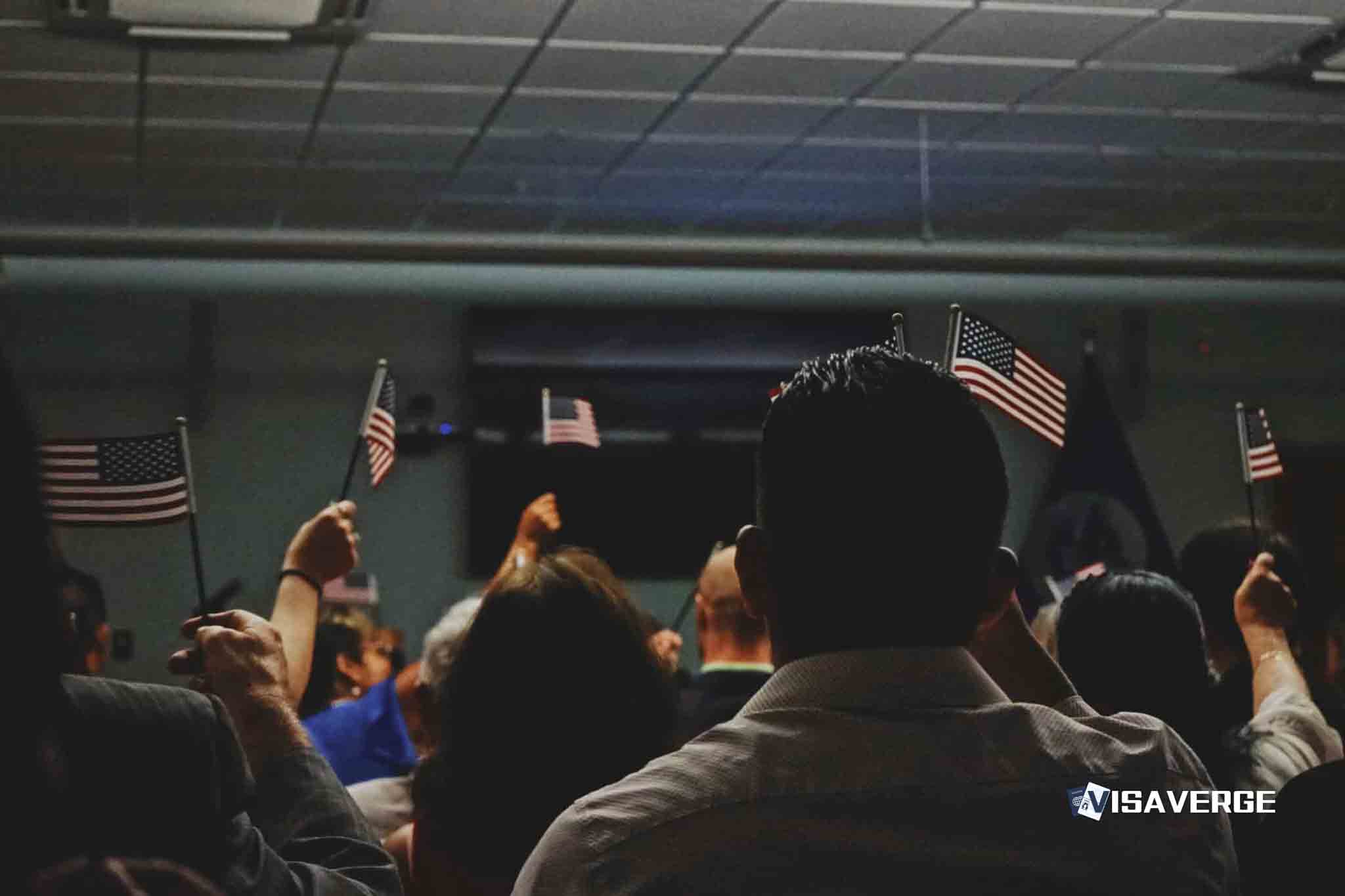
Charleston’s courthouse setting reflects what many applicants see nationwide in typical ceremony locations.
What Charleston’s ceremony numbers tell you
USCIS and the court swore in 50 people from 27 countries. That scale signals steady local demand for naturalization. It also shows how many people reach the “last mile” after lawful permanent residence (a green card) and eligibility screening.
A practical detail mattered as much as the speeches. The Kanawha County Clerk’s Office offered voter registration help in the courthouse lobby right after the oath.
Some locations are changing how they handle that service, so it helps to know what your ceremony site plans to offer, including the trend discussed in on-site voter registration.
What happens during a naturalization ceremony
Most ceremonies follow a similar flow:
- Check-in and document review. Staff may collect your Permanent Resident Card (green card).
- Oath program. Remarks from judges or USCIS leaders set expectations for civic participation.
- Oath of Allegiance. This is the legal moment you become a U.S. citizen.
- Certificate distribution. You receive your Certificate of Naturalization. Review it before leaving.
- Post-ceremony assistance. Some sites offer voter registration or passport guidance.
At the Charleston naturalization ceremony, speakers emphasized civic responsibilities. Chief Judge Albert Diaz highlighted voting as a core duty.
Judge B. McKay Mignault described how meaningful the ceremony is to families. Those themes match what USCIS and courts often stress: voting, jury service, and obeying laws.
If you are unsure what to wear, many applicants follow courthouse norms. See oath ceremony dress code guidance for practical expectations.
Where RFEs fit into the N-400 path
To reach the oath stage, you generally file Form N-400, Application for Naturalization, attend biometrics if scheduled, complete an interview, and pass English and civics testing, unless you qualify for an exception.
Many applicants worry when USCIS issues a Request for Evidence (RFE). An RFE is not a denial. It means the officer needs more documents or clarification before deciding your case.
USCIS also verifies background and security checks, good moral character, continuous residence, physical presence, and attachment to the Constitution. A single missing record can trigger an RFE.
A clear process overview is in this Form N-400 guide.
⏱️ RFE Deadline: Many RFEs allow 87 days to respond. Always follow the exact deadline on your notice.
Processing times and fees to plan around
USCIS processing times are estimates and vary by field office and case type. As of January 2026, many Form N-400 cases take about 6–12 months, depending on your location and background checks.
Confirm current estimates at egov.uscis.gov/processing-times/.
Fees change. As of January 2026, Form N-400 costs $760 when filed on paper and $710 when filed online for most applicants.
Some applicants may request a fee waiver using Form I-912, Request for Fee Waiver, if eligible. Verify the current amount at uscis.gov/fees. An incorrect fee can cause a rejection.
| Detail | Information |
|---|---|
| Form Number | N-400 |
| Purpose | Naturalization (U.S. citizenship) |
| Filing Fee | $710 online / $760 paper (as of January 2026; verify at uscis.gov/fees) |
| Biometrics | Some applicants are scheduled; some reuse biometrics |
| Typical Processing | ~6–12 months (as of January 2026; varies by field office) |
| Time estimates source | egov.uscis.gov/processing-times/ |
💰 Current Fee Check: Confirm Form N-400 fees at uscis.gov/fees before filing or refiling after an RFE.
Common RFE reasons in Form N-400 cases
RFEs usually target gaps that affect eligibility. Common issues include:
- Travel history problems. Dates do not match stamps, tickets, or prior filings.
- Continuous residence questions. Long trips or possible abandonment concerns.
- Physical presence math errors. Days counted wrong or missing trips.
- Marital history documents missing. Divorce decrees, death certificates, or name changes.
- Selective Service proof (for those required to register).
- Disposition records for arrests, citations, or criminal charges.
- Tax filing concerns. Missing IRS tax transcripts, “non-filer” gaps, or unpaid tax issues.
- Good moral character clarifications. Prior immigration violations or inconsistent statements.
Green card history can matter too. Some N-400 RFEs connect to earlier filings. Examples include past Form I-485, Application to Register Permanent Residence or Adjust Status, or removal conditions through Form I-751, Petition to Remove Conditions on Residence.
Best practices for responding to an RFE (step-by-step)
- Read the RFE twice. Highlight every item requested.
- Respond to each point in order. Use the same headings as the notice.
- Send copies unless originals are requested. Keep your originals safe.
- Use a clear cover letter. List exhibits and explain what each proves.
- Include the RFE notice page. USCIS uses it to match your response.
- Translate non-English documents. Include a certified translation.
- Mail it to the exact address on the RFE. Do not use your old lockbox.
- Track delivery. Use USPS, FedEx, or UPS tracking and keep proof.
⚠️ Common Mistake: Sending partial records. For court issues, USCIS often needs the certified disposition plus the arrest report, if available.
What to include in your RFE package
| Document | Required | Notes |
|---|---|---|
| RFE notice copy | Yes | Place on top for routing |
| Cover letter | Strongly recommended | Answer each RFE point |
| Identity pages | As requested | Passport bio page; A-number references |
| Travel evidence | If requested | Stamps, I-94 history, tickets, itinerary |
| Court dispositions | If requested | Certified records for every incident |
| Tax documents | If requested | IRS transcripts are often preferred |
| Translations | If needed | Include translator certification |
Deadline risks and what happens if you miss it
If you miss the deadline, USCIS can decide the case on the existing record. That can mean a denial for failure to provide requested evidence.
In some situations, USCIS may treat the application as abandoned. Do not rely on calls or messages to extend time. If you need more time, speak with an attorney right away. Extensions are not automatic.
Policy context in early 2026: “Hold and Review”
USCIS policy shifts can affect how long cases take and how closely they are reviewed. “Hold and Review” approaches generally mean slower adjudication or extra checks for certain cases.
That can result in more RFEs, longer security checks, or added interview questions. Practical takeaway: open every USCIS letter the day it arrives. Respond early and completely.
Citizenship’s benefits and next steps after the oath
One Charleston participant, Mohammed Elassal, described citizenship as a natural next step after many years in the United States. That timeline is common. Many people spend years as permanent residents before filing Form N-400.
After you naturalize, you can apply for a U.S. passport, vote, and petition certain relatives faster. You also take on responsibilities like jury duty. Update your records with the Social Security Administration and your state DMV after you receive your certificate.
For applicants with complex histories, attorney review is worth it. This includes arrests, long travel, prior removal proceedings, or past immigration fraud findings.
Where to verify ceremony and USCIS details
For ceremony recaps and USCIS updates, start with the USCIS Newsroom at uscis.gov/newsroom. For the rules USCIS applies to naturalization, use the USCIS Policy Manual, Volume 12 at uscis.gov/policy-manual/volume-12.
For court-hosted ceremony logistics in West Virginia, check the U.S. District Court for the Southern District of West Virginia website.
Practical next steps
- Review your Form N-400 copy and your RFE line-by-line.
- Gather certified records, translations, and proof that matches each request.
- Mail the complete packet with tracking well before the deadline.
- Track your case in your USCIS account at my.uscis.gov.
Download forms at uscis.gov/forms. Check processing times at egov.uscis.gov/processing-times. Fees and processing times are subject to change—always verify current information at uscis.gov.